
Beyond Drug Safety: Uncovering the Disease-ADR Map via Heterogeneous Social Networks
Extraction of Clinical Phenotypic Information from Online Heterogeneous Healthcare Networks
This paper introduces a novel framework for extracting clinical phenotypic information by mining heterogeneous healthcare networks constructed from health social media data. By proposing three specific path-mining techniques, the study identifies significant and novel associations between diseases and Adverse Drug Reactions (ADRs), achieving a high validation rate against existing medical literature.
TL;DR
Researchers have moved beyond simple drug-safety monitoring to extract "clinical phenotypic biomarkers"—the deep links between diseases and side effects. By building a heterogeneous healthcare network from over 41,000 social media threads, this study reveals that when a disease’s treatments share a common Adverse Drug Reaction (ADR), it signals a fundamental Mechanism-of-Action (MOA) link. Their best path-mining method successfully validated 85% of discovered associations using existing medical literature.
Background: The Hidden Value of Patient Chatter
Traditional pharmacovigilance is reactive. Spontaneous reporting systems like FAERS are plagued by passiveness (only ~6% of events are reported) and administrative lag. However, on platforms like MedHelp, patients discussed their health in real-time. This paper posits that these discussions are more than just complaints; they are a form of "human phenotypic screening."
The central insight: If multiple drugs for Disease cause ADR , then is likely a clinical phenotype of itself. This has massive implications for Drug Repositioning—if a drug causes an ADR that is "beneficial" in another disease context (e.g., hypoglycemia-inducing drugs for diabetes), it becomes a candidate for new therapy.
Methodology: The Heterogeneous Network Approach
The authors argue that traditional "homogeneous" networks (where all nodes are the same type) lose semantic richness. Instead, they build a tri-partite graph of Diseases, Drugs, and ADRs.
1. Bridging the Vocabulary Gap
Patients don't say "Dysesthesia"; they say they have a "tingling sensation." The researchers used the Consumer Health Vocabulary (CHV) to bridge this gap, ensuring that informal "patient-speak" was accurately mapped to professional medical entities.
2. The Three Path-Mining Techniques
To find the strongest links, the paper compares three strategies:
- Path(D-ADR): Pure co-occurrence of disease and ADR in the same thread. (Baseline)
- Path(D-R-ADR, Weighted): A transitive path where the link strength is a product of social media evidence for both and .
- Path(D-R-ADR, Knowledge-Enhanced): Uses the PharmGKB database to define links (treating them as gold standard) and uses social media only for the link.
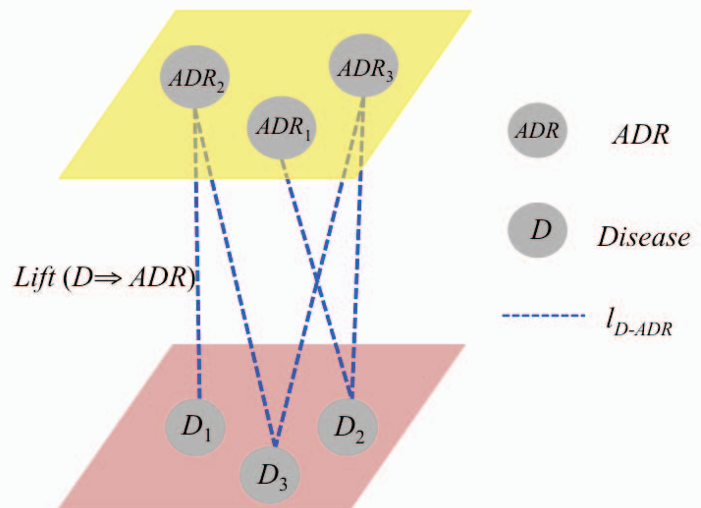 Fig 1: The Heterogeneous Healthcare Network illustrating the multi-path relationships between Diseases (D), Drugs (R), and ADRs.
Experiments and Insights
The study focused on 10 major diseases (including Parkinson’s and Kidney Failure) and 199 ADRs.
Key Numerical Findings:
- Data Volume: 41,713 threads analyzed.
- Superior Accuracy: The Knowledge-Enhanced path method (Method 3) identified 85% of associations later verified by literature, significantly outperforming the direct co-occurrence baseline (Method 1) at 38%.
Case Study: Thrombosis and Hypercholesterolemia
All three methods identified a strong link between Hypercholesterolemia and Thrombosis. Scholarly literature confirms this: high serum cholesterol leads to plaque rupture, which triggers clot formation. This confirms that social media "noise" actually contains high-fidelity clinical signals when filtered through the right network architecture.
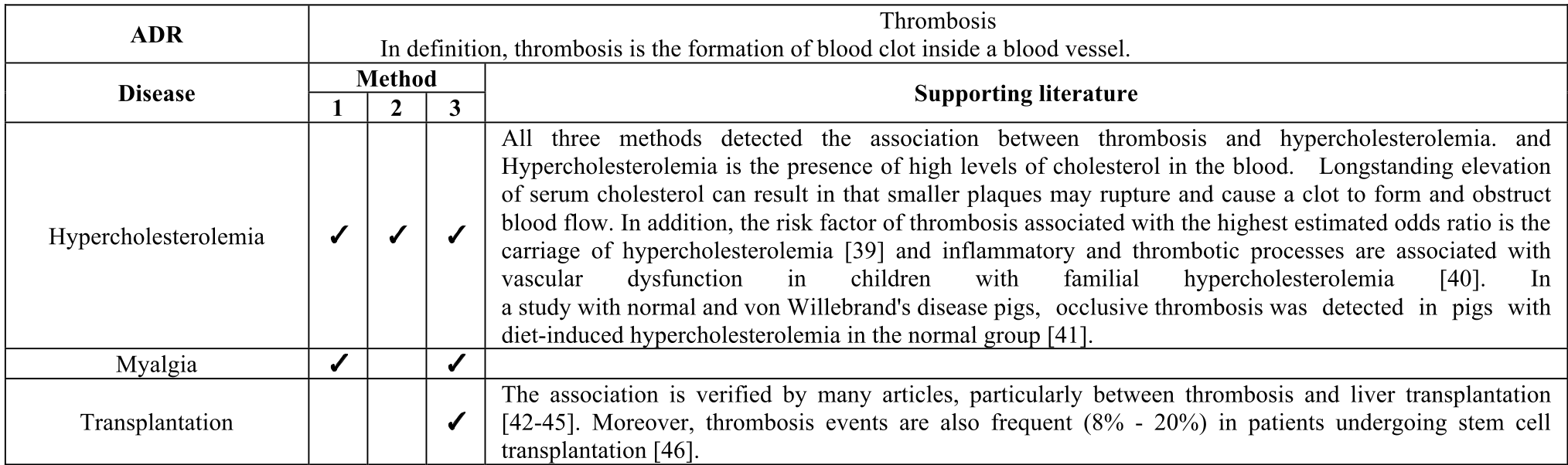 Table 1: Case study results showing how different path-mining methods successfully captured the Thrombosis association.
Critical Analysis & Conclusion
This work demonstrates that Heterogeneous Networks are essential for medical informatics. By treating different entities distinctly, the model preserves the specialized semantics of "treatment" vs. "side effect."
Limitations:
- The study relies on a predefined ADR list from the SIDER database; it might miss entirely "new" ADRs not yet indexed.
- Social media data can be noisy or biased toward specific demographics.
Future Outlook: Integrating this heterogeneous mining with Temporal Analysis (to see how associations evolve post-drug-launch) and Large Language Models (to better understand sentiment and context) could turn social media into the world's largest, fastest clinical trial database.
Takeaway
For researchers and pharmaceutical developers, the value isn't just in knowing a drug’s side effects, but in understanding the network of associations. A side effect in one community is a repositioning opportunity in another.