
ArnetMiner: Building the Semantic Backbone of Global Academic Social Networks
Extraction and mining of an academic social network
This paper introduces ArnetMiner, a comprehensive system designed to automatically extract, integrate, and mine academic social networks from the Web. By processing nearly 450,000 researcher profiles and 1 million publications, the system achieves SOTA performance in researcher profiling (83.37% F1) and expertise search (improving MAP by up to 29.2%).
TL;DR
ArnetMiner (now known as AMiner) is a landmark system that automates the extraction and mining of researcher profiles from the vast, unstructured Web. By utilizing Conditional Random Fields (CRF) for extraction, energy-based HMRF for name disambiguation, and a novel ACT topic model, it transforms scattered PDF and HTML data into a structured, searchable knowledge graph of global expertise.
Problem & Motivation: The Academic Data Silo
Before ArnetMiner, academic data was largely siloed. DBLP provided clean bibliographies but lacked personal profiles; Google provided search results but lacked structured relational data. The researchers identified four critical bottlenecks:
- Extraction Complexity: Homepages have no "standard" layout.
- The Identity Crisis: How do you distinguish between ten different "J. Zhangs" in the same field?
- Heterogeneous Expertise: Keyword matching isn't enough to find an expert; you need to understand the latent "topic" connecting authors and conferences.
- Association Latency: Finding how two researchers are connected (shortest path) in a million-node graph is computationally expensive.
Methodology: The Three Pillars of Intelligence
1. Unified Researcher Profiling
The system uses Conditional Random Fields (CRF) to tag tokens on homepages (under titles, affiliations, etc.). Unlike previous Support Vector Machine (SVM) approaches that treated tokens independently, the CRF model captures the sequential nature of professional profiles, leading to a massive boost in F1-score from 73% to over 83%.
2. Disambiguating the "Same Name" Problem
The authors formulated name disambiguation as a clustering problem within a Hidden Markov Random Field (HMRF). The core of this approach is a distance function that considers co-authors, paper titles, and venue constraints.
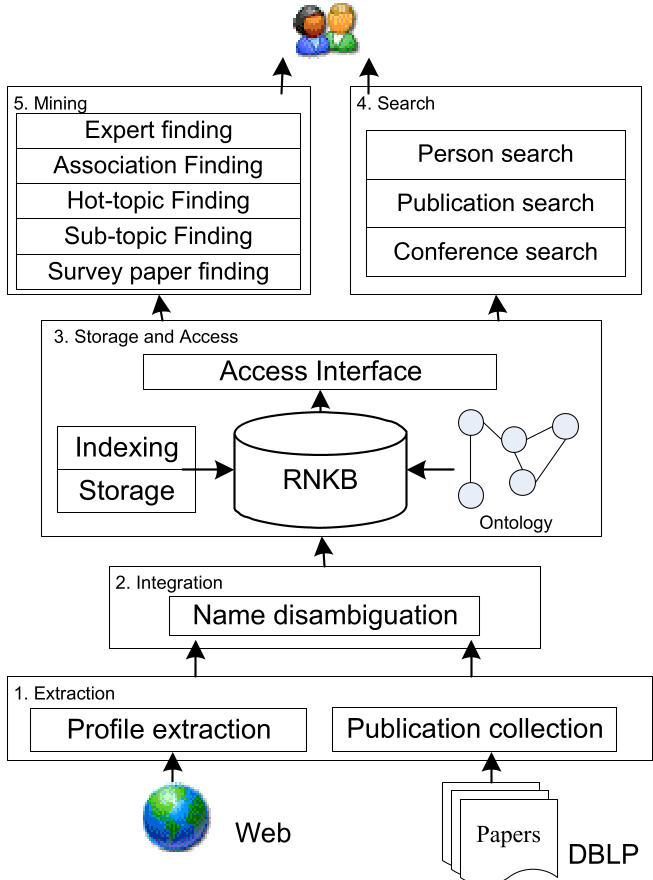 Figure 1: The high-level architecture of ArnetMiner, showing the pipeline from extraction to mining.
The objective function maximizes: By using Expectation Maximization (EM) to learn parameters, the system can autonomously decide if two papers belong to the same person.
3. The ACT Model for Expertise Search
Moving beyond simple PageRank, the Author-Conference-Topic (ACT) model was proposed. It is a generative model where:
- An author is sampled.
- A latent topic is chosen based on that author.
- Words and venues (conferences) are generated from that topic.
This creates a hidden "semantic layer" where an expert in "Machine Learning" is linked to the "ICML" conference even if those exact words don't appear in their bio.
Experiments & Results: Setting the New Standard
The effectiveness of ArnetMiner was validated against established systems like Libra and Rexa.
- Extraction: With 1,000 annotated names, the CRF model outperformed Amilcare by nearly 30%.
- Search Accuracy: The ACT model achieved significantly higher Mean Average Precision (MAP) than traditional Language Models, proving that modeling the "Conference" and "Author" as distinct nodes in a topic model adds valuable context.
- Efficiency: Despite the complexity of the social graph, association (path-finding) queries return results within 2-5 seconds.
 Note: The probabilistic framework allows ArnetMiner to maintain high precision even as the dataset scales to millions of nodes.
Critical Analysis & Conclusion
Takeaway: ArnetMiner demonstrated that an academic network is more than just a list of names; it is a heterogeneous graph where latent topics bridge the gap between people and publications.
Limitations:
- The system relies heavily on the Google API for initial page discovery, making it vulnerable to search engine indexing biases.
- The HMRF model, while robust, requires significant computational overhead for large-scale EM training.
Future Impact: This work laid the foundation for what we now know as AMiner.org, one of the world's most influential academic search engines. It pioneered the shift from "Keyword Search" to "Expertise Mining," a concept now central to modern talent acquisition and scientific trend analysis.