
Beyond Code: Redefining AI Guidelines through the Lens of ELSI and Human-Centered Service
8371_Extraction of New Guideline Items from the View Point of ELSI (Ethics, Legal, Social Issues) for Service Utilized AI-Focus on Healthcare Area.
This paper proposes a new set of AI development guidelines focused on ELSI (Ethical, Legal, and Social Issues) from a human-centered service perspective. By analyzing a healthcare AI use case, the authors extracted 12 specific guideline items and validated them through a survey of 268 IT professionals.
TL;DR
As AI shifts from a backend tool to an autonomous service provider, technical guidelines are no longer sufficient. This paper introduces 12 critical guideline items focused on ELSI (Ethical, Legal, and Social Issues), specifically tailored for healthcare services. By moving from a "developer-first" to a "user-service-first" mindset, the authors provide a roadmap for building AI that users actually trust.
The "Human-Centered" Vacuum in AI Development
Current AI guidelines (such as those from the IEEE or ISO) often focus on the integrity of the system—its fairness, robustness, and safety. However, there is a distinct lack of focus on the Human-System Interaction at the service level.
The authors argue that conventional user experience (UX) metrics are insufficient for AI because:
- AI interacts with society even without explicit user intention.
- AI makes autonomous judgments (e.g., a medical diagnosis) that carry social weight.
- The "relief and trust" criteria are missing from existing safety standards.
Methodology: From Health-Check Use Cases to Ethical Rules
The researchers focused on a specific, high-sensitivity use case: AI-driven influenza monitoring in the workplace. This system would monitor employee vitals and "suggest" they visit a clinic or inform their manager.

Using this use case, they identified 12 guideline items categorized into:
- Dynamic Human-AI Relationship: Including "Reliability between AI and human" and "AI and communication."
- Autonomy and Rights: Specifically "Self-authority" (the user's right to decide disclosure) and "Acceptability of AI prediction."
- Transparency: "Accountability" and "Clarification of AI being used."
Validating the Guidelines: What do Users Really Think?
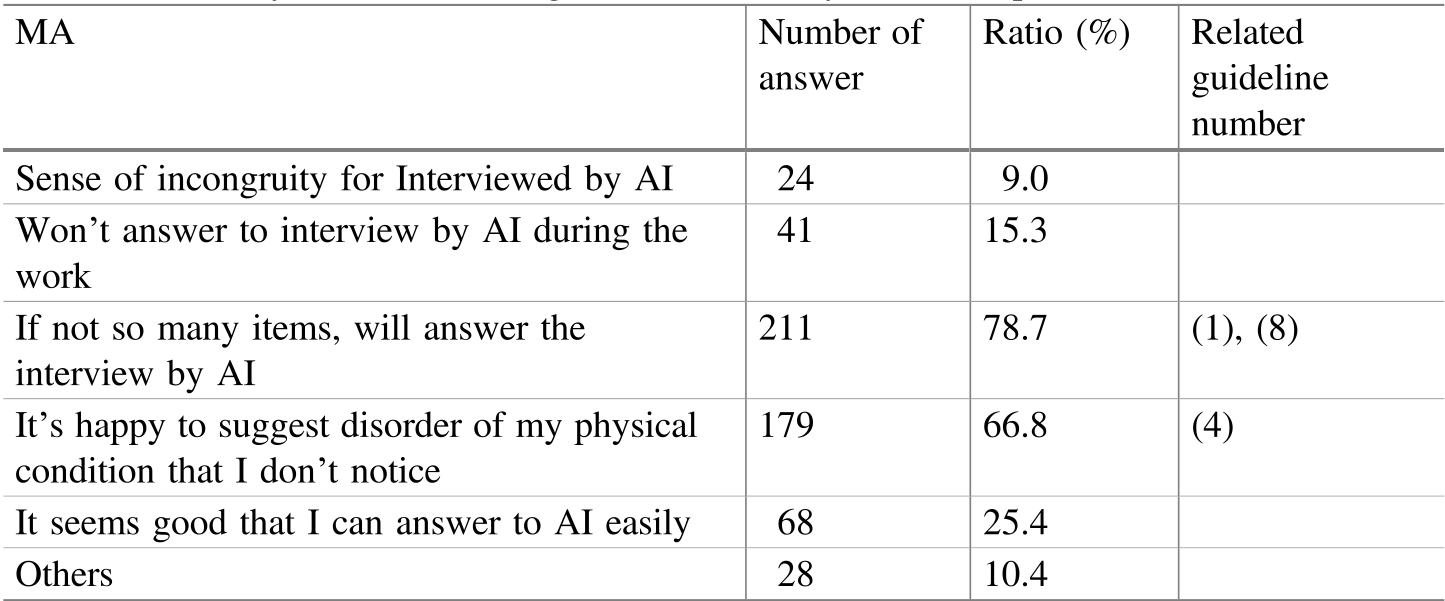
To see if these rules made sense to real humans, the team surveyed 268 IT employees. The results were telling:
- The Need for a Human in the Loop: 68.3% of respondents felt anxious with only an AI and preferred a human doctor to take final responsibility. This validates the guideline on Reliability (3) and Communication (5).
- Privacy is Conditional: 69% of users were comfortable with AI reporting a diagnosis (like the flu) to a manager only if it was for the common good (workplace safety), but demanded strict "Self-authority" for more sensitive conditions.
Deep Insight: The Transition to Social-Centered Design
The paper’s most significant contribution is the push toward Acceptability. In ergonomics, we often talk about usability (can I use it?), but for AI, the question is acceptability (should I let it judge me?).
The authors suggest that Human-Centered Design (HCD) must be extended into the social sphere. This involves:
- Labeling Sensitivity: AI predictions can feel like "labeling" (e.g., being labeled "sick" or "low-performing"), which causes psychological resistance.
- Evolving Reliability: Trust isn't static; it changes as the service becomes pervasive.
Conclusion & Future Outlook
While this study was limited to the healthcare domain and a specific Japanese cohort, its findings are globally relevant. The 12 guideline items act as a checklist for any product manager or developer building AI services:
- Does the user have an 'escape' or help option? (Guideline 11)
- Is the merit of data collection clearly imaginable for the user? (Guideline 12)
The next frontier for this research is cross-industry application—applying these ELSI principles to autonomous vehicles and financial AI, where the "human-in-the-loop" is increasingly harder to maintain.
Takeaway: Innovation without an ethical service framework isn't progress—it's a liability.