
The paper proposes a novel extrapolation method for stationary max-stable random fields with -Fréchet marginals. It utilizes a framework based on the excursion metric and level sets, effectively bypassing the need for moment assumptions in heavy-tailed data (). The approach is validated on simulated Brown-Resnick, Smith, and Extremal Gaussian fields, achieving law-preserving predictions.
TL;DR
This research introduces a robust framework for predicting extreme events (like record rainfall or financial crashes) using max-stable random fields. Unlike traditional methods that "smooth out" peaks, this approach uses the Excursion Metric and Max-Linear combinations to ensure that predicted values follow the same heavy-tailed distribution as the original data, even when moments are infinite.
The "Smoothing" Problem in Extreme Events
In classical geostatistics, Kriging is the gold standard. However, Kriging is built on the norm (minimizing squared error). While this works for Gaussian data, it fails miserably for heavy-tailed (Fréchet) distributions because:
- Infinite Moments: For many extreme processes, the variance or even the mean is infinite.
- Smoothing Bias: Kriging tends to predict the average behavior, effectively "erasing" the very extremes (floods, market crashes) that we need to forecast.
The authors argue that prediction should not just minimize error, but preserve the Law (the distribution family) of the random field.
Methodology: The Geometry of Extremes
The core idea is to construct a predictor as a max-linear combination of observed points:
This is a natural fit for Max-Stable processes (like the Smith or Brown-Resnick models), where the maximum of several variables remains in the same distribution family.
1. The Excursion Metric
Instead of Mean Squared Error, the authors use the Excursion Metric . It measures the distance between level sets. Physically, it answers: "How often does my predictor exceed the same thresholds as the actual unobserved value?"
2. Optimization and Wasserstein Penalty
To ensure the predictor doesn't drift away from the Fréchet distribution, a penalty term using the 2-Wasserstein distance is added to the loss function. This forces the optimal weights to produce a result that "looks like" the original data distributionally.
 The objective function combines the Excursion Metric with a Wasserstein penalty.
Simulation and Experimental Results
The authors tested the method on three primary models:
- Brown-Resnick: Associated with Brownian motion; common in environmental modeling.
- Smith Model: A "moving-maxima" process with a Gaussian shape.
- Extremal Gaussian: Based on the pointwise maximum of Gaussian fields.
Key Numerical Insight
As the spatial lag (distance) increases, the Excursion Metric stabilizes around 1/3 (the value for stochastic independence). This shows that while the predictor's confidence decreases as we move further away, it never behaves "irrationally" or outputs impossible values.
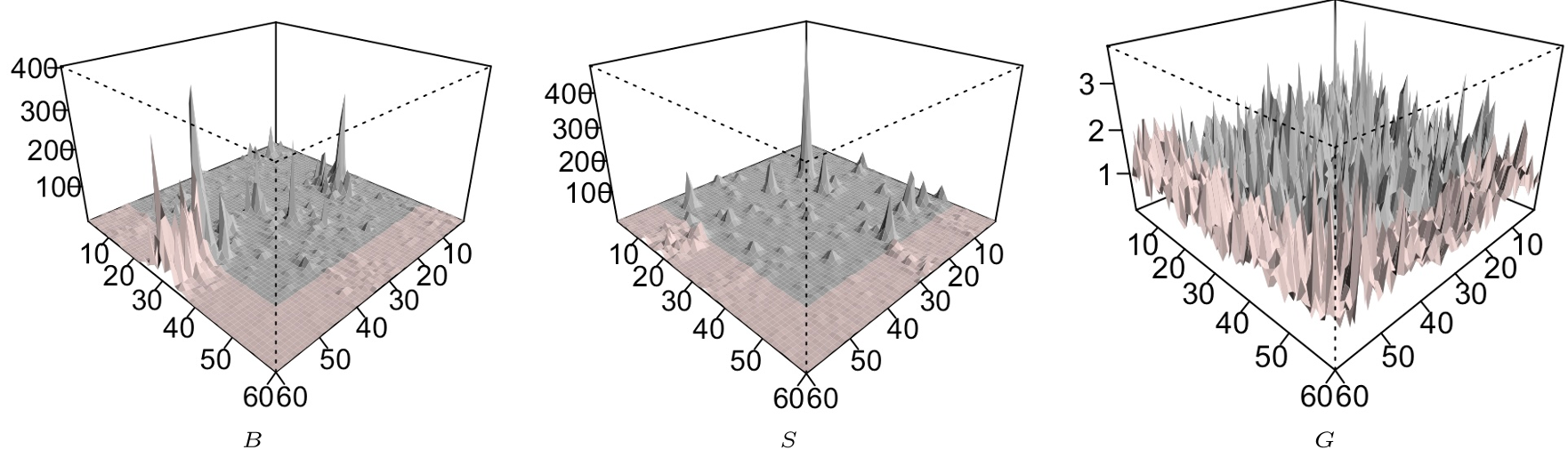 Figure: 10-step forecast extension of 2D random fields. The predictor maintains the spatial "texture" of the extreme events.
Real-World Case: Munich Rainfall (1879–2025)
The method was applied to 140+ years of precipitation data.
- Task: Predict annual daily maxima for 2023–2025.
- Result: The "Non-Bootstrap" formulation provided a singular best-estimate trajectory, while the "Bootstrap" version generated a yellow confidence envelope.
- Performance: The actual observed rainfall for the recent years fell squarely within the predicted envelope, validating the "law-preserving" nature of the model even in weakly dependent time series.
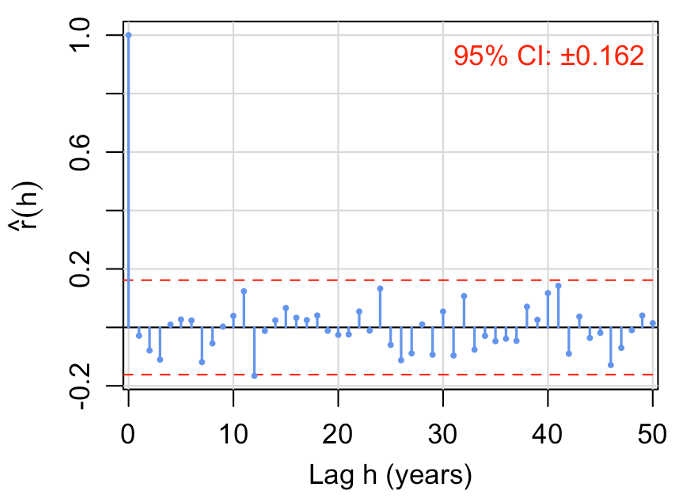 Figure: The true precipitation (blue) remains within the forecast envelope (yellow), demonstrating high reliability.
Critical Insight & Conclusion
This paper proves that Geometric/Excursion-based prediction is superior to Moment-based prediction for heavy-tailed environments. By optimizing weights using Stochastic Gradient Descent on the Excursion Metric, we can build "Extreme AI" systems that are aware of the probability of black-swan events rather than just averaging them away.
Future Work: The authors suggest exploring non-ergodic cases (like the Extremal Gaussian) where standard limit theorems fail, requiring even more specialized penalty terms.