
Beyond "Free": Decoding the Psychology of Paying for Social Networks
The influence of extro/introversion on the intention to pay for social networking sites
This study investigates the impact of extroversion and introversion on the intention to pay subscription fees for Social Networking Sites (SNSs). Using the PERVAL framework and the MBTI scale on a sample of 288 VIP members of "iPartment," the research identifies that perceived value, rather than satisfaction, is the primary driver of payment intention.
TL;DR
In an era where most digital services are expected to be free, what makes a user pull out their credit card? This study by Lu and Hsiao reveals that Perceived Value, not satisfaction, is the king of conversion. By analyzing personality types, the researchers highlight a critical divide: Extroverts pay for social status and interaction, while Introverts pay for emotional relaxation and price-performance ratio.
Background Positioning
While most research focuses on why people use SNSs for free (Utility, Network Effects), this paper is a strategic pivot toward Revenue Models. It bridges psychological profiling (MBTI) with consumer behavior (PERVAL) to solve the chronic monetization struggle of social platforms.
Problem & Motivation: The "Satisfaction" Trap
For years, product managers believed that a "satisfied" user is a "paying" user. This paper debunked that myth in the context of SNSs.
The authors identified that because the web is saturated with free alternatives, "Satisfaction" is merely the baseline (the "Hygiene Factor"). To convert a user to a VIP member, one must create a specific kind of Perceived Value that aligns with the user's inner psychological orientation.
Methodology: The Core Framework
The researchers utilized the PERVAL scale, breaking "Perceived Value" into four distinct dimensions:
- Emotional Value: Does it make me feel relaxed/good?
- Social Value: Does it improve my social image?
- Price Value (Value for Money): Is the VIP fee economical?
- Performance Quality: Is the service stable and well-designed?
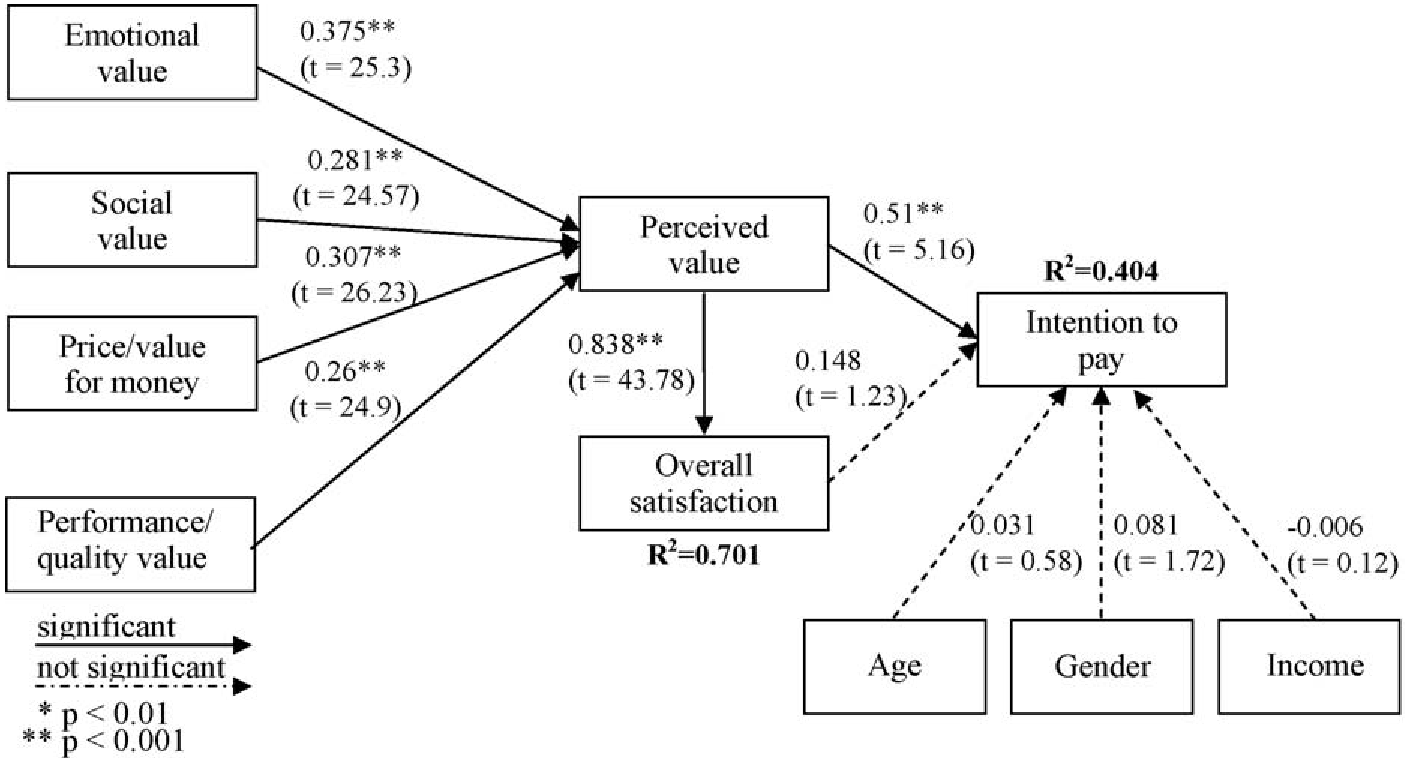 Figure 1: The Research Model illustrating the path from specific values to payment intention.
They applied this model to iPartment, a major avatar-based SNS, sampling 288 paying VIP members to see how these values shifted based on their MBTI extroversion/introversion scores.
Experiments & Results: Personality as a Filter
The study’s most striking discovery is the Multi-Group Analysis results. Personality acts as a lens that magnifies certain values over others:
- Extroverts (The Social Seekers): They are highly motivated by Social Value. They are more likely to pay for items that adorn their avatars or "Invite for visiting" functions because these tools amplify their visibility and social approval.
- Introverts (The Value Optimizers): They place significantly higher weight on Price/Value for Money and Emotional Value. For them, an SNS is a private sanctuary; they pay for services that help them "escape" or relax, provided the price is "fair."
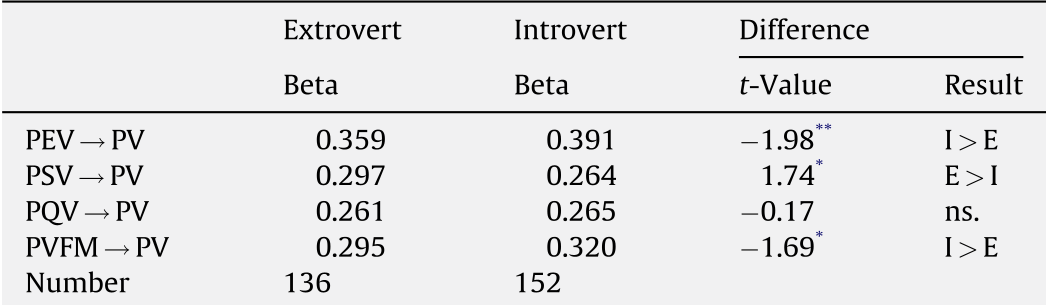 Table 1: Path Coefficients comparison showing that for Introverts, Price and Emotional value are stronger drivers than for Extroverts.
Key Numerical Stat: The model explained 49% of the intention to pay for introverts, but only 32% for extroverts, suggesting extroverts might be influenced by external peer pressure not fully captured by the value-based model alone.
Critical Analysis & Conclusion
Takeaway
- For Academic Researchers: This work proves that personality is not just a "trait" but a "moderator" that dictates how value is calculated in the mind of the consumer.
- For Product Strategy: If your platform target consists of introverts, offer "Value Packs" and "Privacy/Relaxation Features." If you target extroverts, offer "Limited Edition Badges" and "Broadcast Tools."
Limitations
The study focused on a 2010-era avatar site (iPartment). In today’s world of TikTok and Instagram, "Social Value" might have even more complex sub-dimensions like "Algorithmic Reach" or "Influencer Status" that the original PERVAL scale doesn't fully capture.
Future Outlook
As we move toward the Metaverse, the "Avatar Decoration" findings from this paper become incredibly relevant. Modern "Introverts" may still be the primary drivers of digital item sales if they perceive these items as tools for emotional self-expression rather than just social signaling.