
Eye-Tracking the SERP: Decoding the Psychology of the Search Result
Eye-tracking analysis of user behavior in WWW search
This seminal study explores user interaction with WWW search engine results pages (SERPs) using eye-tracking technology. By analyzing gaze fixations and clickthrough patterns, the authors provide early empirical evidence of the "position bias" and scanning behaviors that influence how users select information online.
TL;DR
This 2004 Cornell study is a foundational piece of Information Retrieval (IR) history. By tracking the eye movements of users on Google, the researchers proved that visual attention is heavily "top-heavy" and that the act of clicking is only a small part of a much more complex cognitive scanning process.
Background: The Hidden Behavior of Searchers
In the early 2000s, search engines were evolving rapidly, but our understanding of how people used them was limited to server-side logs. We knew what people clicked, but we didn't know what they ignored. This paper bridge the gap between human-computer interaction (HCI) and machine learning by providing a "ground truth" of visual attention.
The "Why": Why Gaze Matters More than Clicks
If a user clicks the 3rd result, does it mean the 1st and 2nd were irrelevant? Or did the user simply skip them? The authors' insight was that fixations (gazes lasting 200-300ms) are the true currency of information acquisition. By mapping these fixations, they could determine the "inspection probability"—a critical component for any researcher trying to fix the bias in search algorithms.
Methodology: Looking Under the Hood
The study used 36 participants performing "informational" and "navigational" searches. Using the Pupil-Center and Corneal-Reflection method, they identified precisely which segments of the Google interface (Title vs. Abstract vs. Snippet) captured the eye.

Core Insights: Attention vs. Selection
The authors uncovered several behaviors that are now considered standards in UX design:
1. The Rank 1 vs. Rank 2 Paradox
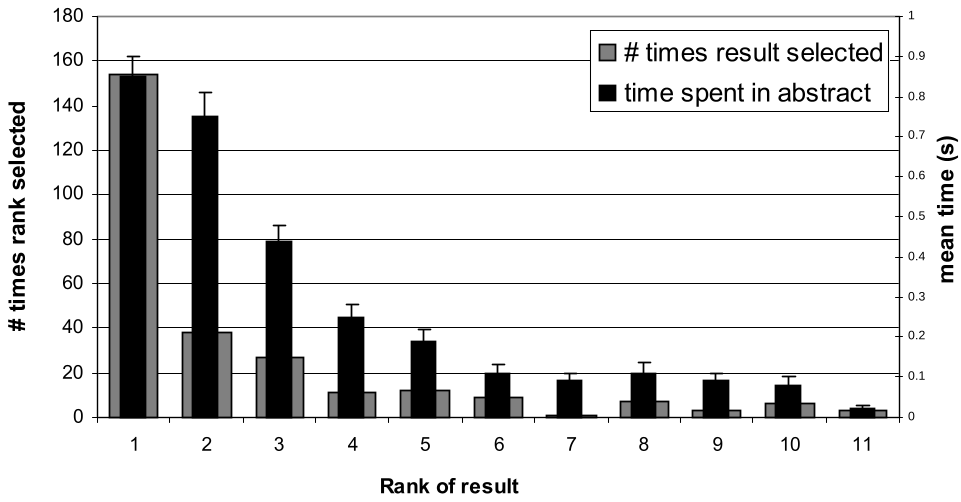
One of the most striking findings was that users spent almost the same amount of time looking at the first and second results. However, the click frequency for the first result was dramatically higher. This suggest a high level of "trust" in the search engine's top choice, even when the second result looks equally interesting.
2. The Great Drop-off
Attention falls off a cliff after the second result. There is also a notable "dip" around result 6 or 7. Why? Because this was typically the "fold"—the bottom of the screen. If a user has to scroll to see a result, the probability of it being inspected drops significantly, regardless of its objective relevance.
3. Sequential Scanning
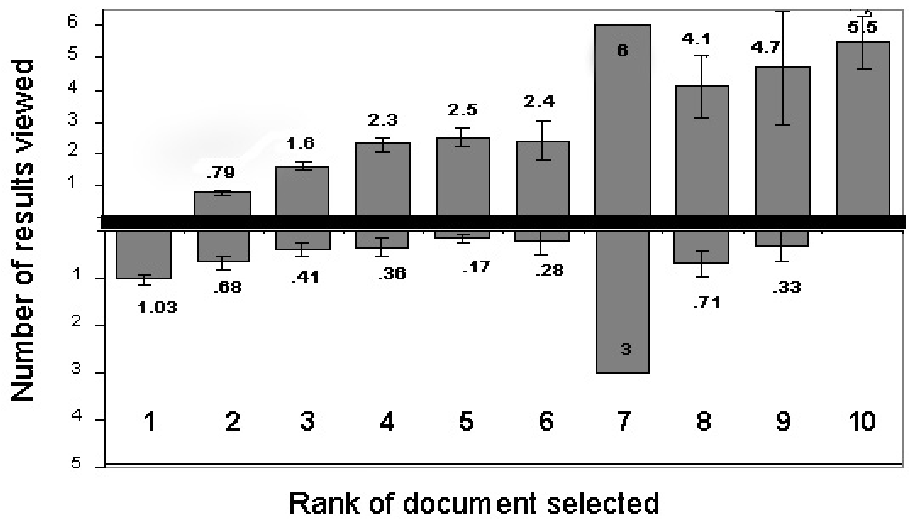
Users are remarkably efficient (or lazy). As shown in the figure below, users rarely look at abstracts below the one they eventually click. They scan from top to bottom and stop as soon as they find a "good enough" match (Satisficing).
Critical Analysis: Impact and Evolution
Takeaway: This paper is the reason why modern search metrics (like NDCG or MRR) are so focused on the "Top 3" or "Top 5" results. It provided the empirical justification for the fact that a result at rank 10 is almost invisible to the average user.
Limitations:
- Small Metadata: The study used a 2004 version of Google. Modern SERPs are cluttered with Ads, Shopping widgets, and AI Overviews, which likely disrupt the linear scanning found here.
- Sample Bias: The study used university students, who might be more adept at scanning than the general population.
Future Outlook
Today, this line of research has moved toward "Large-scale Implicit Feedback" where AI models predict where a user is looking without needing an eye-tracker. However, the core truth discovered here remains: Position is power. If you aren't in the top two, you are fighting for the crumbs of visual attention.