
EZeeCom: Redefining Social Connectivity through Mobile Ad Hoc Networks
EZeeCom: enabling spontaneous social interactions over mobile ad hoc networks
EZeeCom is a social interaction framework designed for Mobile Ad Hoc Networks (MANETs). It utilizes IEEE 802.11b to allow users to spontaneously discover, localize, and communicate with nearby individuals without relying on centralized cellular infrastructure or costly internet services.
TL;DR
EZeeCom is a decentralized social networking system that enables users to discover and interact with people in their immediate vicinity using only mobile devices and Wi-Fi. By bypassing centralized servers and cellular networks, it offers a low-latency, zero-cost solution for spontaneous human-human interaction, featuring a unique hybrid localization technique and multi-hop data forwarding.
Background Positioning
Published during the rise of pervasive computing, EZeeCom addresses the "introvert’s dilemma" and the "emergency search" problem in environments like universities or hospitals. It moves away from the then-standard server-client model (like SapienNet) toward a pure Mobile Ad Hoc Network (MANET) approach.
The Core Challenge: Isolation in a Networked World
Despite the proliferation of mobile devices, social interactions in 2007 were often hampered by:
- Infrastructure Dependency: Needing GPRS/Cellular even to talk to someone 5 meters away.
- Prohibitive Costs: High data rates for simple profile exchanges.
- Low Range: Bluetooth-based solutions were too limited for campus-wide or building-wide discovery.
Methodology: Decentralized Intelligence
EZeeCom's architecture turns every smartphone (or PDA, in the context of the 2007 study) into a sovereign node.
1. Hybrid Location Determination
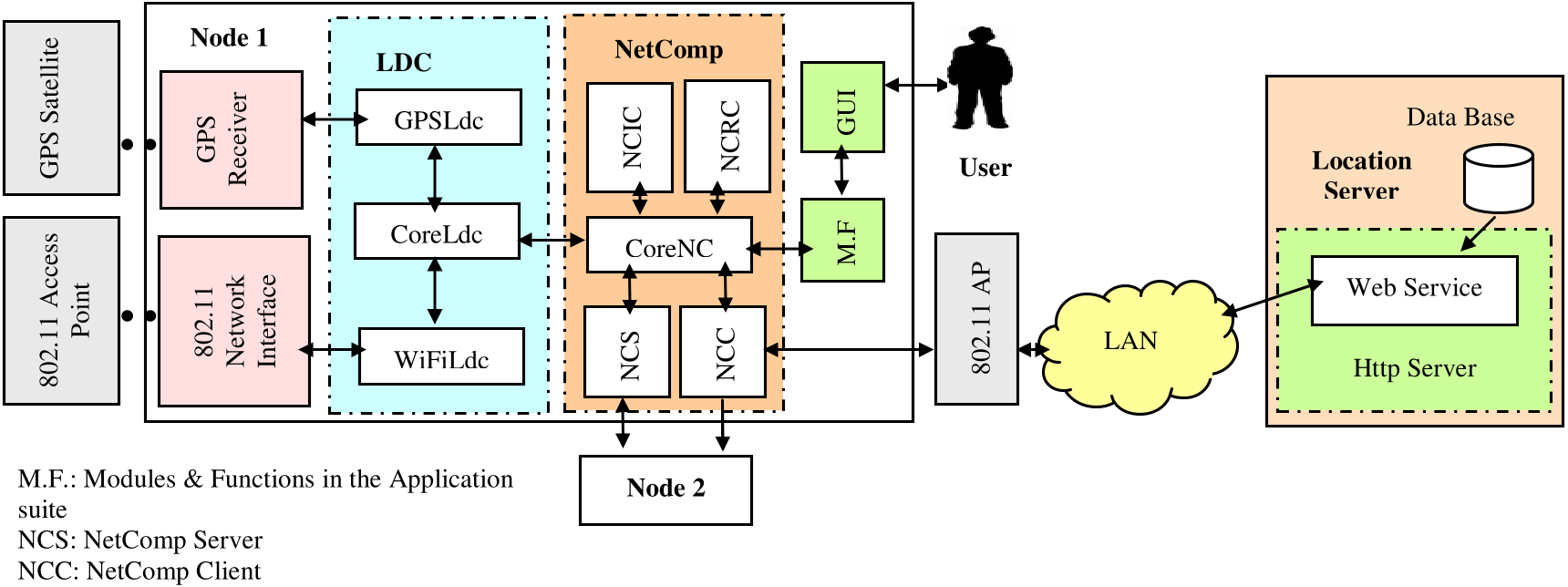
The system supports both Geometric (GPS coordinates) and Symbolic (e.g., "Room 201") locations. For indoor scenarios where GPS fails, EZeeCom uses Wi-Fi access point Mac addresses to map icons to physical locations.
2. The Gateway Protocol
A standout innovation is the Location Translation Protocol. If an outdoor node lacks internet access, it finds a "Gateway Node"—a neighbor that can see both the user and a Wi-Fi Access Point—to fetch symbolic data on its behalf.
3. Buffer Protocol for Mode Switching
Since a single Wi-Fi card cannot easily maintain an Ad-Hoc (P2P) and Infrastructure (Client-Server) connection simultaneously, EZeeCom implements a Buffer Protocol. It pauses outgoing messages and alerts neighbors to hold incoming packets whenever a node "switches modes" to talk to a location server.
Experimental & Simulation Benchmarks
The authors validated EZeeCom through real-world deployments using Toshiba PocketPCs and Laptops.
Real-World Latency
In indoor scenarios, discovering a neighbor and receiving their Essential User Information (EUI) took between 29.47ms and 122.83ms. Even with walls and obstacles, the delay remained well below the threshold for human frustration.
Scaling to 100 Nodes
To test the limits, the researchers simulated 100 moving nodes. They compared Flooding (sending data to everyone) vs. Location-Based Forwarding.
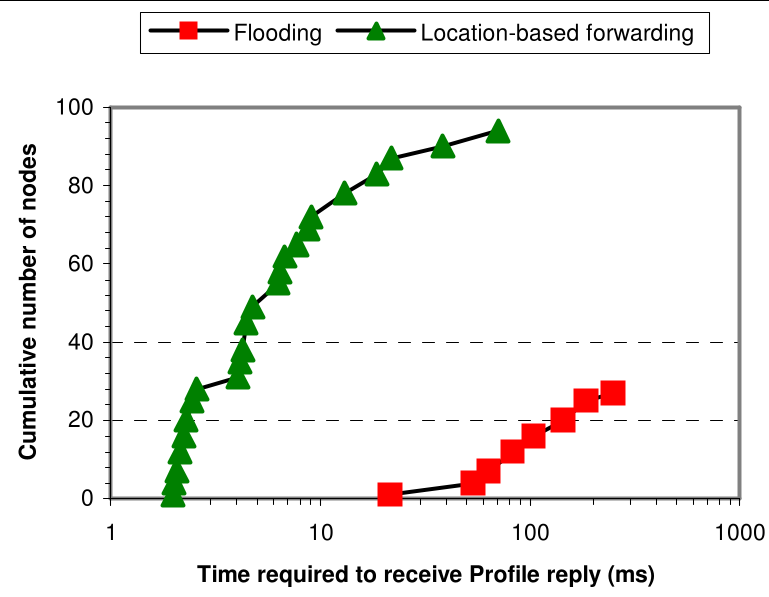
- Flooding: Only 27% of profile requests were successfully answered due to network congestion (broadcast storms).
- Location-Based Forwarding: Achieved a 94% success rate, proving that intelligent packet routing is essential for MANET social networks.
Critical Insight: The Value of Spontaneity
EZeeCom’s true contribution isn't just the code, but the validation of spontaneous networking. By allowing users to set "Smart Alerts" for specific characteristics (e.g., finding a doctor in a crowd or a fellow countryman in a foreign city), it bridges the gap between digital identity and physical presence.
Future Outlook and Limitations
While EZeeCom was a pioneer, it lacked a rigorous Security and Privacy framework—a critical requirement for modern social apps where "leaking" your symbolic location (e.g., "Room 201") could pose risks. However, its proof that localized Wi-Fi mesh networks can outperform cellular-based social apps remains a foundational concept for modern decentralized web (Web3) and Edge Computing research.
Takeaway for Architects
If you are building localized IoT or social discovery tools, EZeeCom teaches us that the Gateway Node and Localized Buffering are the keys to handling the intermittent connectivity inherent in mobile P2P environments.