
F-PAD: Quantifying the "Inference Gap" in Social Network Privacy
F-PAD: Private Attribute Disclosure Risk Estimation in Online Social Networks
The paper introduces F-PAD (Framework for Private Attribute Disclosure), a generalized risk estimation system designed to quantify the probability of hidden social network attributes (e.g., gender, age, location) being exposed by machine learning inference attacks. It utilizes a weighted bootstrap technique to aggregate risks from a "basket" of diverse attack models, achieving state-of-the-art accuracy in individual privacy assessment.
TL;DR
Even if you hide your gender or location on Facebook, machine learning can reveal them with startling precision. F-PAD is a sophisticated framework that doesn't just predict your secrets—it predicts the risk of those secrets being leaked by a variety of different AI attacks. By simulating a "basket" of adversaries and using a weighted bootstrap method, it offers users a 95% confidence interval of their privacy status and tailored advice on what to hide next.
The "Hiding" Illusion: Why Current Privacy is Failing
In the modern Online Social Network (OSN) era, users play a game of "selective disclosure": they share interests to get better recommendations but hide sensitive attributes like age or current city.
The authors identify a critical Motivation:
- Adversary Uncertainty: You don't know if an attacker is using a Simple Random Forest or a complex Neural Network.
- The Specificity Problem: Previous work focused on average risk. However, a user sharing "Hometown: Seattle" and "Employer: Amazon" has a much higher risk of "Current City: Seattle" disclosure than a user sharing nothing.
F-PAD bridges this gap by moving from "What is the model's accuracy?" to "What is the probability that your specific profile will be cracked?"
Methodology: The Three Pillars of F-PAD
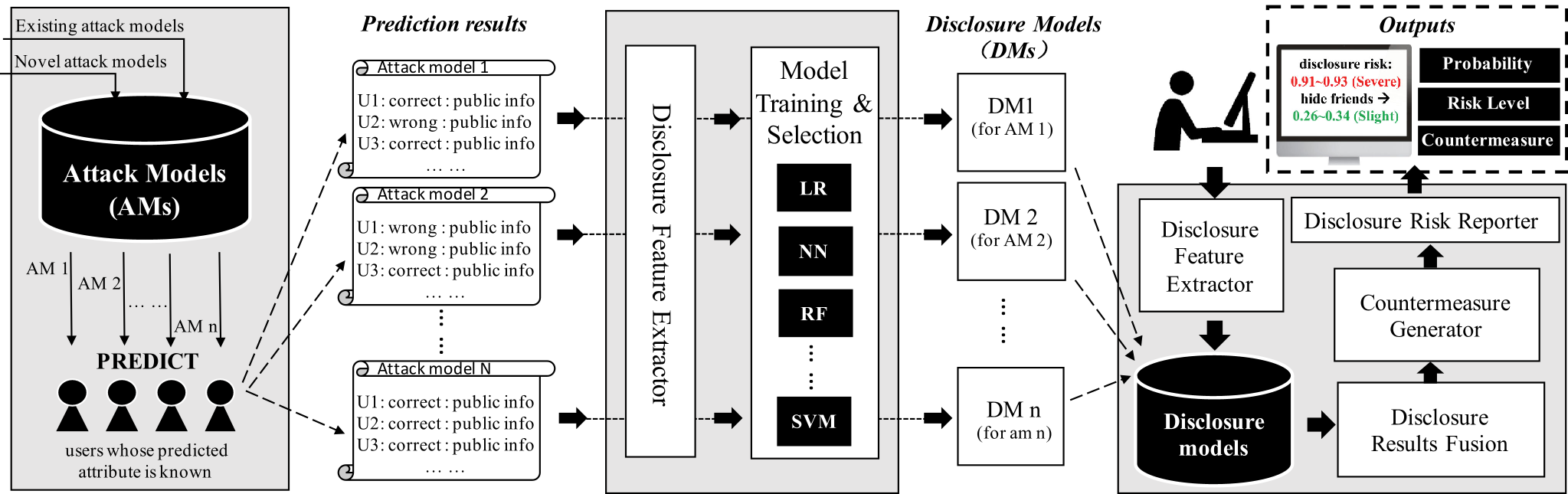
The core of F-PAD is its ability to remain "Attack Model Independent." It achieves this through a structured pipeline:
1. Attack Basket Simulation
F-PAD acts as a "Red Team." It runs multiple inference models—ranging from proximity-based algorithms (DIST) to collaborative filtering (SVD-LR). It also introduces a General Bayesian Attack that converts categorical social features into conditional probability vectors.
2. Learning the "Disclosure Pattern"
This is the paper's secret sauce. Instead of just looking at the prediction, F-PAD trains a meta-classifier (The Disclosure Model). It looks at:
- Indication Confidence: How sure was the attacker?
- Indication Advantage: Distance between the top-1 and top-2 predictions.
- Effective Candidate Number: Are there many likely answers, or just one?
3. Weighted Bootstrap Fusion
Because an adversary is more likely to use a "stronger" model, F-PAD weights the results of various attacks based on their historical accuracy. It then uses Bootstrap Resampling to generate a probability distribution rather than a single number.
Experimental Proof: Measuring the Unseen
The researchers tested F-PAD on the FB (Facebook) and BX (Book-Crossing) datasets.
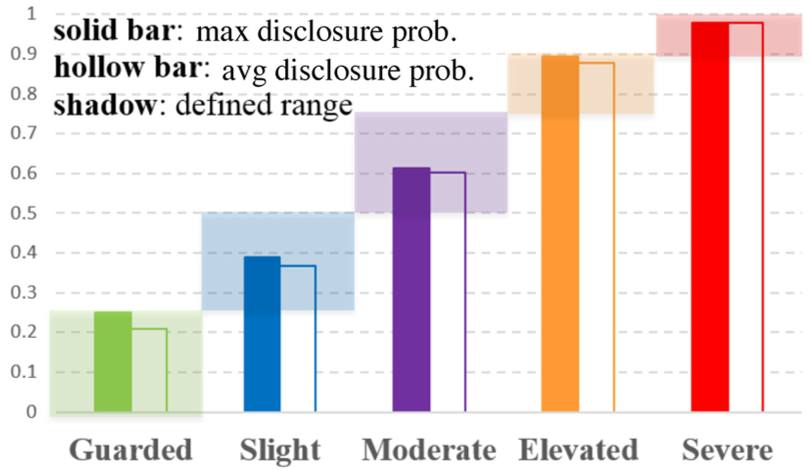
Key Result: The "Risk Levels" (Guarded to Severe) actually mean something. In their "Current City" experiments, users labeled as "Elevated Risk" by F-PAD were indeed successfully attacked ~80% of the time, proving the estimator's calibration.
The "Backfire" Effect
Interestingly, the study found that blindly hiding attributes can sometimes increase risk. For example, if a male user hides "gender-neutral" interests, the remaining "highly-masculine" interests make the attacker's job even easier. F-PAD's Countermeasure Generator prevents this by simulating the "what-if" scenario before the user changes their settings.
Critical Insight & Conclusion
F-PAD represents a shift in privacy research from Prevention (trying to block all attacks) to Awareness and Calculus (giving the user the tools to decide if the benefit of sharing is worth the risk).
Future Outlook: While F-PAD is robust, it relies on having a representative "attack basket." As Deep Learning and Large Language Models (LLMs) evolve, the "basket" will need to include more sophisticated semantic inference models. However, the framework's modular nature ensures that as long as we can simulate the attack, we can estimate the risk.
Takeaway for Developers: If you build social platforms, don't just give users a "Private" toggle. Give them a "Privacy Score" that accounts for the power of modern AI.