
Collective Intelligence in Social Networks: Harmonizing Distributed Face Recognition
Face annotation for personal photos using collaborative face recognition in online social networks
This paper introduces a Collaborative Face Recognition (FR) framework specifically designed for Online Social Networks (OSNs). By leveraging multiple distributed FR engines and databases shared across a user's social circle, the method achieves superior face annotation accuracy using Bayesian evidence fusion and confidence-integrated majority voting.
TL;DR
Researchers from KAIST and University of Toronto have developed a Collaborative Face Recognition (FR) system that breaks the "single-engine" bottleneck of traditional AI. By treating every user's local FR engine as a specialized expert and fusing their decisions via Bayesian logic, the system significantly improves face tagging accuracy in the chaotic, uncontrolled environment of Online Social Networks (OSNs).
The "Silo" Problem in Modern Social Networks
In the era of Facebook and Instagram, photos are no longer just files; they are nodes in a massive, decentralized social graph. However, AI face annotation has traditionally reached a plateau because:
- Data Decentralization: Every user has their own "silo" of photos.
- Acquisition Noise: Web photos suffer from wild variations in lighting and angles.
- Engine Limitations: A single central model often lacks the specific "expertise" required to identify a niche group of friends or family members as accurately as a localized model trained on those specific individuals.
The authors' core insight is simple yet powerful: Your friends' facial recognition engines are likely better at identifying your mutual acquaintances than a generic central model.
Methodology: The Power of Fusion
The proposed system moves away from a "one-size-fits-all" model toward a Democratic Ensemble of distributed engines.
1. Social Engine Selection
Instead of querying every engine in the network, the system uses the user's Social Context (S)—their friend list—to pick the most relevant "expert" databases. This drastically reduces computational overhead and increases the "Prior Probability" of a correct match.
2. Bayesian & Decision Fusion
The technical heart of the paper lies in how it combines conflicting results from different engines.
- Measurement Level (Bayesian): It calculates a posterior probability for each identity across all engines, normalizing distance scores to ensure that different algorithms (e.g., holistic vs. local feature matching) can be compared fairly.
- Decision Level (Majority Vote): Each engine "votes" on an identity, but its vote is weighted by a "Confidence Value" derived from a Sigmoid or Soft-max function. This prevents a "confident but wrong" engine from hijacking the results.
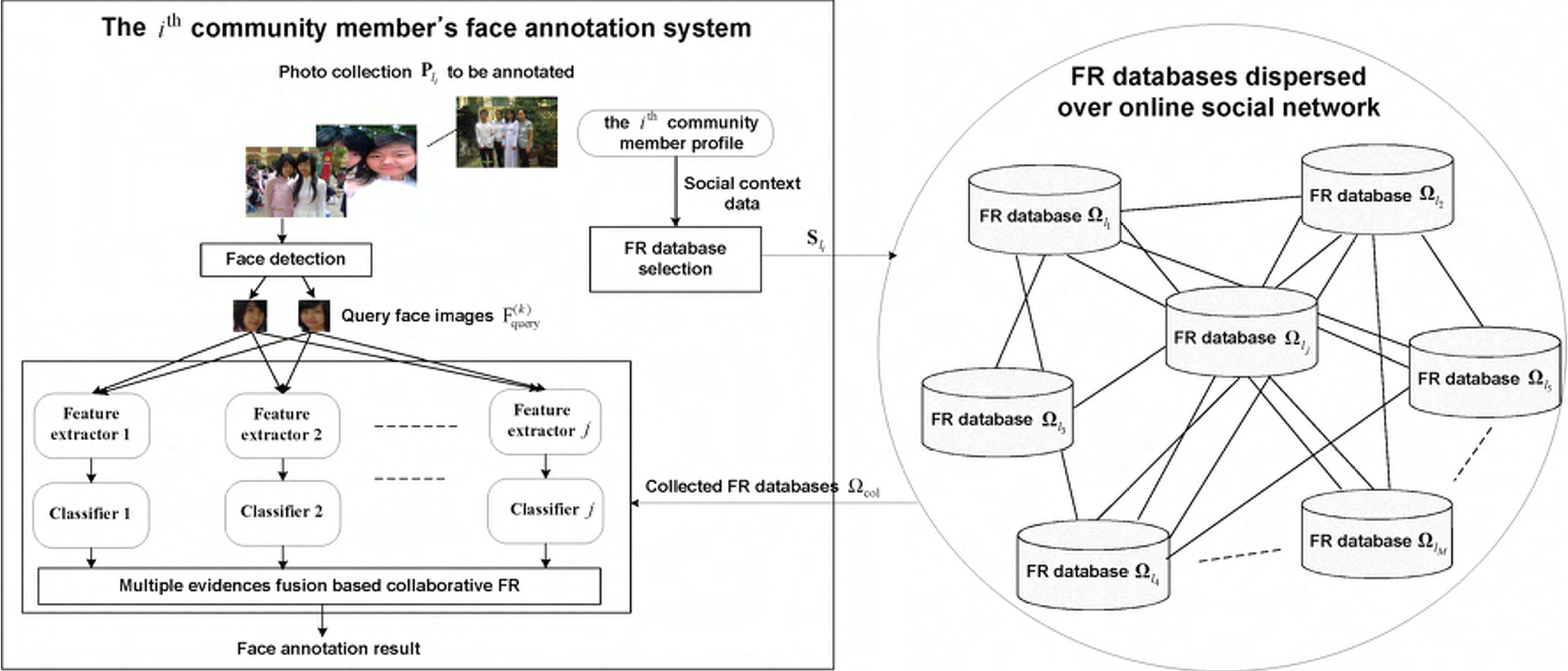 Figure 1: The flow of face annotation through distributed social databases.
Experiments: Real-World Performance
The researchers didn't just test this in a lab. They used 4,000 real-world web photos characterized by poor quality and inconsistent tagging.
Key Findings:
- Collaborative vs. Single: The Collaborative FR consistently outperformed single-database systems. By aggregating multiple "galleries," the system was able to find matches that simply didn't exist in a single user's private database.
- Robustness: The fusion techniques (Bayesian and Majority Vote) effectively canceled out the noise from "weak" engines, leading to a much higher Rank-1 Recognition Rate.
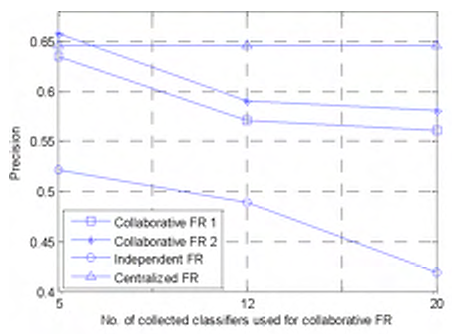 Figure 2: Comparative analysis showing the superiority of collaborative fusion (graphs a, b, e).
Critical Insight & Future Outlook
This paper serves as a precursor to modern Federated Learning and Edge AI. It highlights a transition from "Big Model AI" to "Connected AI."
Takeaway: The true potential of OSNs isn't just the data they host, but the relationships between that data. This work proves that by leveraging social architecture, we can build recognition systems that are more accurate, more personalized, and more resilient to the "noise" of the real world.
Limitations: The paper assumes that distributed engines are accessible to one another. In a modern context, privacy constraints and encryption would require this collaborative layer to be implemented using Secure Multi-Party Computation (SMPC) or similar tech.