
Who Puts the Best "Face" Forward? How Culture Re-routes the Psychology of Facebook Positivity
Who puts the best “face” forward on Facebook?: Positive self-presentation in online social networking and the role of self-consciousness, actual-to-total Friends ratio, and culture
This study investigates the predictors of positive self-presentation (PSP) on Facebook, focusing on individual (public/private self-consciousness), interpersonal (actual-to-total Friends ratio), and cultural (U.S. vs. South Korea) levels. Using a cross-sectional survey (N=320), it identifies culture as a critical moderator that dictates how individual traits and social circles influence online behavior.
TL;DR
Is our tendency to post only "happy" moments on Facebook an innate human trait or a cultural byproduct? This study reveals that while American users maintain a high baseline of positive self-presentation (PSP) regardless of their personality, South Korean users are far more strategic. For Koreans, the "positive face" is Dialed up only when public self-consciousness is high or when the audience consists of fewer "actual" friends.
The "Positivity Bias" and Its Discontents
Social Network Sites (SNSs) like Facebook have long been criticized for creating an "unreality" where everyone looks happier and more successful than they truly are. This "positivity bias" can lead to depression and social comparison. However, most scholarship has viewed this through a Western-centric lens. This study argues that we cannot understand why people self-enhance without looking at the cultural coordinate system in which they operate.
The authors identify a gap: does the pressure to be positive come from within (self-consciousness) or from the crowd (audience composition)? And does the answer change when you move from the individualistic United States to the collectivistic South Korea?
Methodology: A Cross-Cultural Lens
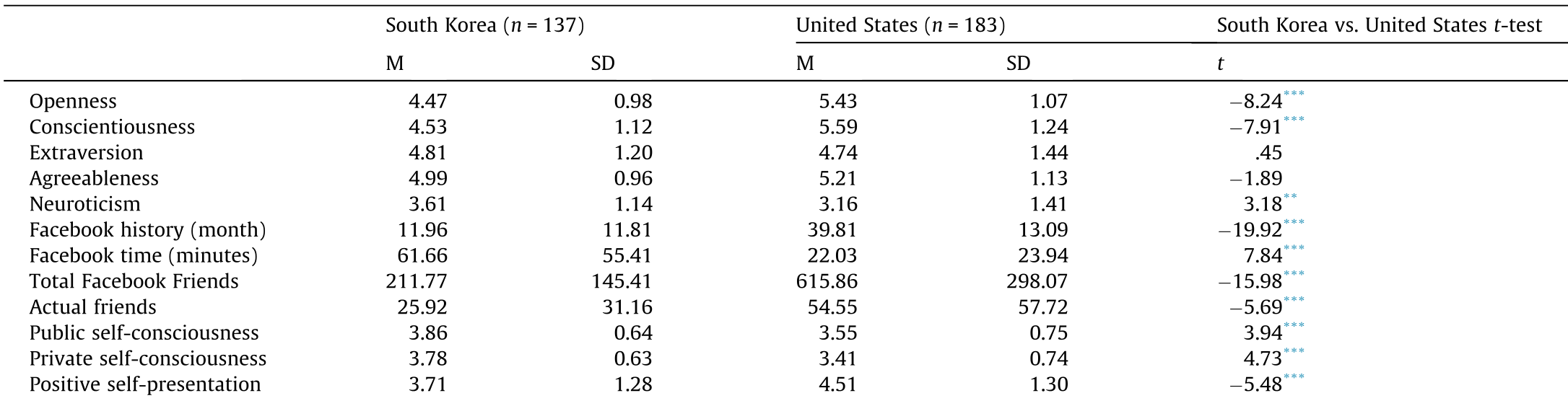
The researchers surveyed college students in the U.S. (Midwest) and South Korea (Seoul). They measured:
- Positive Self-Presentation (PSP): Posting happy photos/avoiding negative status updates.
- Public Self-Consciousness: Concern for one's public image.
- Actual-to-Total Friends Ratio: The percentage of your "Friends" you actually consider real friends.
Key Insight: The Moderating Power of Culture
The most striking finding isn't just that Americans are more positive—it's why they are positive.
1. The "Norm" vs. The "Strategy"
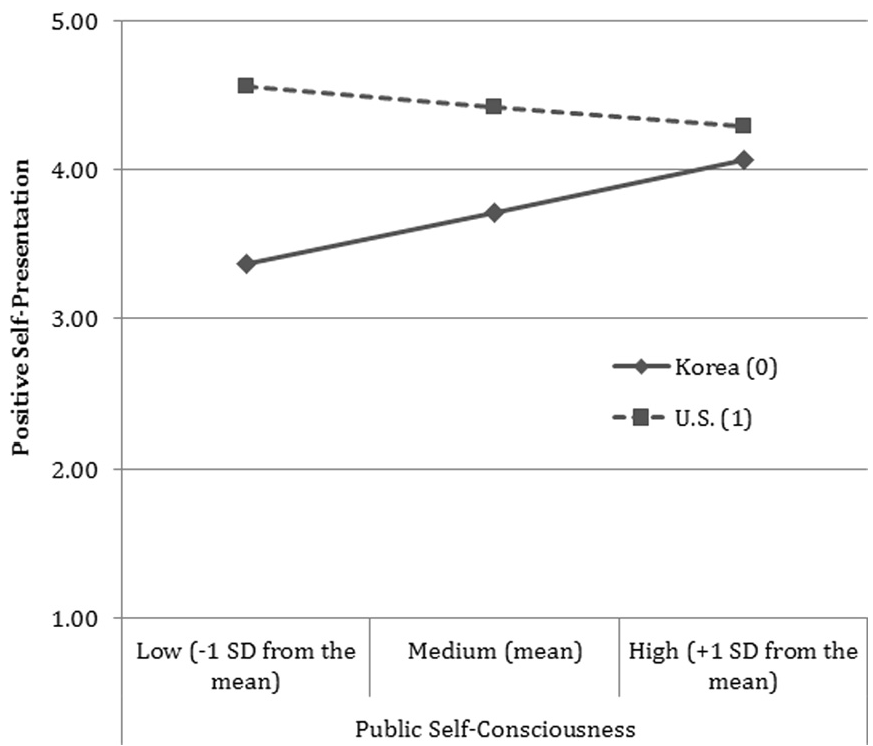
In the U.S., positive self-presentation is an ingrained cultural script. Whether an American is naturally self-conscious or not, they tend to put on a "good show" because American culture values self-promotion and individual achievement.
Conversely, in South Korea, cultural norms emphasize modesty and self-criticism (Confucian roots). Therefore, PSP becomes a strategic tool. A South Korean user only ramps up the positivity when their Public Self-Consciousness is activated.
2. The Audience Effect
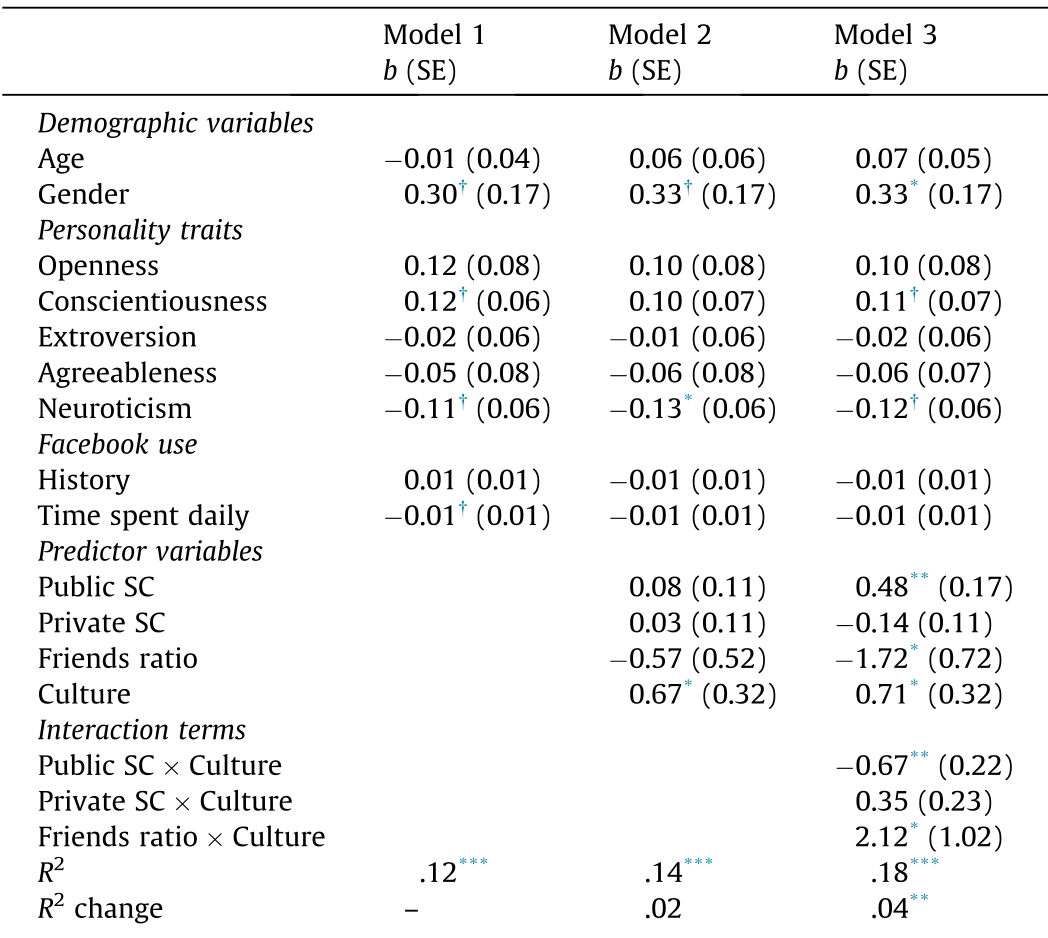
The study found that for South Koreans, having a higher ratio of "real friends" led to less positive self-presentation. Intimacy allows for authenticity. However, when the audience was filled with "mere acquaintances" (low ratio), they felt the need to manage their image more carefully. For Americans, the audience didn't matter—positivity was constant regardless of who was watching.
Critical Analysis & Conclusion
Takeaway
For designers of global platforms, this work is a wake-up call. A "one-size-fits-all" interface might fail because users in different cultures use the same features (like status updates) for different psychological ends. Americans might want "broadcasting" tools for self-enhancement, while East Asians might prefer "audience segmentation" tools to facilitate authentic sharing with true friends.
Limitations
- Cross-sectional data: We can't definitively say culture causes these changes, only that they are associated.
- College-age bias: The behavior of a 20-year-old on Facebook may differ significantly from a 50-year-old.
- Binary Culture: Using "U.S. vs. Korea" is a proxy for "Individualism vs. Collectivism," but these cultures are more nuanced than a single dimension.
Future Outlook
As social media platforms shift toward "Close Friends" lists and private "Stories," it will be fascinating to see if these cultural gaps narrow or if the strategic nature of East Asian self-presentation finds new digital outlets.