
Face/Off: Rethinking Photo Privacy through Fine-Grained Face Access Control
Face/Off: Preventing Privacy Leakage From Photos in Social Networks
Face/Off is a fine-grained access control system for Online Social Networks (OSNs) that shifts privacy management from the photo level to the face level. By leveraging automated face recognition and selective blurring, the system ensures that any user depicted in a photo can independently control the visibility of their own face, achieving SOTA results in preventing unauthorized identification.
TL;DR
"Face/Off" introduces a paradigm shift in social network privacy. Instead of deciding who sees a photo, it empowers individuals to decide who sees their face within that photo. By decoupling the uploader's permissions from the subjects' privacy needs, it effectively eliminates privacy leakages caused by conflicting social settings with minimal performance overhead.
Background: The Illusion of Privacy in Social Media
Current OSNs like Facebook and Instagram assume the uploader is the "owner" of a photo. This leads to several critical privacy failure modes:
- The Malicious/Silent Tagger: You are uploaded in an embarrassing state without your consent or knowledge.
- The Group Photographer: A group shot is public because the uploader has weak privacy settings, even if your personal settings are "Friends Only."
- The Friendly Stranger: Your face is visible to "Friends of Friends"—people you don't know—simply because you share a mutual friend with the uploader.
The authors argue that the face is the primary PII in a photo, and access control must be applied at that granularity.
Methodology: The Face-as-Object Model
The core technical innovation is treating faces as independent objects within a 3D access control matrix.
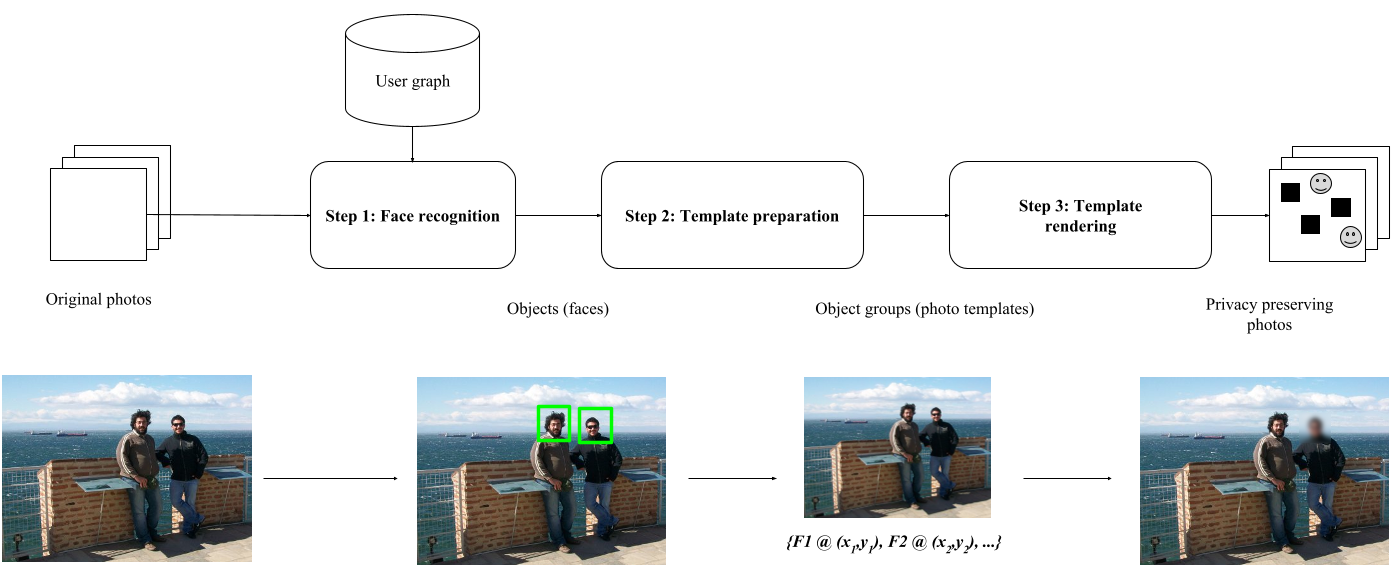
1. The Workflow
The system follows a three-stage pipeline designed for scalability:
- Detection & Tagging: Using face recognition (comparable to Facebook's DeepFace), the system identifies all users.
- Layered Templates: For every photo, a template is created. If a photo has three people, the system generates three separate "blurred patches" (layers).
- On-the-Fly Composition: When a friend views the photo, the server checks the viewer's status against the ACL of each face. If the viewer lacks permission to see User A but can see User B, the server merges the original photo with User A's blurred layer in real-time.
2. Physical Intuition: Decoupling Representation from Content
By using layers, the system avoids the heavy computational cost of re-processing (blurring) the entire image for every single request. It turns an image processing problem into a simple alpha-blending/composition task, which is extremely fast for modern servers.
Experimental Validation
Performance Metrics
A common criticism of privacy-enhancing technologies is that they are "too slow." Face/Off debunked this:
- Processing Time: Average 0.052 seconds per photo.
- Scalability: The time increase per additional tag is only ~0.002 seconds, making it suitable for group photos.
Effectiveness (The Human Factor)
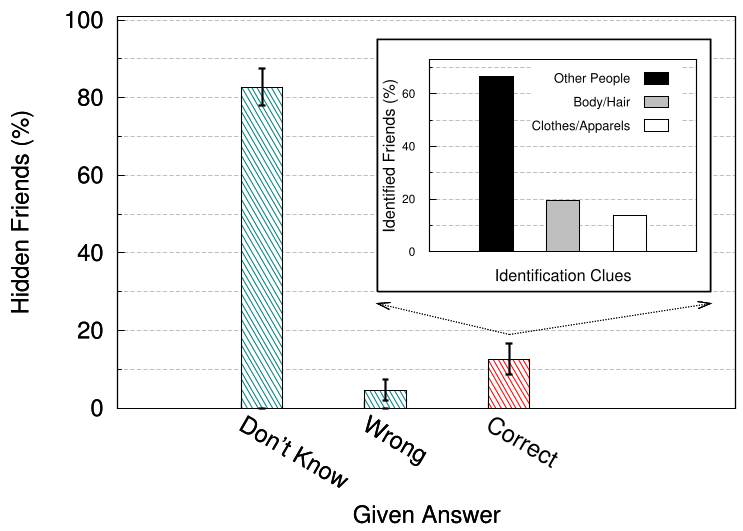
In a study of 476 identification challenges, participants (who were actual friends of the targets) could only identify the "hidden" user in 12.6% of cases. Most successful "guesses" were due to context (e.g., "I know Alice is usually with Bob, so that blurred face must be Bob"), suggesting that while face-blurring is powerful, social context remains a residual leak.
Critical Analysis & Future Outlook
While Face/Off is a robust solution to a 10-year-old social media problem, it has limitations:
- Social Inference: As noted, your "hair" or "clothing" or even the "comments section" can give you away. The authors suggest future work on "Inpainting" (completely removing the person from the scene) rather than just blurring.
- Non-members: The system currently cannot protect strangers who don't have an account on the platform to set their own permissions.
The "Takeaway" for the Industry
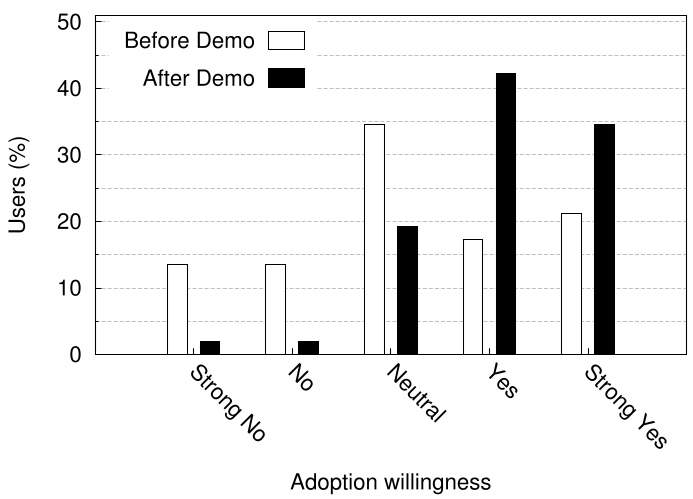
The study found a massive "Privacy Literacy" gap. Initially, users didn't want the feature. After being showed how their privacy was actually being leaked, 77% demanded it. This suggests that OSNs shouldn't just wait for user demand; they must lead with "Privacy by Design."
Conclusion
Face/Off proves that fine-grained access control is not just a theoretical gold standard but a practical reality. By shifting the power of PII visibility back to the individual, we can maintain the social benefits of photo sharing while eliminating the "accidental over-sharing" that haunts modern digital lives.