
FSF: Bridging Online Social Circles and Physical Encounters for Efficient Opportunistic Routing
Face-to-face with facebook friends: Using online friendlists for routing in opportunistic networks
The paper introduces FSF (Friendlist-based Social Forwarding), an opportunistic routing protocol that integrates Detected Social Network (DSN) data from physical device encounters with Online Social Network (OSN) data from Facebook friendlists. It utilizes a composite metric of node degree centrality and online tie strength to optimize message forwarding in Delay Tolerant Networks (DTNs).
TL;DR
In the world of Opportunistic Networks, where connections are fleeting and intermittent, the biggest challenge is deciding which "stranger" to trust with your data. This paper presents FSF (Friendlist-based Social Forwarding), a routing scheme that doesn't just look at who you've met, but who you are friends with on Facebook. By merging real-world encounter patterns with stable online social graphs, FSF achieves the high delivery rates of flooding-based protocols while slashing the energy-draining overhead of unnecessary message replication.
The "Warm-up" Trap in DTNs
Opportunistic networks (or Delay Tolerant Networks) operate on a "store-carry-forward" basis. Nodes carry messages until they meet a suitable relay. Most current SOTA (State Of The Art) methods, like Bubble Rap, rely on local encounter history to calculate a node's importance (Centrality).
However, there is a fundamental flaw: The Warm-up Problem. It takes time for nodes to "learn" the social structure of a new environment. During this period, routing is inefficient, latency is high, and batteries are wasted. The authors' insight is simple yet profound: Online social links are more stable than physical encounters. If you are Facebook friends with someone, there is a high intrinsic probability that you will meet them or belong to the same physical social circle, even if the mobile device hasn't recorded that pattern yet.
Methodology: The Power of Two Layers
FSF utilizes a two-layer social network approach to calculate the Forwarding Utility (FU) of a potential relay node.
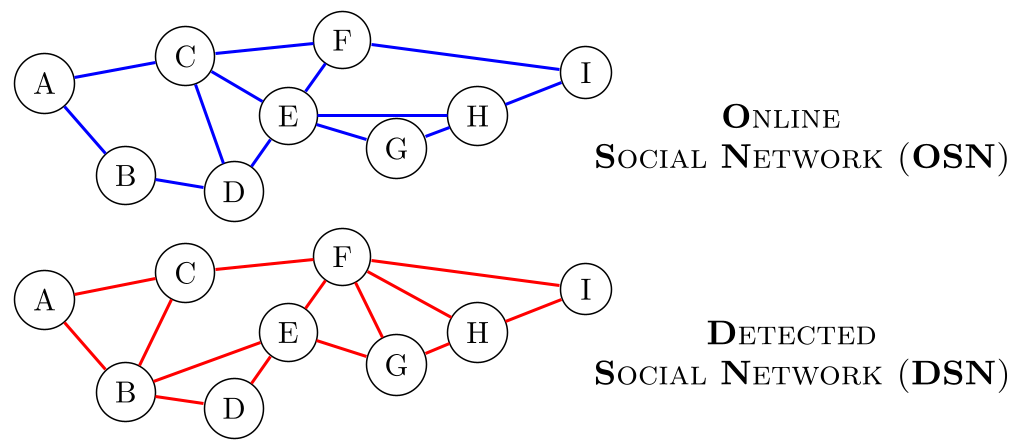
1. The Detected Social Network (DSN) - "The Physical"
FSF calculates a long-term cumulative estimate of Degree Centrality. Unlike global measures that require a full map of the network, FSF does this locally:
- It counts unique encounters over specific time slots.
- It averages these counts over time slots to find "popular" nodes that act as hubs.
2. The Online Social Network (OSN) - "The Digital"
This layer extracts the "Tie Strength." If a potential relay node is an online friend of the destination, or shares mutual friends, the utility increases. It bridges the gap where physical encounter data might be missing.
The Decision Rule: When two nodes ( and ) meet, they exchange centrality values and friendlists. Node will pass the message to node only if has a higher overall Forwarding Utility for the destination .
Experimental Validation
The authors tested FSF using the ONE Simulator on two distinct real-world datasets:
- Sigcomm2009: A high-density conference environment (76 nodes).
- Sassy: A sparse academic environment (25 nodes, 79 days).
Performance vs. The Giants
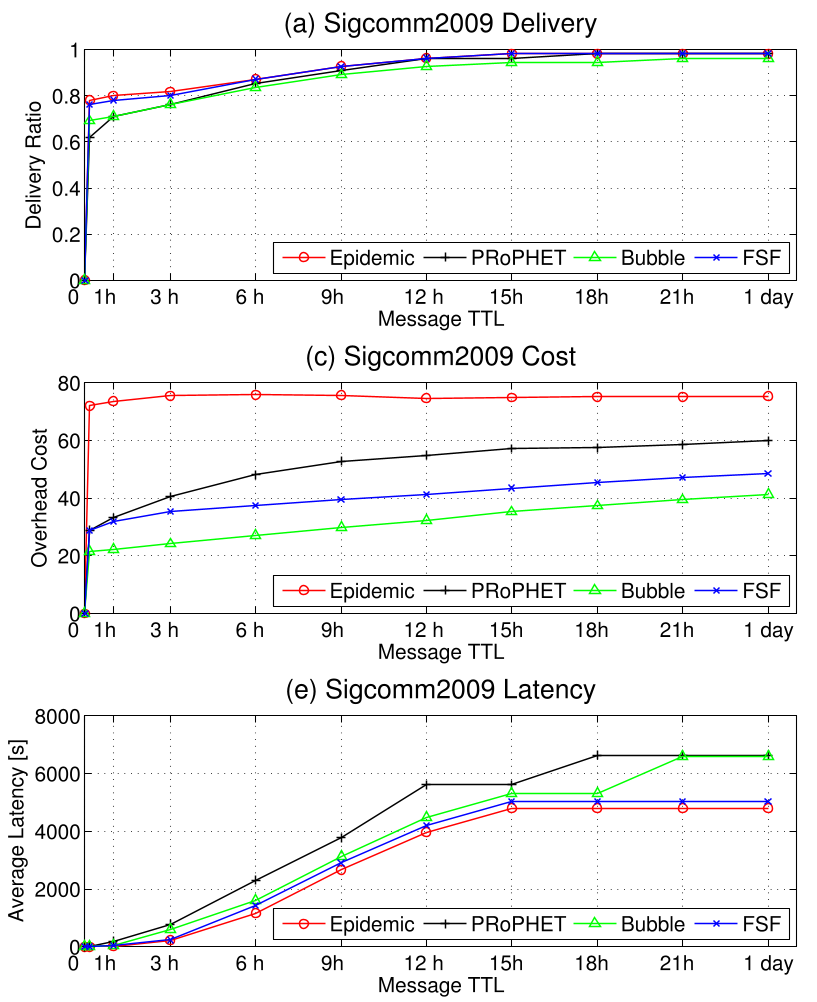
The study compared FSF against Epidemic (flooding everything), PRoPHET (probabilistic), and Bubble Rap (purely encounter-based social routing).
Key Findings:
- Efficiency: In the Sigcomm dataset, FSF matched the 98% delivery ratio of the Epidemic protocol but with significantly lower overhead. While Epidemic transmits 74 copies of a message for every one delivered, FSF only transmits between 29 and 48.
- Consistency: In the sparse Sassy dataset, FSF consistently outperformed Bubble Rap, proving that adding the OSN layer provides more reliable routing paths than encounter data alone.
- Latency: FSF maintains an average latency comparable to Epidemic, meaning it doesn't just deliver more messages; it delivers them fast.
Critical Insight & Conclusion
The true value of FSF lies in its energy-aware social intelligence. By refusing to flood the network and instead selecting relays based on a multi-dimensional social profile, FSF preserves the limited battery life of mobile devices—a critical requirement for real-world deployment.
Limitations & Future Work: While FSF is currently weighted equally between DSN and OSN data, the authors acknowledge that the optimal "mix" might vary. Future research could explore dynamic weighting—perhaps relying more on OSN in the early stages (cold-start) and shifting to DSN as physical encounter history becomes more robust.
FSF proves that in the age of the "Always-On" social web, our digital friendships can be the key to making our physical communication networks smarter and more resilient.