
Beyond the Friend List: Decoding the Hidden Activity Dynamics of Facebook
An analysis of activities in Facebook
This paper presents a comprehensive analysis of a regional Facebook dataset (New Orleans) to distinguish between the static "contact network" (friendship links) and the dynamic "activity network" (wall postings). It reveals that while both follow a power-law degree distribution, the intensity of interaction is highly skewed and does not strictly correlate with a user's total number of friends or degree similarity.
TL;DR
Is your most popular friend also your most active one? Not necessarily. This study dissects a massive Facebook dataset to prove that the Contact Network (who you know) is vastly different from the Activity Network (who you actually talk to). While both follow scale-free power laws, the paper reveals that interaction intensity is surprisingly independent of how "similar" two users are in terms of popularity.
Background: Connectivity ≠ Interactivity
Since the early days of Erdos-Renyi random graphs, we've known that real-world networks are "small worlds." However, the authors argue that simply mapping friendship links provides a "frozen" view of society. In Facebook, writing on a "Wall" (the predecessor to modern Timelines) represents a deliberate act of engagement. The core motivation of this research is to see if the laws governing how we make friends also govern how we communicate with them.
Methodology: A Tale of Two Crawls
The researchers analyzed data from the Max-Planck Institute, spanning over 90,000 users and millions of interactions. They categorized the data into:
- Contact Network: The graph of 3.6M friendship links.
- Activity Network: The subgraph of users who actually exchanged wall messages.
By using CCDF (Complementary Cumulative Distribution Function) and power-law fitting, they mapped how "activity" is distributed across the user base.
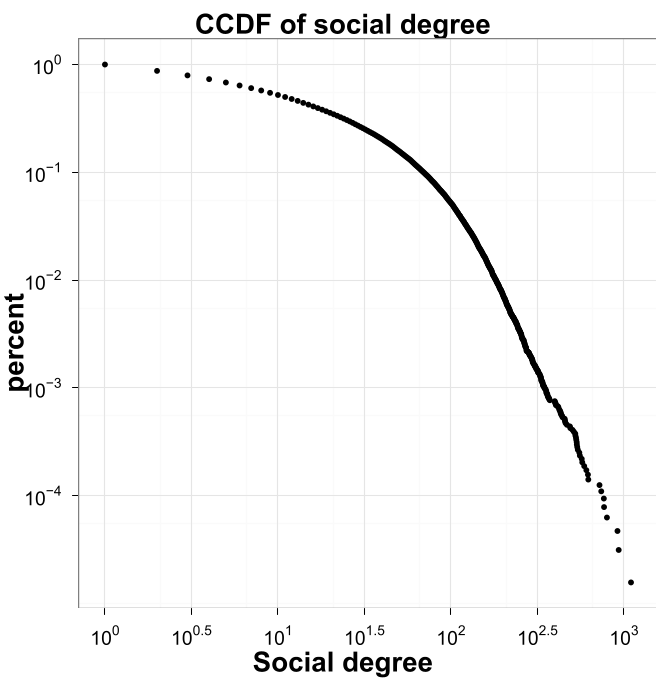 Figure: Comparison of node degree distributions in the Contact Network (left) and Activity Network (right). Both exhibit the characteristic power-law tail.
Key Insights
1. The Paradox of Self-Posting
One might assume that popular users (high degree) are more active in all aspects. The data proves otherwise for "self-posting" (posting on one's own wall). As shown in the study, some users with over 200 friends barely post to their own walls, while users with fewer than 20 friends can be hyper-active.
Insight: Self-expression is a personal trait, whereas message exchange is a social function correlated with network size.
2. Activity Homophily is a Myth
A common theory in sociology is that "similar" people interact more. The authors tested this by looking at "degree difference." Does a popular person (degree 100) primarily talk to other popular people?
The results were striking: the level of interaction between two users is not significantly affected by their degree difference. Whether the gap in popularity is 0 or 100, the activity pattern remains the same—dominated by a tiny fraction of highly active pairs.
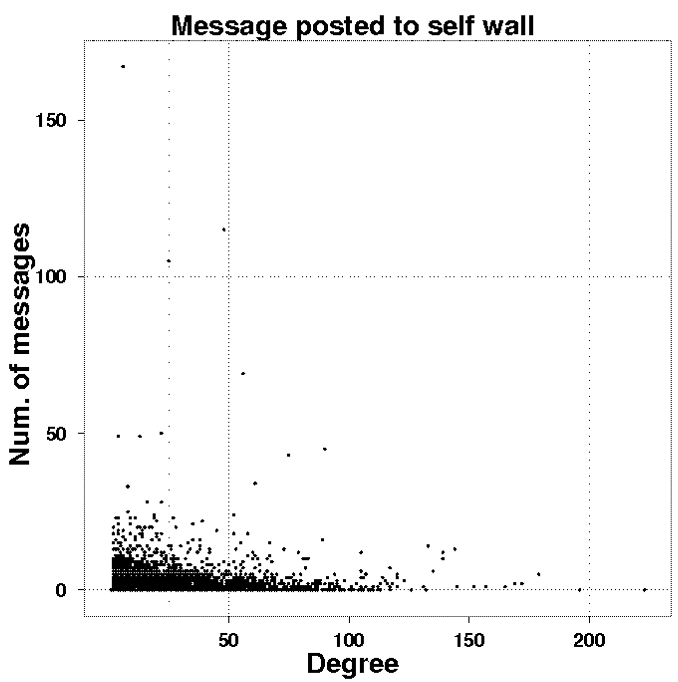 Figure: Distribution of message counts. Note the heavy tail—a small set of users accounts for the vast majority of network traffic.
Experiments & Results: The Power-Law Dominance
The study confirmed that the "rich-get-richer" (Preferential Attachment) phenomenon applies to friendships, but the Activity Network is even more exclusive.
- Contact Network Exponent: 3.5 (standard for social networks).
- Undirected Activity Exponent: 2.59 (indicating a much "heavier" tail where top users are extremely dominant).
The researchers also found that communication is highly ephemeral. Most message exchanges happen shortly after a link is formed, then decay rapidly.
Critical Analysis & Conclusion
Takeaway
This paper serves as a warning to data scientists: Connectivity is a vanity metric. If you are building an algorithm to predict influence or information spread, looking at friend counts without weighing "Activity Intensity" will lead to massive inaccuracies.
Limitations
- Regional Bias: The data is specific to New Orleans, which may not reflect global cultural nuances in communication.
- Activity Type: The study focuses solely on "Wall Posts," ignoring private messages (DMs) or "Likes," which might tell a different story about "invisible" activity.
Future Outlook
As we move toward "Algorithmic Feeds" in the 2020s, the concept of a "Contact Network" is becoming even less relevant, replaced by interest-based discovery. This 2009 analysis was a prophetic first look at why your "Friend" list doesn't actually define your social experience.