
Facebook Applications: The Architecture of Virtual "Third Places"
Facebook Applications and playful mood: the construction of Facebook as a "third place"
This research investigates early Facebook Applications as cultural artifacts that transform social networks into virtual "third places." By analyzing the affective elements of "fun" and "playful mood," the paper argues that these apps function less as traditional games and more as symbolic tools for social identity construction and atmosphere setting.
TL;DR
In this seminal 2008 analysis, Valentina Rao argues that Facebook Applications are not just "bad games"—they are essential sociological tools. By facilitating a "playful mood," these applications transform rigid digital profiles into flexible "third places" where identity is constructed through ritualized, low-stakes social interaction.
The "Not-Quite-A-Game" Dilemma
In the late 2000s, researchers were baffled by the success of Facebook apps like Vampires or Zombies. To a hardcore gamer, these weren't "games" at all. They required zero skill, featured almost no visual animation, and the "gameplay" often consisted of a single click followed by a textual description of an outcome.
The Problem: Existing digital game theory, which prioritizes rules, challenges, and mastery, couldn't explain why people were obsessed with these "frivolous" interactions.
The Insight: Rao suggests we stop looking at the mechanics and start looking at the mood. These apps weren't designed for "Flow"; they were designed for "Playfulness"—a persistent state of mind that prepares individuals for social connectivity.
Methodology: Facebook as the Digital Tavern
The paper utilizes Ray Oldenburg’s concept of the "Third Place." If the home is the first place and work is the second, the third place is where we go to unwind and socialize (the café, the pub, the agora).
1. Replicating Physicality
In a real bar, social warmth comes from physical proximity—a pat on the back or a shared drink. Facebook apps like Superpoke or Hug Me act as "embedded affordances" to reproduce these physical acts symbolically.
2. The Ritual of Identity
Every time a user interacts with an app, the result is published to their "Mini-feed." This creates a permanent digital chronicle. The app acts as a prop for social play, where the goal isn't to "win" the game, but to "win" friends and signal personality traits.
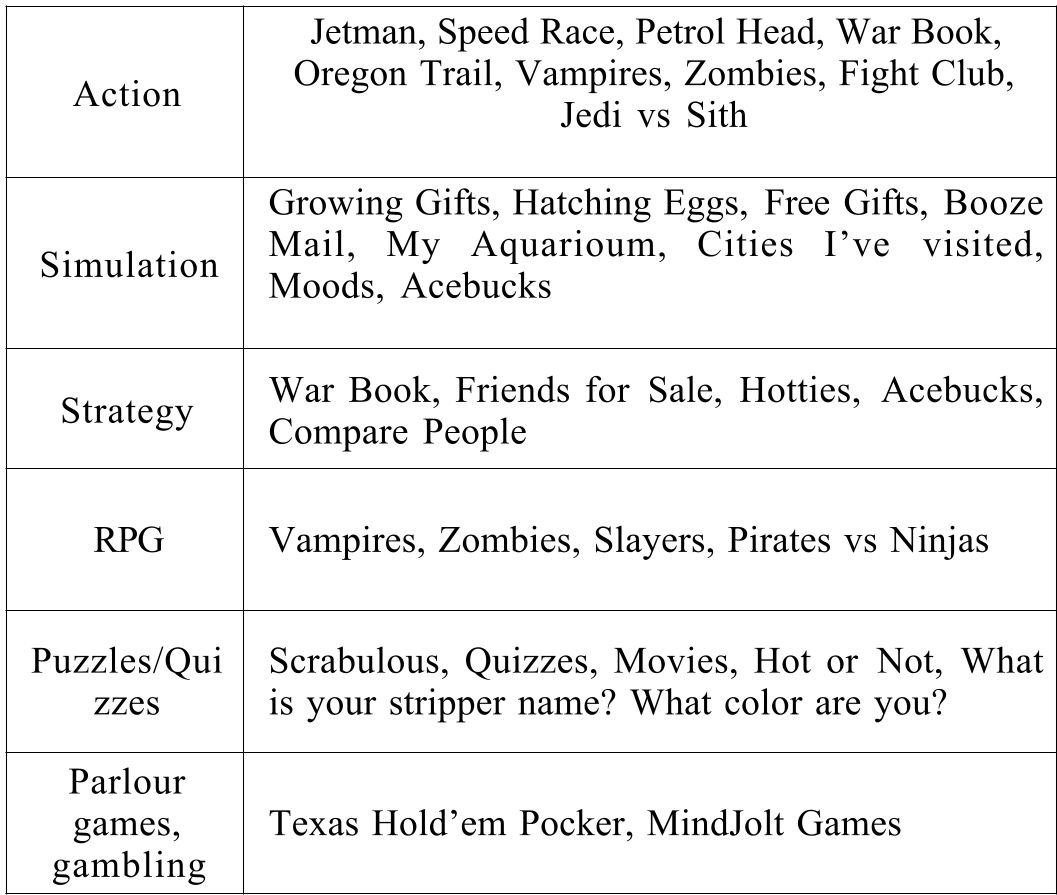 Figure 1: Early taxonomy of Facebook applications categorized by genre and interactive intent.
Key Findings: The Power of "Interactive Silliness"
Rao identifies three pillars of online playfulness:
- Physicality (Symbolic): Re-introducing the "motor activity" of play via clicks and digital gifts.
- Spontaneity: Breaking the rigid structure of a professional or formal profile with "pointless" fun.
- Inherent Sociability: Most apps require "Friends" to function, creating a "Greek Chorus" effect where the presence of others is felt even if they aren't online at the same time.
 Figure 2: A typical textual reward in early RPG-style Facebook apps, where narrative replaces complex graphical gameplay.
Critical Analysis & Conclusion
This paper was ahead of its time in identifying that Social Play is different from Ritual Play.
- Ritual Play: High fictionality, "Sacred" boundaries, strong win-states.
- Social Play: Low fictionality, blurred boundaries with everyday life, weak/preposterous goals.
The Takeaway: Facebook apps were the "Casual Sex" of gaming—fleeting, short-lived, and spontaneous—but they cumulatively built a "Casual Friday" environment for the internet.
Limitations: The study was conducted at the peak of the Facebook App craze (2008). Today, many of these "frivolous" features have been integrated into platform UI (reactions, stickers, stories), proving Rao’s point that playfulness eventually becomes a core part of digital infrastructure.
Future Outlook: As we move toward the Metaverse, the lesson remains: a space only becomes a "place" once users are given the tools to play within it.