
Facebook in Higher Education: From Procrastination Tool to Multi-Layer Learning Strategy
A case study of Facebook use: Outlining a multi-layer strategy for higher education
This paper presents a multi-layer Facebook strategy for higher education, moving beyond informal use to a structured academic integration. Utilizing the School of Computing at the University of Dundee as a case study, the authors demonstrate how a hierarchical "Group" structure provides a SOTA approach for collaborative learning and faculty-student communication.
TL;DR
Higher education has long struggled with "ghost-town" Virtual Learning Environments (VLEs). This paper examines a successful 5-year implementation at the University of Dundee that utilizes a hierarchical Facebook Group strategy. By mapping academic structures (Year -> Module -> Assignment) onto Facebook, the researchers transformed an informal social tool into a high-engagement collaborative learning environment without sacrificing professional boundaries.
Context: The VLE Failure and the SNS Opportunity
For years, the battle cry of educational technologists was "Log into Blackboard." However, the reality was bleak: poor usability and cumbersome navigation (often requiring six or more clicks to find a forum) led to near-zero interaction. In contrast, 95% of undergraduate students are already on Facebook, checking it multiple times daily.
The authors argue that instead of fighting the "distraction" of Facebook, educators should hijack its familiarity and real-time interactivity. The core challenge, however, remains the "creepy treehouse" effect—the discomfort students feel when academic requirements invade their private social spaces.
Methodology: The Hierarchical Strategy
The "Dundee Model" overcomes the privacy hurdle by avoiding "Friending" altogether. Instead, they use a tiered Group Structure that mirrors the School of Computing's physical hierarchy.
 Figure 1: The three elements comprising the student experience: VLE (Resources), Face-to-Face (Teaching), and SNS (Interaction).
The Four Layers of Engagement:
- School Society (Main Hub): A central resource for all students and alumni to share general news, job postings, and social events.
- Year Groups (The Cohort): Focused on administrative milestones like internships and graduation.
- Module Groups (The Subject): Managed by staff and tutors to answer specific technical questions and provide supplementary resources.
- Assignment Groups (The Task): Student-led, ad-hoc groups for micro-level collaboration.
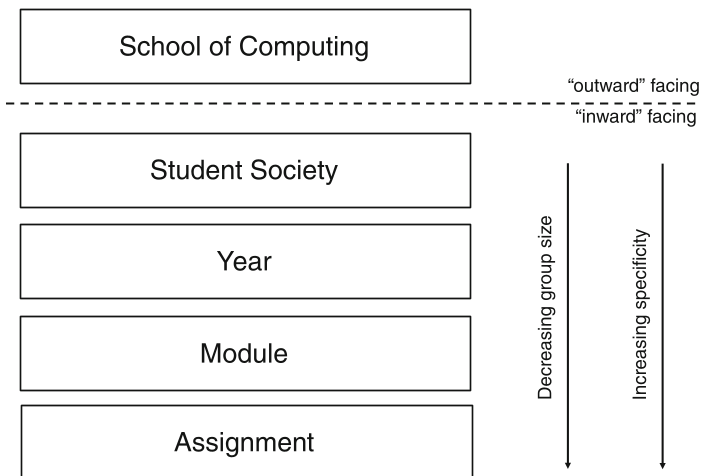 Figure 2: The hierarchical structure of groups used to increase specificity as group size decreases.
Key Insights: Why It Works
The study’s thematic analysis through focus groups yielded several critical insights:
- The "Social-Education Divide": Contrary to fears that Facebook would blur boundaries, students reported that the Group structure actually helped them compartmentalize. By posting in a "Module Group" rather than on their "Timeline," they avoided "annoying" their non-computing friends with technical jargon.
- Usability as a Pedagogy: Speed matters. The ability to ask a question and receive a peer or tutor response in minutes—within an app they were already using—reduced the cognitive load associated with traditional academic tools.
- Moderation & Ownership: The strategy involved student representatives as moderators. This "peer-policing" created a sense of community ownership and reduced the workload for faculty while maintaining a professional atmosphere (the "don't post what you wouldn't show your mum" rule).
Critical Analysis & Conclusion
Takeaway
The success of the Facebook strategy at Dundee isn't just about the technology; it's about Structural Alignment. By mirroring the institution's existing learning hierarchy, the strategy provides an intuitive UX that VLEs simply cannot match.
Limitations
- Sample Bias: The study focused on Computer Science (CS) students, who likely have higher technical literacy and different privacy expectations than students in other disciplines.
- Platform Dependency: Relying on a third-party platform like Facebook subjects the curriculum to the platform's algorithm changes and data policies.
Future Outlook
As social media shifts toward "dark social" (private messaging, Discord, and Slack), the principles outlined here—hierarchy, peer moderation, and reducing "clicks-to-content"—will be the blueprint for the next generation of Social Learning Environments. Educators must focus on where the students already are rather than forcing them into obsolete, institutional silos.