
Framing the Conversation: How Social Networks Turned Eyeglass Shopping into a Creative Community
Framing the conversation: the role of facebook conversations in shopping for eyeglasses
This paper presents a sociotechnical case study of the eyeglass retailer Warby Parker’s Facebook page, analyzing how customers utilize social media for collaborative decision-making. By examining over 10,000 interactions, the study highlights how "home try-on" programs transform shopping into a communal, creative, and socially-driven experience.
TL;DR
Shopping for eyeglasses was once a solitary medical errand; Warby Parker turned it into a Facebook event. This study analyzes over 10,000 social interactions to reveal how "home try-on" programs leverage friendsourcing and expert styling to drive purchases while providing a platform for creative self-expression.
Background Positioning
In the landscape of Human-Computer Interaction (HCI) and Social Computing, this paper serves as a seminal case study on Social Commerce. It moves beyond the "what" of social media marketing to the "how" of communal decision-making, sitting at the intersection of Q&A systems and retail psychology.
Problem & Motivation: The "Loneliness" of E-commerce
Why do we still go to physical malls? According to the authors, it’s for "entertailing"—the hedonic pleasure of bonding while shopping. Online retailers usually struggle to replicate this. While users often ask their Facebook friends for advice, response rates can be "sparing."
Warby Parker’s insight was to bridge this gap by encouraging users to post "Home Try-On" photos to their public page, creating a hybrid audience of:
- Close Ties: Friends and family who provide personalized, high-value feedback.
- Weak Ties: A community of fellow "fans" who offer unbiased stylistic opinions.
- Experts: Professional stylists who provide authoritative guidance.
Methodology: Decoding 10,000 Interactions
The researchers utilized the Facebook Graph API to capture three years of data (2010–2013). They didn't just look at text; they analyzed the composition of photos—ranging from simple selfies to elaborate "Instagram-style" collages.
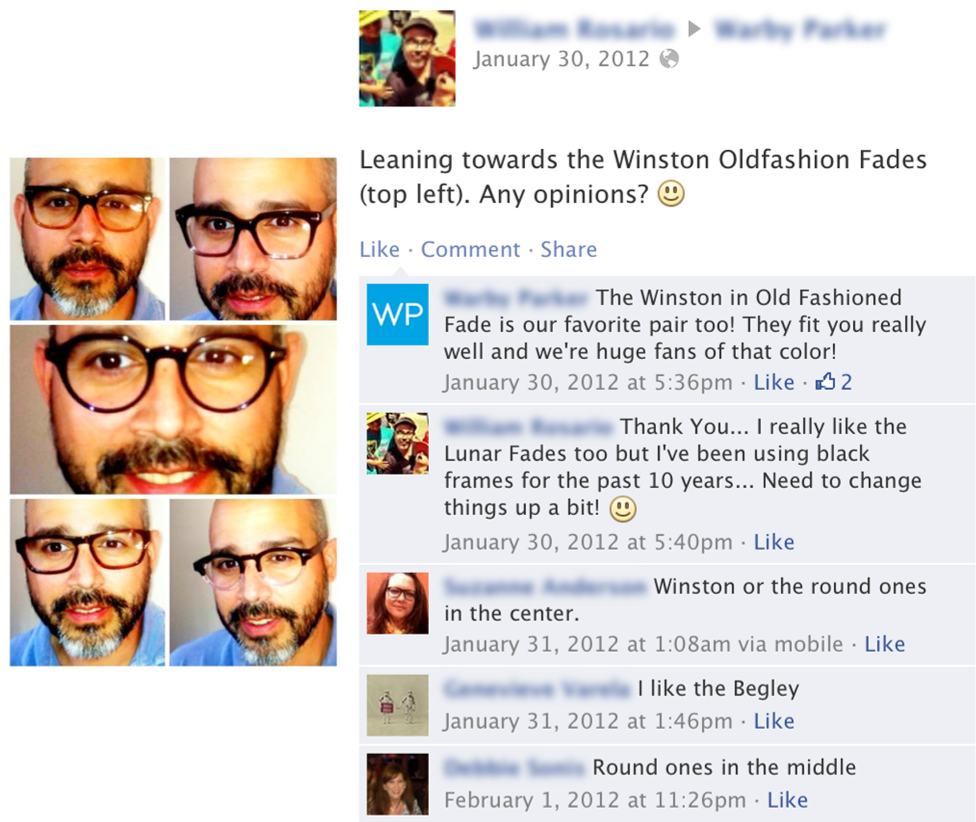 Figure 1: The standard workflow of a "Home Try-On" post: Sharing a collage to solicit advice through comments and likes.
Key Findings: The Power of Presence
The data revealed that this page wasn't just a bulletin board; it was a thriving ecosystem:
- Decision Support: 59% of messages were requests for advice.
- Self-Expression: Users didn't just take utilitarian photos; they used filters, wardrobe changes, and even posed pets or children in the frames.
- The Stylist as "Influencer": In a deep-dive of purchasing decisions, the authors found that if a Warby Parker stylist made a recommendation, the customer followed it 95.7% of the time, even over-riding the "votes" of their own friends.
 Figure 2: User creativity was high, featuring everything from children and pets to professional-grade collages.
Deep Insight: Roles and Relationships
One of the most profound takeaways is the relaxation of company-customer roles. Warby Parker doesn't act like a "corporation" posting ads; they act like a "family member" (as one user put it).
- Marketing through Participation: Instead of professional models, the "face" of the brand becomes real people in real environments.
- Low Friction: By using standard Facebook mechanisms (Likes/Comments), the barrier to entry is minimal, allowing various levels of engagement—from "one-click" voters to deep conversationalists.
Critical Analysis & Conclusion
This paper proves that social commerce is most effective when it focuses on the subjective experience rather than just factual Q&A.
Takeaway: Successful social retail platforms must provide tools for creativity (photo editing, voting) and maintain a "human" presence that bridges the gap between expert advice and peer support.
Limitations: The study relied on public data, missing private group conversations where much of the "close-tie" feedback likely occurs. Future research should look at how these dynamics translate to high-stakes assistive devices like wheelchairs or hearing aids, where the "medical" often overshadows the "fashionable."