
Facebook Data: The $10 Price Tag on Your Digital Life
Facebook Data: Sharing, Caring, and Selling
This study investigates the "Privacy Paradox" by analyzing participants' actual Facebook data packages in a lab setting. It employs a uniquely objective methodology to measure privacy behavior and evaluates how privacy education and financial incentives (willingness to sell) influence data sharing.
TL;DR
Researchers at ETH Zurich conducted a groundbreaking experiment by analyzing actual Facebook data packages rather than surveys. They found that while people claim to care about privacy, most are willing to sell their entire digital history for less than $10. Furthermore, attempts to educate users on privacy lead to a "mental budgeting" effect—users tighten security in one area only to become more reckless in another.
The Core Dilemma: Why Talk is Cheap
The "Privacy Paradox" has long puzzled social scientists: why do people who express deep concern about their data privacy continue to leak personal information for trivial rewards? Most previous research suffered from a fatal flaw—it relied on what people said they did.
This study breaks that mold by requiring participants to download their actual Facebook data in a lab. The researchers identified a massive disconnect: privacy behavior is not correlated with concern levels. In fact, some of those who felt most negatively about sharing information were the ones with the highest exposure scores.
Methodology: Peeking Under the Hood
The study utilized a two-session lab setup combined with a "Privacy Literacy" test (OPLIS) and an in-house parser.
- Quantifiable Exposure: Instead of vague "I post often," the team calculated an Exposure Score based on quantiles of actual data (number of likes, friend requests, and images).
- Psychological Intervention: A treatment group watched a video on how Facebook data can be used for profiling/inference to see if "fear" or "knowledge" changed their habits.
- The Selling Mechanism: Using the Becker-DeGroot-Marschak (BDM) value elicitation—a gold standard in behavioral economics—they forced participants to put a real price on their data.
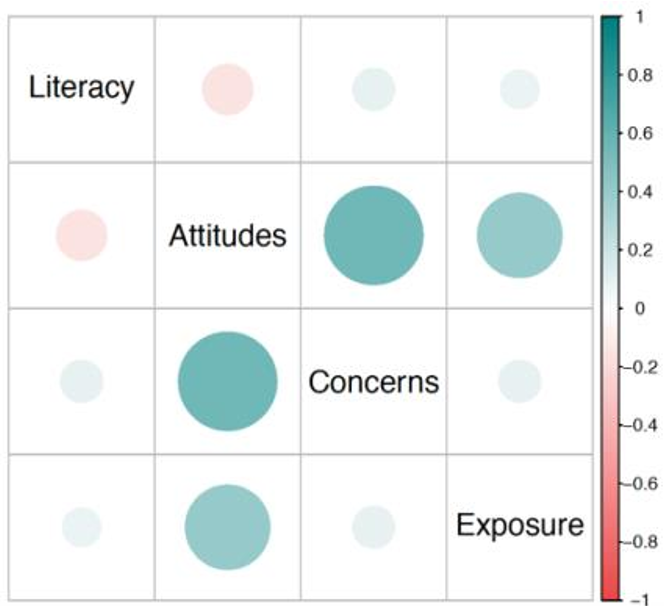 Fig 1. The disconnect between Privacy Concern and Exposure Score is visually evident in the low correlation coefficients.
Key Findings: The "Mental Budgeting" Trap
When the researchers tried to "fix" the problem through education, they encountered a strange phenomenon. The group that watched the privacy warning did indeed change their behavior—but not entirely for the better.
- The Good: They sent fewer private messages and stopped sending pictures via DM.
- The Bad: They logged in on more devices, "liked" more posts, and made more searches than the control group.
This suggests that humans treat privacy like a financial budget. If they "save" some privacy by rejecting a friend request, they feel they have "spare" privacy to spend on liking a public post. This mental budgeting issues makes traditional privacy education campaigns much less effective than previously thought.
What is Your Privacy Worth?
The most striking result was the Willingness to Sell (WTS). Despite claiming moderately high levels of concern, the majority of participants (63%) were happy to hand over their entire Facebook package to the researchers for money.
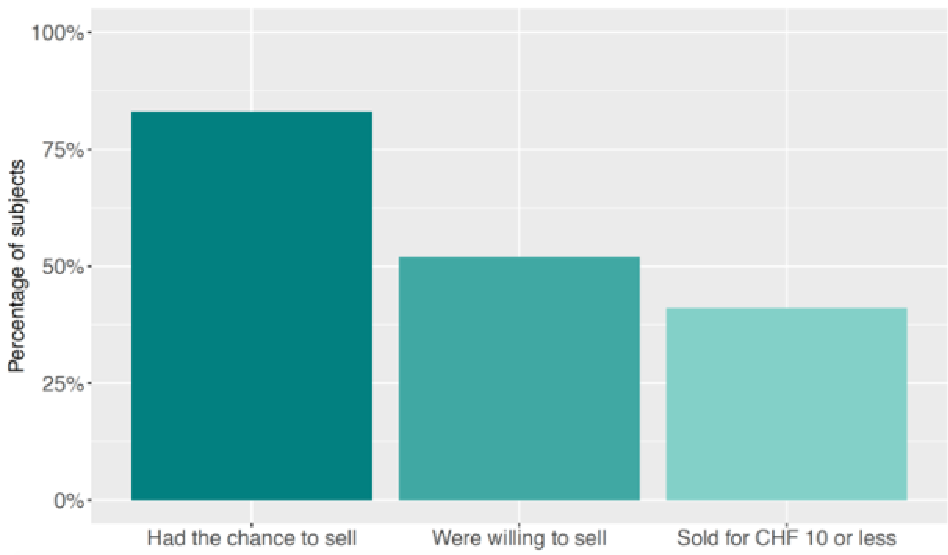 Fig 2. A staggering 79% of those willing to sell did so for 10 Swiss Francs (~$10) or less.
Critical Analysis & Takeaways
The study highlights a grim reality for privacy advocates:
- Institutional Trust matters more than Law: Participants knew a lot about "cookies" (technical literacy) but almost nothing about data protection laws (institutional literacy). They sold their data likely because they trusted the university's confidentiality.
- The $10 Ceiling: For the average user, years of digital footprints—private messages, locations, and likes—is worth no more than a fast-food meal.
- Limitations: As a pilot study with 46 students, the findings are a "canary in the coal mine." However, the lack of gender effect and the negative correlation with income (wealthier people value privacy slightly more) suggest that privacy is increasingly becoming a luxury good.
Conclusion: To protect users, we cannot rely on education alone. Because humans naturally "offset" their privacy-seeking behaviors, systemic platform-level protections are more vital than trying to bridge the "knowledge gap."