
Facebook e-court: Implementing Online Justice for the Social Media Era
Facebook e-court: Online justice for online disputes
This paper proposes "Facebook e-court," a specialized Online Dispute Resolution (ODR) system utilizing online arbitration to resolve user-to-user conflicts on social media. By leveraging Facebook's administrative control, it introduces both mandatory and voluntary models to handle "soft" disputes like defamation, privacy breaches, and social disagreements.
TL;DR
As social networks like Facebook become the primary arena for human interaction, they also become a breeding ground for unique legal and social conflicts. This paper proposes the Facebook e-court, an online arbitration system designed to resolve "user-to-user" disputes—such as defamation and privacy leaks—by utilizing the platform's power to enforce decisions through account management rather than traditional courts.
Problem & Motivation: The Law is Too Slow for the Internet
The digital world moves at light speed, but traditional law progresses at a glacial pace. The authors identify a critical gap: when one user defames another on Facebook, the victim has few viable options. Traditional litigation is expensive and often lacks jurisdiction over international users. Conversely, ignoring the problem allows permanent digital archives of insults to ruin lives.
The motivation behind this research is to create a "social community ethics" enforcement mechanism. The authors argue that since Facebook can block or delete accounts, it possesses the technological "sovereignty" needed to mimic a judicial system, making it the perfect host for an Online Dispute Resolution (ODR) system.
Methodology: The Architecture of Digital Arbitration
The paper outlines two distinct paths for justice:
1. The Mandatory Model
This is designed for serious disputes (e.g., harassment). It follows a structured legal process Adapted for the web:
- Notice: Defendants are notified via their Facebook wall/notifications.
- Tribunal Selection: A three-person panel where each party picks one arbitrator, and the system picks a neutral chair.
- Enforcement: Since Facebook controls the "identity," the award (e.g., a mandatory apology or account suspension) is enforced via the platform's specialized administrative tools.
2. The Voluntary Model (The "E-Court" App)
To test the human interest in this system, the authors developed a "gamified" application.
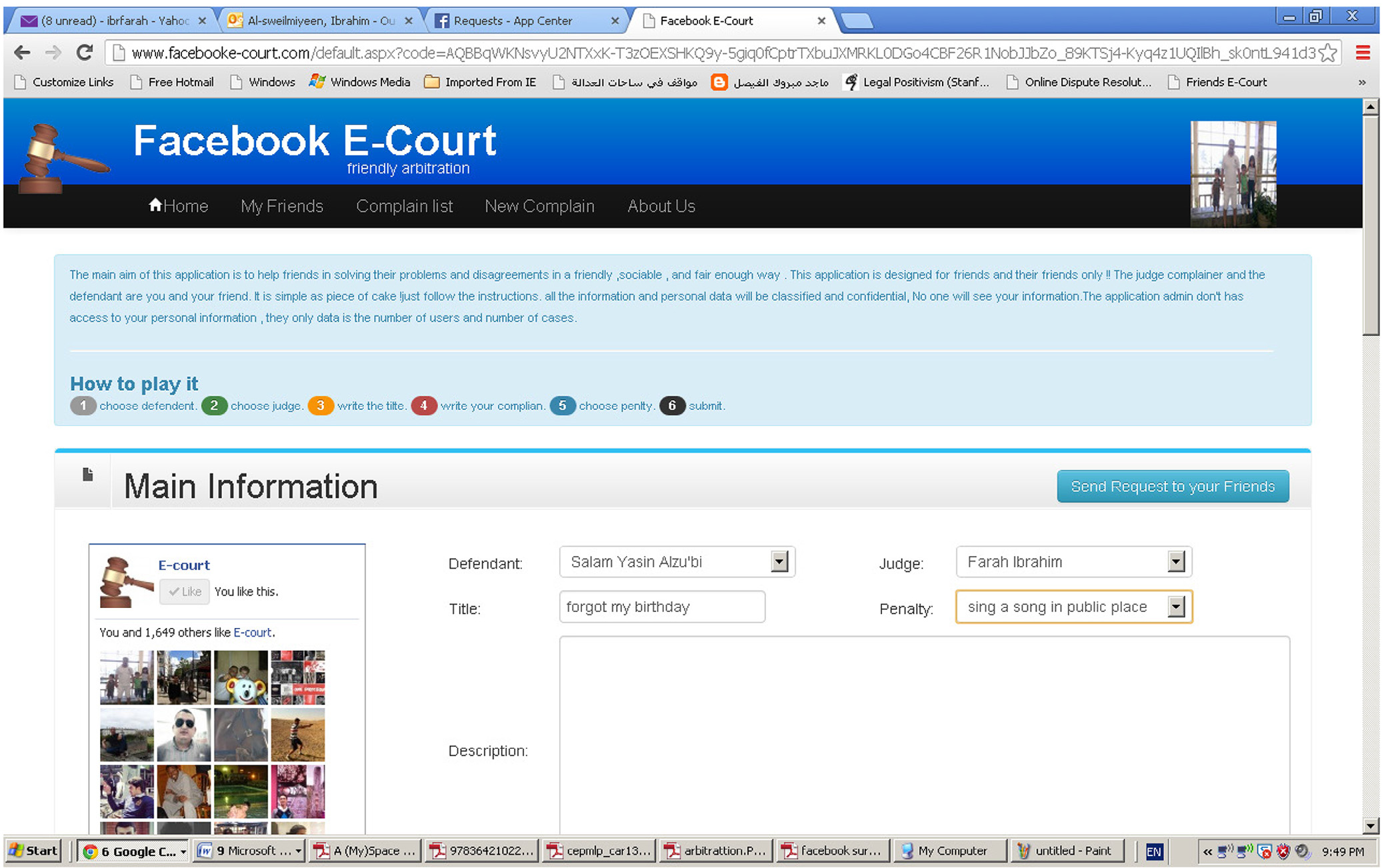 Caption: The user interface for selecting a friend to enter the arbitration process.
In this voluntary model, users choose a mutual friend to act as a "judge." It focuses on "soft disputes"—those minor social frictions (like being ignored or forgotten anniversaries) that don't belong in a real court but still cause social stress.
Experiments & Results: Crowdsourcing Justice
The authors launched a pilot version of the Facebook e-court. Within 60 days, the results were telling:
- Total Users: Over 330 active participants.
- Cases Resolved: 225 disputes successfully closed.
- Types of Disputes: 50 cases regarding borrowed items, 30 regarding dinner invitation slights, and 27 marital disputes.
- Efficiency: Average resolution time was just 3 days, compared to the months or years required by physical courts.
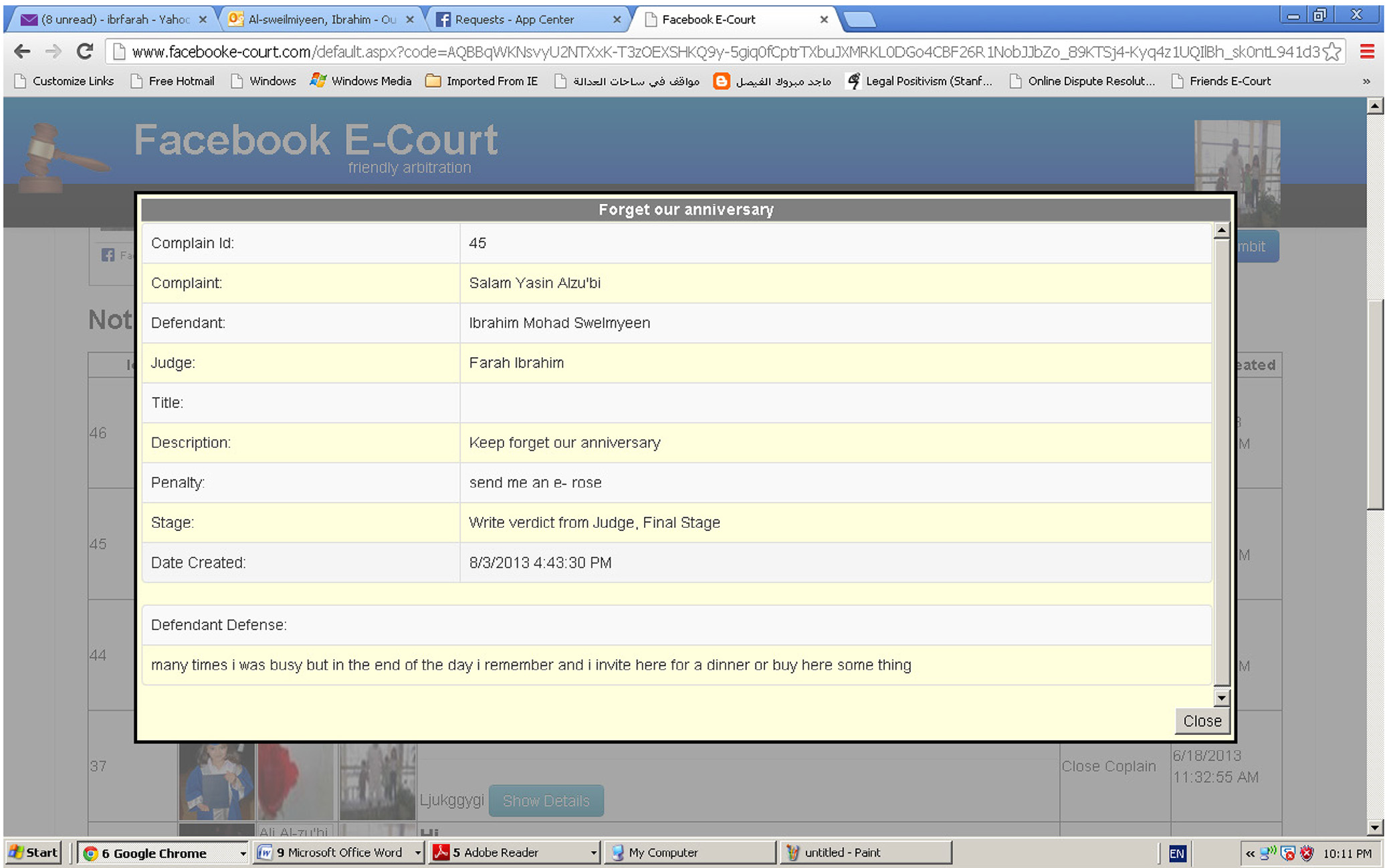 Caption: The "Judge Phase" where the arbitrator selects a penalty, such as a public apology or a digital gift.
The study found that users felt more comfortable having a "mutual friend" who understands the social context act as the arbitrator, rather than a detached legal professional.
Critical Analysis & Conclusion
The Facebook e-court represents a pivotal shift in how we view platform responsibility. By treating social networks as "islands" with their own policies and citizens, the authors provide a blueprint for semi-autonomous digital justice.
Takeaway: The success of the "gamified" pilot suggests a high social demand for formalizing peer-to-peer conflict resolution.
Limitations:
- Due Process: The paper acknowledges that "email notices" in arbitration have lower legal standards than litigation, which could lead to "default" judgments if users miss notifications.
- Scale: While the pilot worked for small groups, scaling this to 1.2 billion users requires massive automation and verified arbitrator pools to maintain impartiality.
Ultimately, this work suggests that for the internet to be a "trusted world," it must provide its citizens with a way to defend their reputations that is as fast and accessible as the platforms they inhabit.