
Facebook vs. WeChat: Why Culture is the Ultimate Architect of Interface Design
Is Facebook Easier to Use than WeChat?: A Critical Comparative Analysis of Interface Features of WeChat and Facebook
This study provides a critical comparative analysis of interface features between Facebook and WeChat using the Culturally Localized User Experience (CLUE) framework. It identifies how divergent design philosophies—Western individualism vs. Eastern collectivism—shape core functionalities such as status updates, official accounts, digital payments, and group interactions.
TL;DR
Is Facebook "easier" to use than WeChat? The answer isn't a simple "yes" or "no," but rather a reflection of where you live. This paper argues that the architectural differences between these two giants are not accidental but deep-rooted extensions of Western individualism and Eastern collectivism. From the way we post "Status Updates" to how we send "Red Packets," culture acts as the invisible hand guiding every pixel.
Contextual Positioning
In the world of Interaction Design (IXD), we often strive for "universal usability." However, this study by Pandey and Chen (2021) challenges that myth. By analyzing Facebook and WeChat through the CLUE (Culturally Localized User Experience) framework, the authors demonstrate that what feels "intuitive" in San Francisco might feel "limiting" in Shanghai.
The Problem: The Myth of the Universal Interface
Most UX research focuses on efficiency and error rates. However, traditional metrics fail to explain why Facebook Pay struggled to gain mass adoption while WeChat Pay effectively killed cash in China. The researchers point out that prior work has ignored how sociological forces—like the blurring of private and professional lives—influence whether a feature is adopted or rejected.
Methodology: The Interface as a Cultural Bridge
The authors analyzed four critical functional "sections" where the platforms diverge most sharply:
- Moments vs. Status: The psychology of sharing.
- Official Accounts: How businesses and users interact.
- Digital Currency: The ritualization of money.
- Group Chat: The hierarchy of communication.
1. Moments vs. Status: The "Face-Saving" Mechanic
WeChat’s "Moments" (Peng You Quan) is inherently minimalist and image-heavy. Interestingly, the paper links WeChat’s robust real-time photo editing to the Asian cultural concept of "face-saving" (mianzi).
- Insight: WeChat users utilize stickers and filters to "beautify" their lives to maintain high social esteem, whereas Facebook’s "Status" is more textual and neutral, reflecting a Western preference for directness.
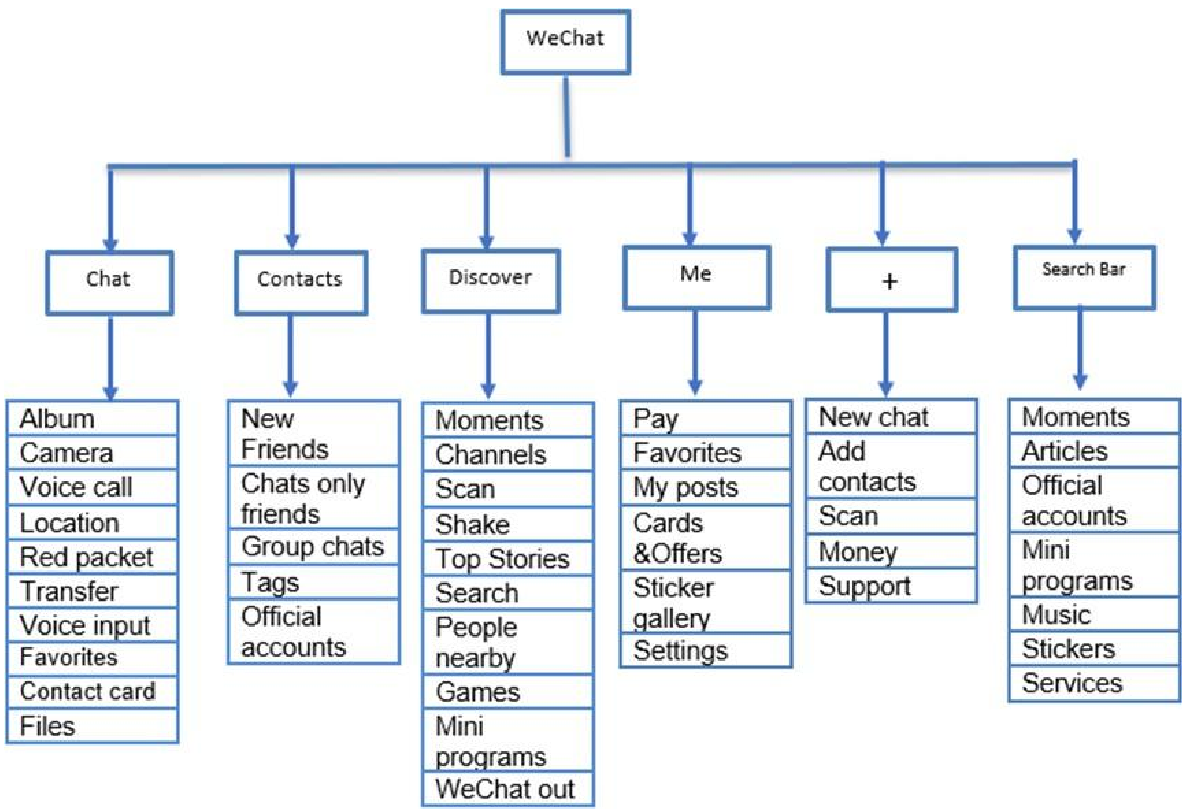 Figure: WeChat's minimalist design vs. Facebook's multi-modal status prompts.
2. Digital Currency: From Transactions to Social Rituals
Perhaps the most striking difference is the Red Packet (Hongbao).
- Facebook: Payments are functional, peer-to-peer transactions (Zelle-like).
- WeChat: Payments are social games. The "Luckiest Draw" feature in group chats turns a money transfer into a bonding ritual. This "special digital money" reflects the transition of physical cultural traditions into digital latent spaces.
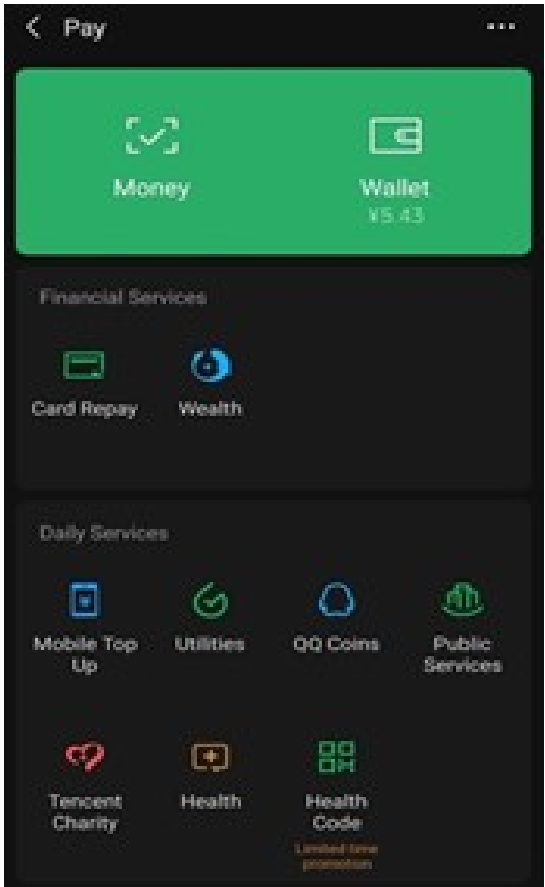 Figure: WeChat Pay's integrated wallet ecosystem.
3. The "Super-App" vs. The Specialized App
WeChat acts as a "Swiss Army Knife." Through Mini-Programs, it houses over 2.3 million sub-applications, from health tracking to government services.
- Western Logic: Prefers specialized apps (Venmo for money, Slack for work, Facebook for social).
- Eastern Logic: Prefers a "converged" landscape where professional and personal boundaries are intentionally blurred.
Experiments & Results: Cultural Driving Forces
The study concludes that WeChat’s mobile-first, image-centric orientation stems from early Chinese infrastructure (where mobile penetration vastly outpaced PC ownership in 2002).
- SOTA Comparison: While Facebook offers more "freedom" in account types, WeChat offers higher "integration" through Service Accounts and WeChat Work, making it indispensable for daily survival in China.
- Ablation of Features: The researchers found that "Group Settings" in WeChat (like "Sticky on Top") are vital for managing the high-pressure, always-on communication style typical of Chinese professional environments.
Critical Insight & Future Outlook
The Takeaway: Design is not just about aesthetics; it is an articulation of cultural meanings.
Limitations: The study relies heavily on the authors' decade-long user experience and existing literature. The "Phase Two" of this research will require large-scale user interviews to validate these cultural intuitions.
Future Outlook: As we move toward the "Metaverse," the question is: will these digital worlds be universal, or will we see a continue "glocalization" where virtual social norms are dictated by the physical heritage of the users? This paper suggests the latter is not just likely, but necessary for user adoption.