
The Facebook Paradox: Why We Use It Even When It Makes Us Miserable
Facebook’s emotional consequences: Why Facebook causes a decrease in mood and why people still use it
This research investigates the impact of Facebook use on emotional well-being through three psychological studies, revealing that active engagement leads to a significant decline in mood. The core contribution is the identification of "lack of meaningfulness" as a mediator and "affective forecasting error" as the reason for continued usage despite negative outcomes.
TL;DR
A seminal study from the University of Innsbruck reveals that Facebook use actively degrades your mood, primarily because it leaves you feeling like you’ve wasted your time on a meaningless activity. Despite this, we keep coming back due to an "affective forecasting error"—we falsely predict it will make us feel better.
Context: The Digital Waste of Time?
Since its inception, Facebook has been criticized as a "distraction," yet its growth to over a billion users suggested a powerful underlying motivation. While early research focused on social capital, Sagioglou and Greitemeyer pivoted to a more visceral question: How does it actually feel to use Facebook in the moment? They suggest that most Facebook activity (91%) is passive consumption, which lacks the social rewards of active communication and often triggers envy or social comparison.
The Core Conflict: Passive Consumption vs. Meaningfulness
The researchers hypothesized that the lack of meaning is the "silent killer" of user mood. In psychological terms, activities that lack a sense of purpose or utility fail to provide the hedonic or eudaimonic rewards necessary for well-being.
Methodology & Causality
To move beyond simple correlation, the authors conducted a randomized controlled trial (Study 2) with 263 participants.
- Group A (Facebook): 20 minutes of active use.
- Group B (Control - Browsing): 20 minutes of general web surfing (no social media).
- Group C (Control - Baseline): Immediate measurement.
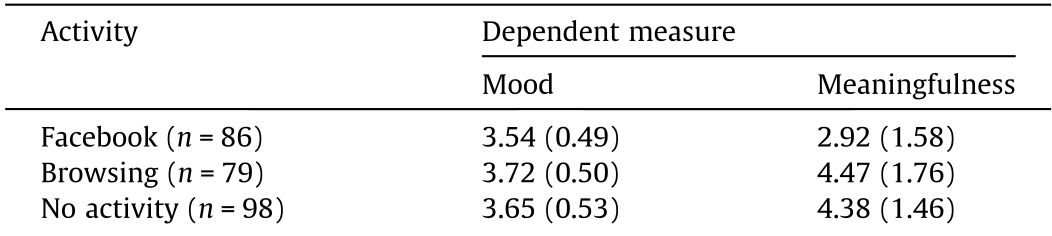 Table 1: Comparison of Mood and Meaningfulness scores across conditions.
The Discovery: The Waste-of-Time Mediator
The results were striking:
- The Mood Drop: Participants in the Facebook group reported lower mood scores compared to both the browsing and neutral groups.
- The "Meaning" Gap: The Facebook group felt their time was significantly less meaningful (M = 2.92) than the browsing group (M = 4.47).
- The Mechanism: Through mediation analysis, the authors proved that the decrease in mood was almost entirely explained by the feeling of having wasted time. Interestingly, browsing the general web did not produce this effect, suggesting there is something specifically "un-meaningful" about the social media feed.
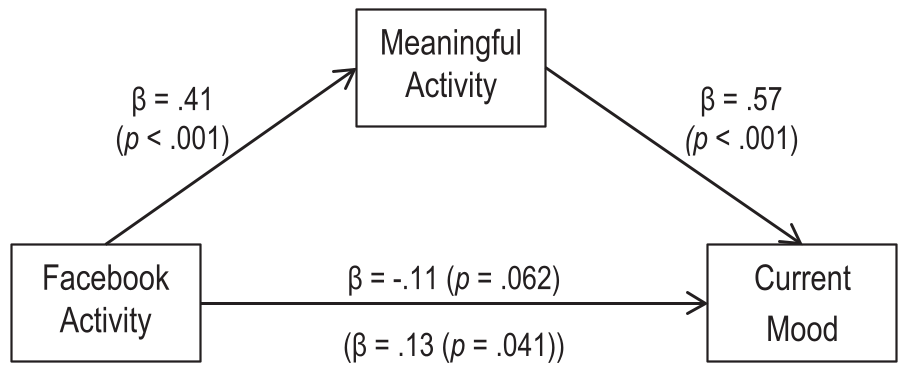 The statistical path showing how Facebook use leads to lower mood through reduced meaningfulness.
The "Why": Why Do We Keep Logged In?
If Facebook makes us feel like we’ve wasted our lives and dampens our spirits, why haven't we all deleted our accounts?
The authors identify an Affective Forecasting Error. In Study 3, they asked users to predict how they would feel after 20 minutes on Facebook. Participants overwhelmingly expected to feel better (6.10 on a scale of 10). Because our brains selectively remember rare positive interactions or are driven by biological needs like "social grooming," we fail to accurately recall how mundane and draining the average browsing session actually is.
Critical Insight & Future Outlook
This paper is a cornerstone for understanding Digital Well-being. It suggests that the "infinite scroll" may be a trap built on a cognitive glitch.
- Limitations: As an online study, the researchers couldn't monitor exactly what users looked at (e.g., hate-scrolling vs. looking at baby photos).
- Future Work: The industry must ask—can social networks be designed to feel "meaningful" rather than just "engaging"? Until then, users should be aware that their next 20-minute session likely won't deliver the happiness they predict.
Takeaway: We are poor judges of our own digital happiness. If you feel a mood drop after scrolling, it’s not just you—it’s a statistically proven byproduct of a platform that feels like a waste of time.