
Deciphering the Facebook Habit: Flow, Motivation, and the Seniority Paradox
Facebook Engagement—Motivational Drivers and the Moderating Effect of Flow Episodes and Age Differences
This paper presents an integrated model of Facebook engagement, identifying enjoyment, self-disclosure, and community identification as primary motivational drivers. Using Partial Least Squares (PLS) analysis on a sample of active users, the study achieves a robust validation of how these motivations translate into multidimensional engagement (cognitive, emotional, and conative) and subsequent patronage.
TL;DR
Why do we stay on Facebook? This study moves beyond simple "usage" to analyze the anatomy of Facebook Engagement. By modeling engagement as a bridge between internal motivations (like self-disclosure) and long-term patronage, the researchers reveal that "Flow" states act as a catalyst for enjoyment, and unexpectedly, that engagement is a far more powerful predictor of loyalty for older users than for the youth.
Background: Beyond the "Like" Button
In the academic coordinate system, this work sits at the intersection of Media Psychology and Consumer Behavior. It moves the needle from "What do people do on Facebook?" to "Why does doing it make them stay?" By viewing engagement as a multidimensional mechanism (Cognitive, Emotional, and Conative), the authors provide a sophisticated lens to view the digital social experience.
The Problem: The Missing Link in Engagement
Current literature is fragmented. Marketing research focuses on brand loyalty, while psychological research focuses on the "Uses and Gratifications" (U&G) of social media. The "Missing Link" is the interaction between these motivations and the subjective state of the user. For instance, why does the same content engage one person but not another? The authors argue the missing variables are Flow (the state of being "lost" in an activity) and Age-related priorities.
Methodology: The Integrated Structural Model
The authors propose a "Motivation-Engagement-Patronage" framework. They utilized a sample of 407 active users and applied Partial Least Squares (PLS) Structural Equation Modeling.
The Research Hypotheses
Instead of viewing engagement as a flat metric, the model treats it as a Second-Order Molar Construct. This means it’s a synergy of how much you think about the platform (Cognitive), how it makes you feel (Emotional), and how much you interact (Conative).
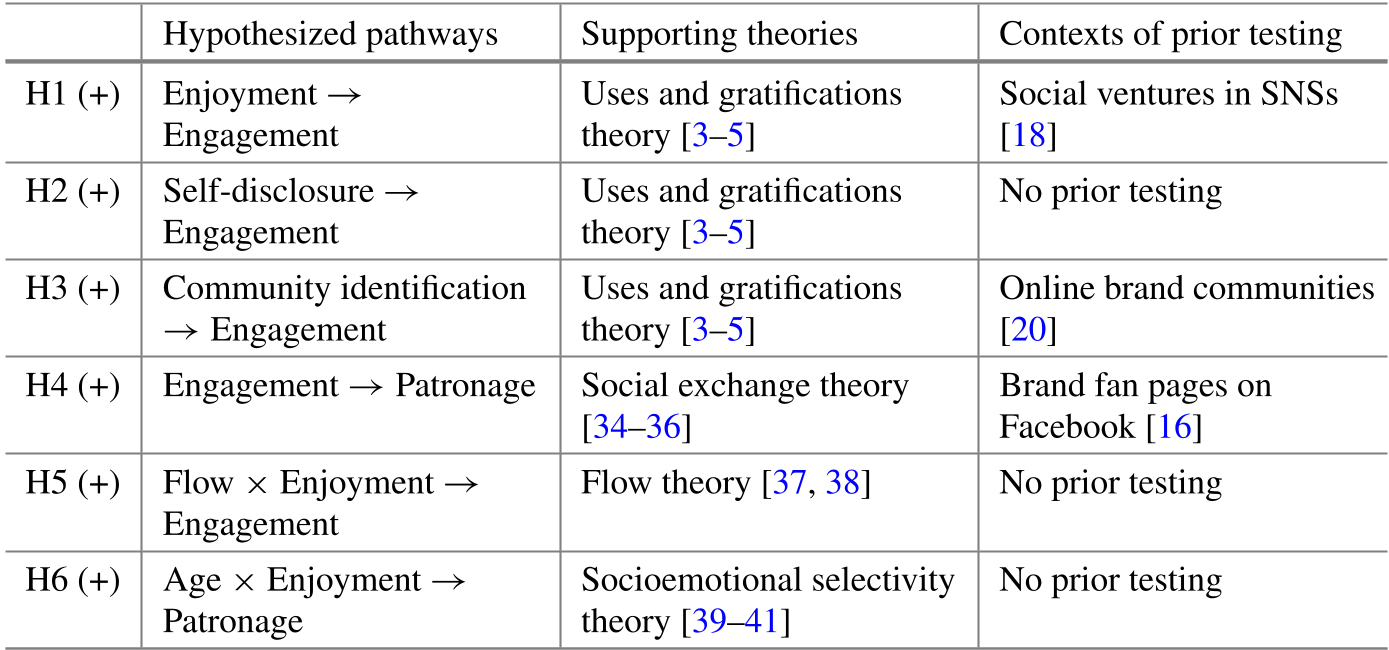 Table 1: The theoretical roadmap connecting motivations like Self-Disclosure and Community Identification to Engagement.
Key Insights: Flow and Aging
1. The "Flow" Force Multiplier
The study finds that when users experience "Flow"—a state of optimal immersion—the relationship between Enjoyment and Engagement becomes significantly stronger. If a user is just "browsing," enjoyment has a moderate impact. If they are in "the zone," that enjoyment translates directly into deep, multi-faceted engagement.
2. The Seniority Paradox
Drawing on Socioemotional Selectivity Theory, the researchers found that as people age, they prioritize emotionally meaningful goals. The data showed that for older users, a high level of engagement is a much stronger predictor of continued patronage than for younger users. Younger users may engage out of habit or social pressure, but for older users, engagement is a conscious investment in social value.
 The model illustrates the causal flow from psychological drivers to behavioral patronage, moderated by flow and age.
Experiments & Results: Quantifying the Bond
The results confirm that:
- Community Identification (β = 0.26) is the strongest driver of engagement. Users don't just use Facebook; they use it to belong.
- Engagement to Patronage (β = 0.91): The link between being engaged and staying on the platform is nearly linear, showing that "Engagement" is the single most important metric for platform health.
- The Age Effect: The negative interaction coefficient for age (β = -0.32) suggests that while young people might use the platform regardless of deep engagement, older users require that emotional and cognitive "hook" to remain loyal.
Critical Analysis & Future Outlook
Takeaway
This paper serves as a blueprint for platform designers. To keep users, don't just provide "tools"; facilitate "Flow" and foster "Community Identity."
Limitations
The study relies on a snowball sample from Spain, which may have cultural specificities. Furthermore, the self-reported nature of "Flow" can sometimes be subjective.
Future Work
The authors hint at a future move toward Artificial Neural Networks (ANN) to analyze these relationships, moving from linear structural modeling to non-linear predictive AI. This could allow for person-specific "Engagement scores" based on real-time behavior.