
Beyond the Screen: Unpacking Why We Really Play Social Network Games
Players of facebook games and how they play
This study investigates the motivations and behaviors of Social Network Game (SNG) players on Facebook using the Uses and Gratifications (U&G) framework and Social Cognitive Theory. By surveying 164 players, the authors identified four distinct motivations and seven types of play, emphasizing that habit is a stronger predictor of usage time than social outcomes.
TL;DR
A study of Facebook game players reveals that despite being labeled "social," most users play to kill time or cope with stress rather than to interact with others. While "habit" is the primary driver of play duration, social motivations—when present—split into meaningful "Common Ground" building and purely instrumental "Reciprocity" triggered by game design.
Background: The SNG Paradox
Social Network Games (SNGs) like FarmVille or Texas HoldEm redefined the gaming landscape by leveraging existing social graphs. However, are they truly "social"? This paper moves beyond the hype to categorize the psychological drivers and behavioral patterns of SNG users, positioning the study at the intersection of mass communication and game design.
Problem & Motivation: The "Social" Misnomer
Before this study, researchers often struggled to explain why millions of people engaged in seemingly repetitive, low-challenge tasks. The authors argue that prior work oversimplified "socializing." They hypothesized that what we call "social play" is actually a mix of two distinct drives:
- Common Ground: A desire to share experiences with real-life friends.
- Instrumental Reciprocity: A reaction to game mechanics (e.g., "I send a gift only because the system gives me one back").
Methodology: Unpacking the Play
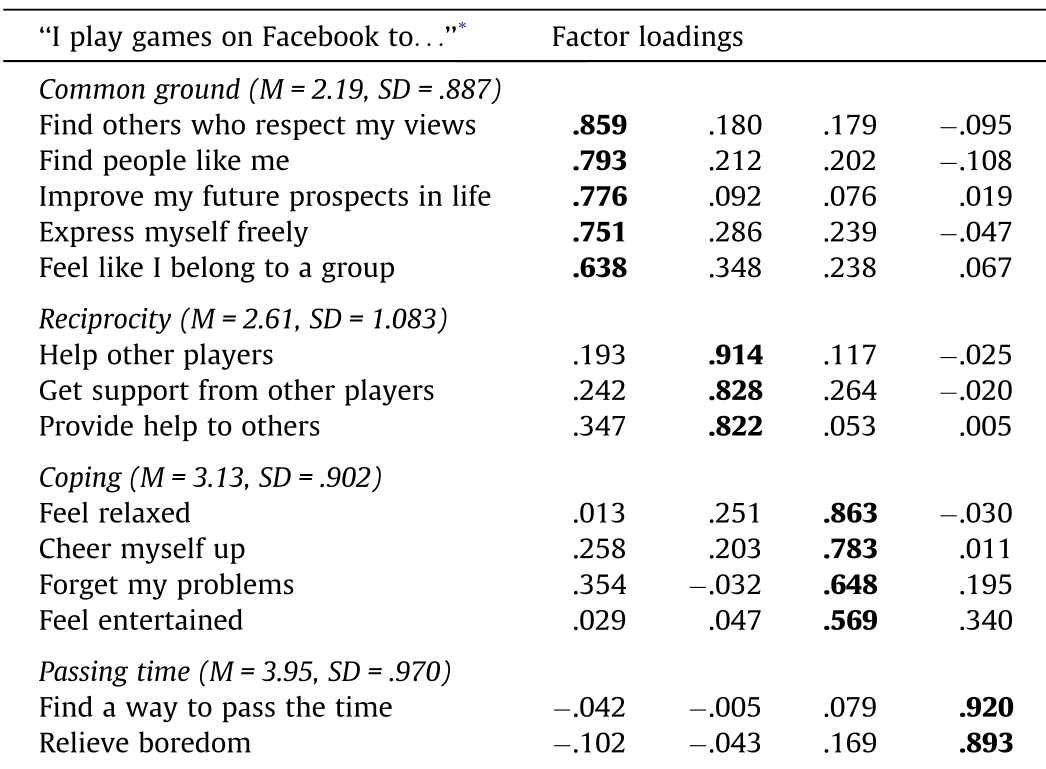
Using a survey-based approach enriched by Social Cognitive Theory, the authors identified four primary "Expected Outcomes" (Motivations) and seven "Uses" (Behaviors).
The Four Motivations
- Common Ground: Building shared topics with acquaintances.
- Reciprocity: Exchanging help/gifts to progress.
- Coping: Relaxing or forgetting problems.
- Passing Time: Relieving boredom.
The Seven Types of Play
The authors identified how these motivations translate into actual actions, ranging from Avatar/Space Customization to Advancement and Publishing achievements.
Key Findings: Habit Over Heart
The most striking result is that social motives are actually the least common reasons for playing. Passing Time (M=3.95) remains the dominant driver.
The Power of Habit
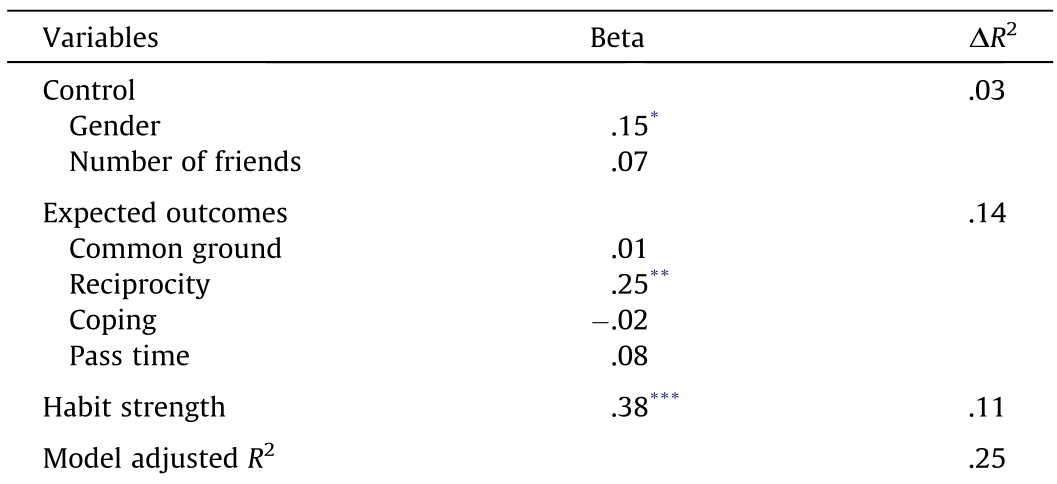
Through hierarchical regression, the study proved that Habit Strength (β = .379) is the single most accurate predictor of how much time a user spends in the game. If it's part of your daily routine, you play longer, regardless of whether you are actually "having fun" or "socializing."
Gender and Culture
- Gender: Women were found to use SNGs more for Coping and dedicated more effort to Space Customization and Gifting.
- Culture: Interestingly, Asian participants scored higher on the Common Ground motivation, suggesting that collectivist cultures view these games as more vital social tools than their Western counterparts.
Deep Insight: "Mechanical" Gifting
The study highlights a fascinating overlap between Gifting and Mechanics. In SNGs, gifting isn't necessarily a sign of affection; it's an instrumental calculation. Players give gifts because the game's economy makes it the most efficient way to level up. This "system-facilitated reciprocity" suggests that SNGs aren't just games; they are cleverly designed social scripts that force interaction through self-interest.
Critical Analysis & Conclusion
Takeaway: If you want to build a successful social game, don't just focus on "fun." Focus on "habit" and "coping." The most successful SNGs are those that provide a low-friction way to kill time and offer "instrumental social" features that let players feel connected without the high emotional cost of real-time interaction.
Limitations: The study relies on self-reported data and focuses on the Facebook era. Today’s landscape with TikTok-integrated games and synchronous mobile play might show a shift back toward more active social components.
Future Outlook: For designers, the distinction between Avatar and Space Customization is crucial. The study shows these are distinct psychological behaviors; "Space" (the digital home) is often a more potent tool for social expression and coping than the "Avatar" (the digital self).