
Decoding Why We Share: A Deep Dive into Facebook Groups' Knowledge Culture
A study of Facebook Groups members’ knowledge sharing
This study investigates the determinants of knowledge sharing behavior within Facebook Groups, proposing a research model that integrates extrinsic motivation, social-psychological forces, and social networking sharing culture. Using Partial Least Squares (PLS) analysis on 271 participants, the research identifies that reputation, self-worth, and a specific sharing culture (fairness, identification, and openness) are critical drivers of sharing intention.
TL;DR
Why do people spend hours answering questions in niche Facebook Groups for free? This study reveals that it isn't about "making friends" (Expected Relationships) as once thought. Instead, it is driven by a potent mix of Reputation, a deep-seated Sense of Self-Worth, and a specific Sharing Culture defined by fairness and openness.
Background Positioning
In the landscape of Knowledge Management (KM), most theories are built for the office. But Facebook Groups represent a "Third Space"—voluntary, non-monetary, and digital-first. This paper bridges the gap between the Theory of Planned Behavior (TPB) and the wild west of social media, providing a blueprint for community sustainability.
The "Motivation Gap": Organizations vs. Social Networks
In a corporate office, you share knowledge because it's in your job description or you want a promotion. In a Facebook Group, those levers don't exist. Prior work by Bock et al. (2005) suggested that "Expected Relationships" were key, but this study uncovers a surprising shift: in virtual groups, people care more about their perceived value (Self-Worth) than actual networking.
Methodology: The Structural Model
The researchers utilized a Second-Order Factor model to define Social Networking Sharing Culture. This isn't just a vague vibe; it is mathematically composed of:
- Fairness: Are all members treated equally by admins?
- Identification: Do I say "we" or "they" when talking about the group?
- Openness: Is new knowledge actively encouraged?
 Figure 1: The proposed research model connecting psychological forces to sharing intention.
Key Insights & Experimental Results
Using 271 valid survey responses and PLS-SEM analysis, the study produced several "Aha!" moments:
- The Death of "Networking": Hypothesis H3 was rejected. Unlike physical offices, Facebook users don't necessarily share knowledge to "make more friends" or "establish future cooperation." The digital barrier makes these connections feel less tangible.
- Self-Worth is King: H4 and H5 were strongly supported. When a user feels their post helped someone solve a problem, their "Sense of Self-Worth" skyrockets, which is the strongest internal driver for continued sharing.
- Culture as a Catalyst: Sharing culture was the most significant predictor of intention (). If the group feels unfair or closed-off, no amount of personal reputation will keep a user engaged.
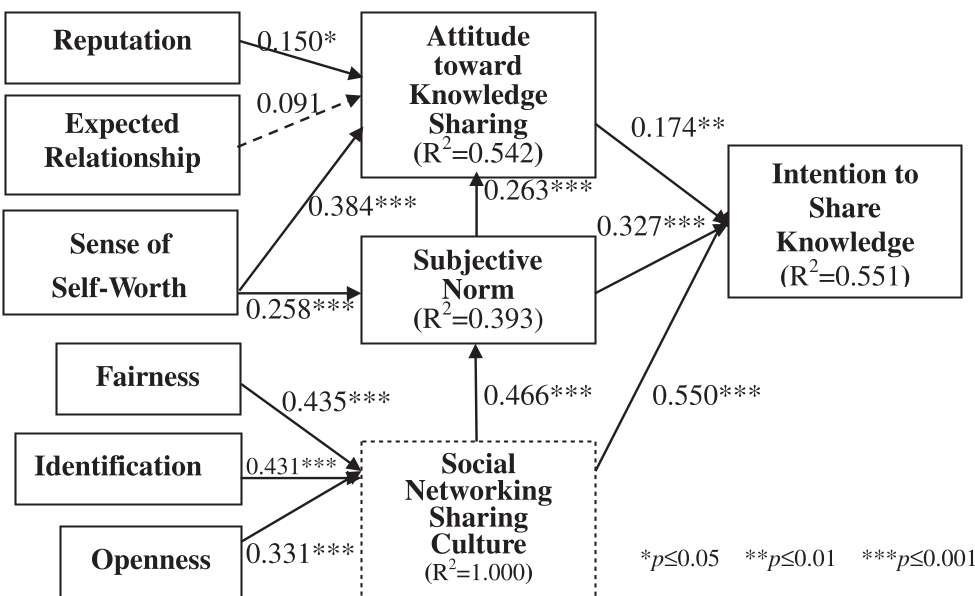 Figure 2: Path coefficients showing the strength of influences on sharing intention.
Critical Analysis & Takeaways
Why this matters for Product Managers and Community Leads:
- Stop focus on "Networking" Features: Users in large groups are there for the knowledge, not the coffee-chat. Focus on features that highlight expertise.
- Institutionalize Reputation: Systems like "Group Experts" or "Top Contributors" are not just vanity metrics; they directly feed the "Reputation" factor that drives sharing attitude.
- Admin Fairness is the Foundation: The study shows that if admins show favoritism (low Fairness), the entire "Sharing Culture" collapses, leading to a "Lurker" majority rather than a contributor community.
Limitations
The study heavily skewed toward the 20-29 age demographic (82.7%). Professional knowledge sharing among older experts (40+) might follow different socio-economic incentives, such as consulting leads or legacy building, which warrants further investigation.
Conclusion
Knowledge sharing on Facebook is an act of psychological exchange. While we may not get paid, the "currency" of reputation and self-worth, topped with a fair and open culture, is enough to keep the world's largest information repository growing.
Keywords: Facebook Groups, Knowledge Sharing, Social Exchange Theory, PLS-SEM, Virtual Communities.