
Could Facebook Influence Municipal Elections? Insights from the Tunisian Case Study
Could Facebook Influence Municipal Elections? Tunisian Case Study
This paper investigates the correlation between Facebook engagement and the 2018 Tunisian municipal election results. Using a custom sentiment analysis tool (MARLISET), the authors analyzed 178 candidate lists in the Nabeul governorate, revealing that while social media metrics are strong indicators for independent candidates, they lack predictive power for established political parties.
Executive Summary
TL;DR: Does a "Like" on Facebook translate to a vote in the ballot box? This study analyzes the 2018 Tunisian municipal elections—the first major test of decentralization since the revolution. By examining 178 candidate lists in the Nabeul governorate, the researchers found that while Facebook interaction is massive, its power to predict winners is highly dependent on the "brand" of the candidate.
Context: This work sits at the intersection of Social Computing and Political Marketing. It moves beyond the anecdotal "Twitter Revolutions" narrative to provide empirical, data-driven proof of how digital footprints correlate with democratic outcomes in a nascent democracy.
The Problem: The Noise of Cyber-Activism
Since the 2011 Jasmine Revolution, Facebook has been the "strategic tool" for mobilization in Tunisia, boasting over 6.4 million users by 2018. However, political scientists have struggled to determine if high engagement (likes, shares, comments) is a leading indicator of victory or just background noise.
The challenge is two-fold:
- The Language Barrier: Most Tunisians interact using Darija (Tunisian dialect), which blends Arabic, French, and Latin scripts (Arabizity), making standard Sentiment Analysis tools useless.
- The Institutional Bias: Established political parties have "pre-anchored" supporters whose online behavior may not change their offline voting intent.
Methodology: Decoding the Tunisian Dialect
To solve the linguistic problem, the authors built MARLISET (Mixed ARabic LIbrary for SEntiment analysis in Tunisian dialect).
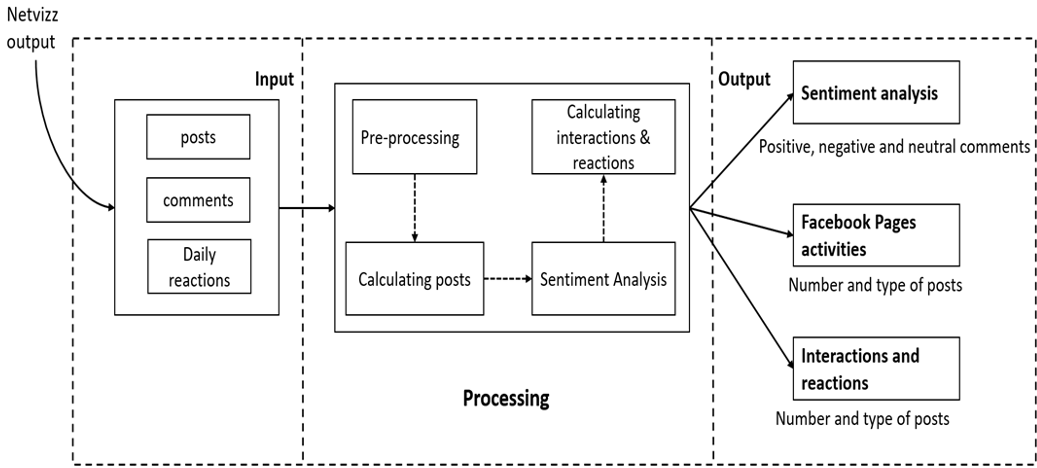
The researchers categorized 178 lists into Political Parties, Independent Lists, and Coalitions. They extracted data using the Facebook API (Netvizz) and analyzed:
- Volume: Followers, posts, and total reactions.
- Sentiment: Positive vs. Negative interactions in Tounsi.
- Correlation: Using Spearman’s Rank Coefficient () to map Facebook metrics against official ISIE election results.
Key Findings: The "Independent" Advantage
The study produced a startling contrast between different types of political entities:
1. Macro-Level Correlation
When looking at the big picture, the correlation is perfect (). Political parties dominate both Facebook activity and the total vote count, followed by independents and then coalitions.
2. The Micro-Level "Independence" Effect
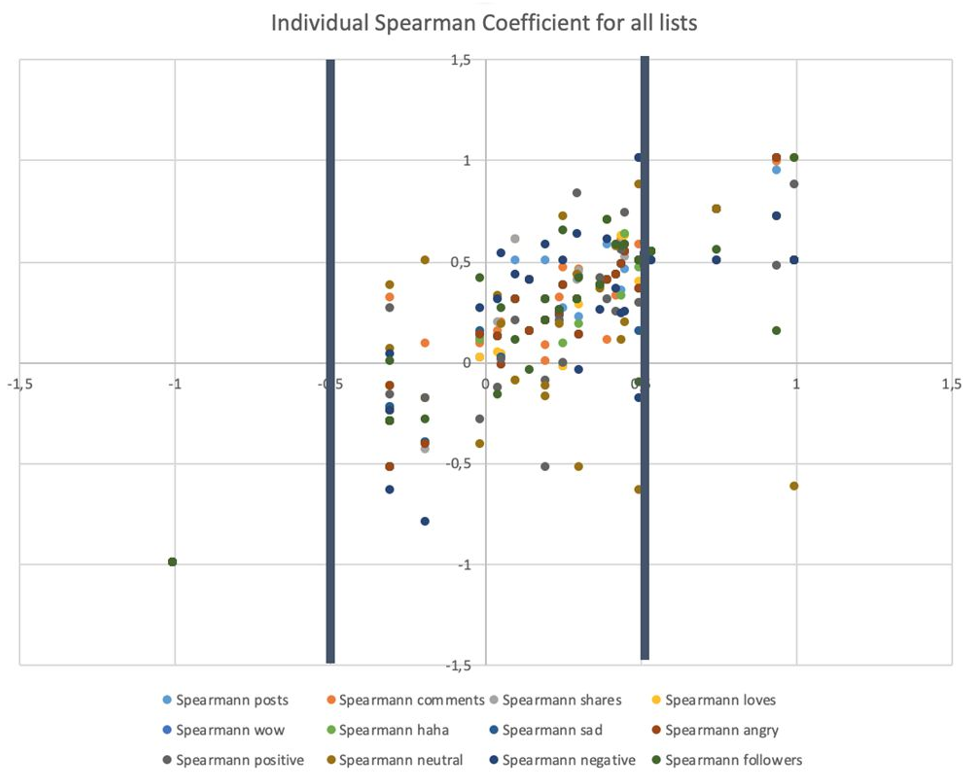
When diving into individual municipalities, the correlation for Political Parties effectively vanishes. However, for Independent Lists, the data tells a different story.
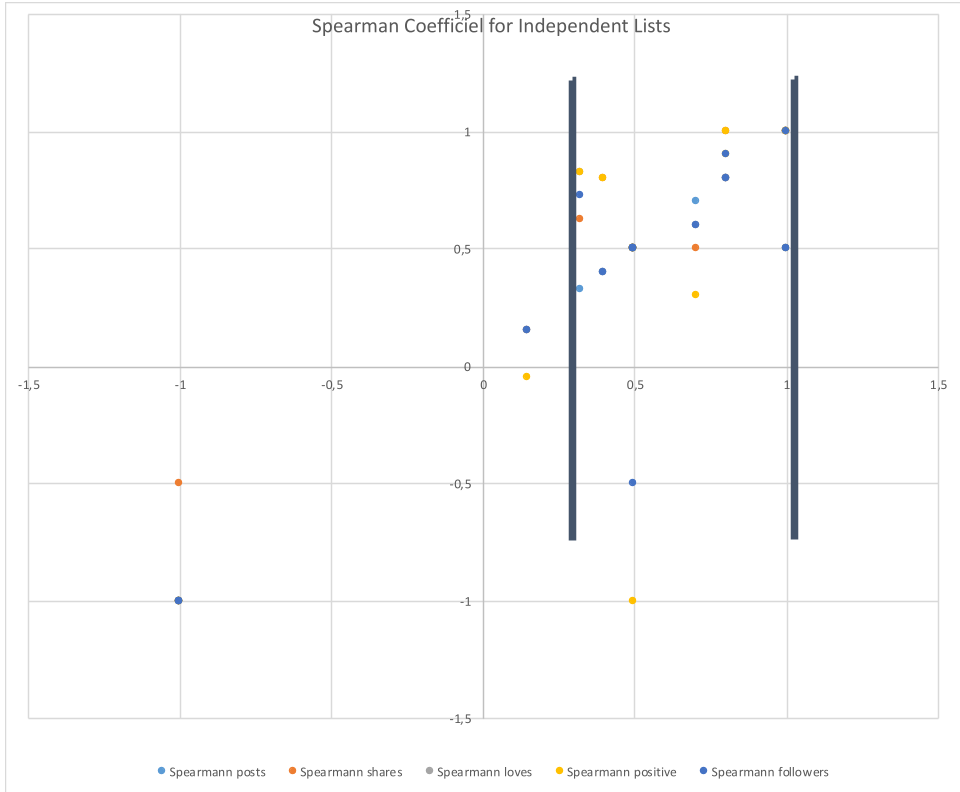
As shown in the chart above, independent candidates see a much higher correlation between their digital presence and their final ranking.
Why? The authors argue that voters use Facebook as an "objective" discovery tool for newcomers. If an independent list lacks a Facebook page, they almost invariably finish last. For voters, the digital profile of an independent is their primary resume.
Critical Analysis & Takeaways
Visual Evidence: Interactions vs. Votes
The data shows that independent lists achieved the highest percentage of positive reactions (88.07%), suggesting that their followers are more "genuine" sympathizers compared to the polarized interactions seen on party pages.
Conclusion
The study concludes that Facebook is a valid predictor for political outsiders but a poor one for institutional giants.
Limitations:
- Demographic Gap: 60% of Facebook users are under 34, while the majority of actual voters are over 35.
- Connectivity: Rural areas with poor internet coverage may reflect voting patterns that social media cannot capture.
Future Outlook: For future "cyber-activism" research, the focus must shift from "how many likes" to "who is liking." As digital literacy grows, the ability of social media to act as an "equalizer" for independent voices in emerging democracies will likely strengthen.