
Facebook Inspector (FbI): Shielding Users from Real-Time Social Media Threats
Facebook Inspector (FbI): Towards automatic real-time detection of malicious content on Facebook
This paper introduces Facebook Inspector (FbI), a real-time browser extension and REST API designed to detect malicious content on Facebook using public features. By analyzing 4.4 million posts across 17 major news events, the authors developed a dual-model supervised learning approach that achieves over 80% accuracy in identifying spam, phishing, and untrustworthy content that evades Facebook’s internal "Immune System."
TL;DR
Researchers have developed Facebook Inspector (FbI), a browser plugin that detects malicious Facebook posts in real-time. Unlike Facebook's native filters, which often miss over 60% of event-driven scams, FbI uses a dual-model approach to catch threats within 3 seconds of them appearing on a user's feed, using only publicly available metadata.
The Background: Why Facebook's "Immune System" is Failing
When a major event happens—be it the FIFA World Cup or a natural disaster—social media activity spikes. Cybercriminals exploit this "news-making" window to spread phishing links, malware, and hoaxes.
The paper reveals a startling reality: 65.05% of malicious posts identified in their study remained on Facebook four months later. Why?
- Blacklist Lag: Traditional security relies on blacklists (like Google Safebrowsing), which are often blind to new URLs for the first 24 hours.
- Cold Start Problem: Most research models require "engagement" data (likes/shares) or "campaign" data (similarity to other posts). By the time a post has enough likes to be "suspicious," the damage is already done.
Methodology: The Two-Fold Defense
The authors realized that "malicious" is a broad term. A link might be a technical threat (malware) or a social threat (fake news/spam). To combat this, they built two separate supervised learning engines:
- Model I (The Technical Filter): Trained against 6 major URL blacklists.
- Model II (The Quality Filter): Trained against 25,500 human-annotated judgments to catch "untrustworthy" posts that blacklists miss.
44 Features of Malice
The system analyzes 44 features in real-time. Interestingly, the authors found that Facebook.com URLs are often indicators of legitimate content in this context, while third-party apps and unusually long text messages are red flags for malicious activity during news events.
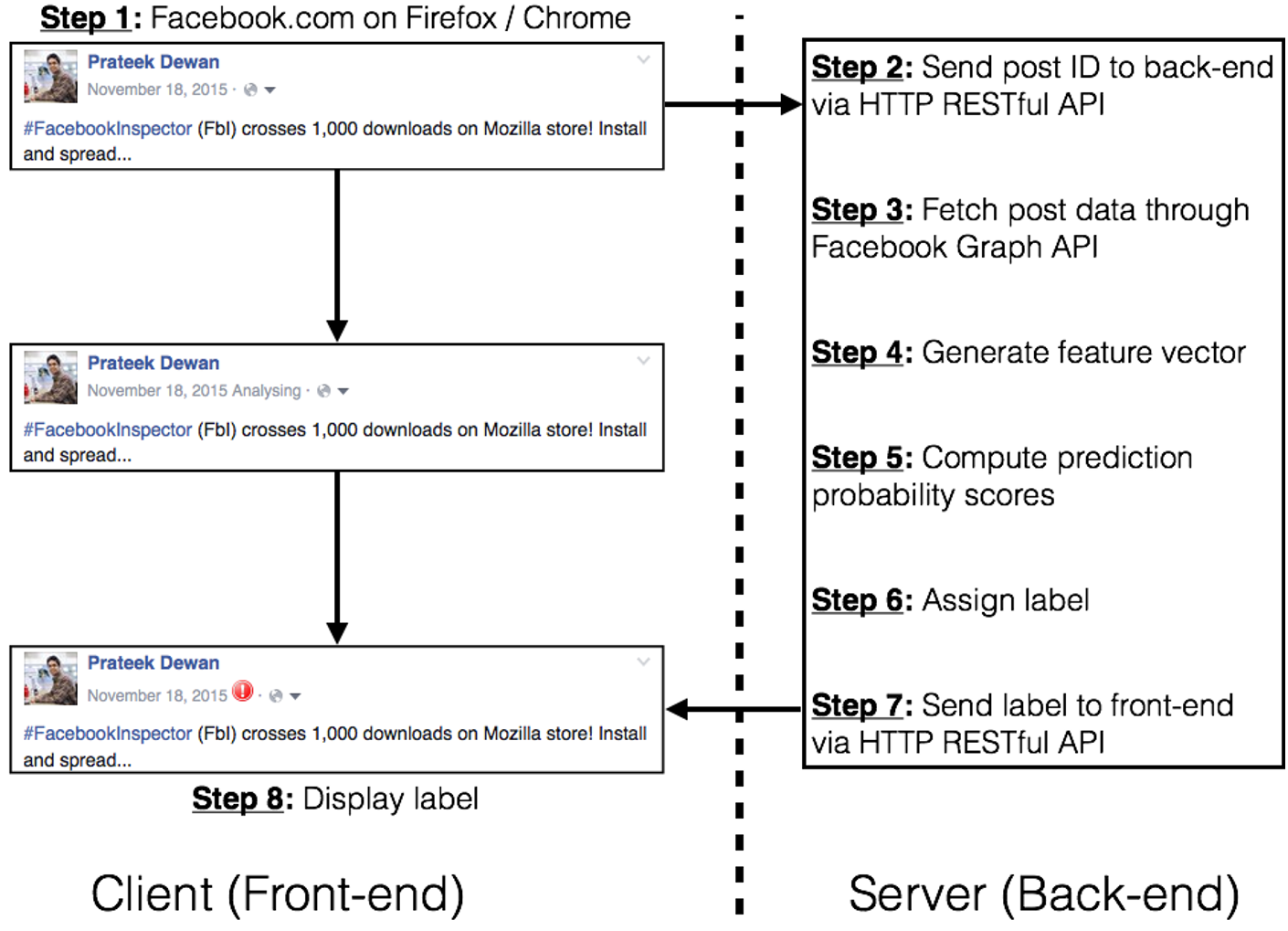 Figure: The architecture of FbI, showing the parallel processing between the browser and the REST API.
Critical Insight: Event-Specific vs. General Spam
A key contribution of this paper is the proof that event-driven spam is unique. The authors trained a model on general Facebook spam and tested it on event-related data; the accuracy plummeted from 90% to a dismal 55.64%. This proves that attackers change their vocabulary and tactics specifically for high-profile news, necessitating specialized models like FbI.
Real-World Performance
The system isn't just a lab experiment. In a public deployment with 2,500+ downloads:
- Speed: 80% of posts were analyzed in under 3 seconds.
- Accuracy: Consistent 80%+ cross-validation accuracy.
- Usability: Received an 'A' grade on the System Usability Scale (SUS).
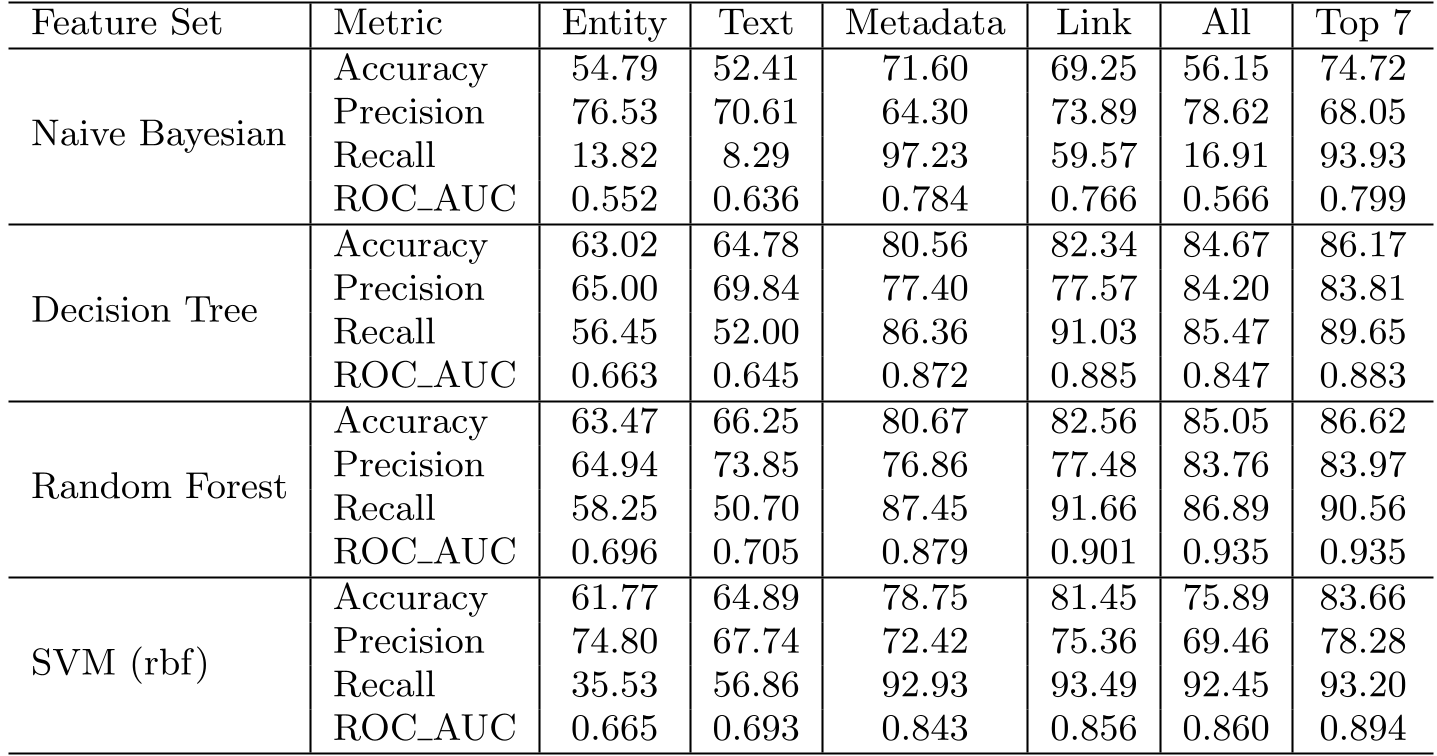 Table: Comparison of various machine learning classifiers. Random Forest consistently outperformed Naive Bayes and SVM.
Conclusion and Future Directions
Facebook Inspector proves that effective security doesn't require "big brother" access to private friendship graphs or massive server-side clusters. By focusing on zero-hour public features, the researchers provide a blueprint for a safer social web.
However, the "cat and mouse" game continues. As attackers move toward private groups and encrypted messaging, the next frontier for FbI will likely involve permission-based analysis of private feeds—giving users the power to audit their own digital safety.