
Beyond the Click: How U.S. Users Interacted with Facebook Misinformation (2017-2019)
Interactions with Potential Mis/Disinformation URLs Among U.S. Users on Facebook, 2017-2019
This study presents an exploratory analysis of U.S. Facebook users' interactions with potential mis/disinformation URLs from 2017-2019 using a unique, privacy-preserving dataset from Facebook and Social Science One. By comparing known "false" URLs and "low-quality news" against a baseline of 9.1 million U.S. URLs, the authors identify significant demographic patterns in exposure and engagement.
Executive Summary
TL;DR: Analyzing billions of rows of Facebook data, researchers found that while older, conservative users are "shown" more misinformation, users across the political spectrum are surprisingly similar in their likelihood to click on a false link once it appears in their feed.
Context: This is a major empirical study utilizing a rare, privacy-protected dataset from Facebook. It moves beyond small surveys to provide a "macro" view of how information pollution actually traveled through the world's largest social network during a critical three-year window.
The "Walled Garden" Problem
For years, academia has been "Twitter-centric" because Twitter's data is public. Facebook, meanwhile, has been a black box. This paper addresses the gap by asking: Who is seeing the fake news, and what are they actually doing with it?
The researchers break the problem into two distinct phases:
- Exposure: What does the algorithm put in front of you?
- Engagement: Do you click it? Do you share it?
Methodology: Identifying the "Fake" in a Sea of URLs
The authors used two distinct subsets to capture misinformation:
- TPFC-False: URLs explicitly flagged by Facebook's fact-checking partners (High precision, low volume).
- Low-Quality News: Domains known for publishing deceptive or amateur content (High volume, lower precision).
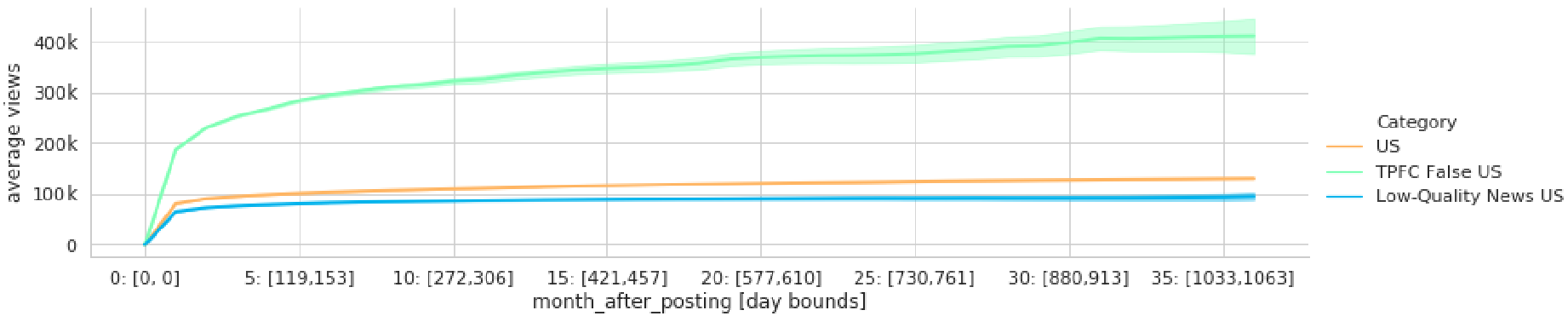 Figure 1: Spread over time shows that misinformation peaks within the first 30 days, emphasizing the need for rapid-response interventions.
Key Insight 1: The Exposure Gap
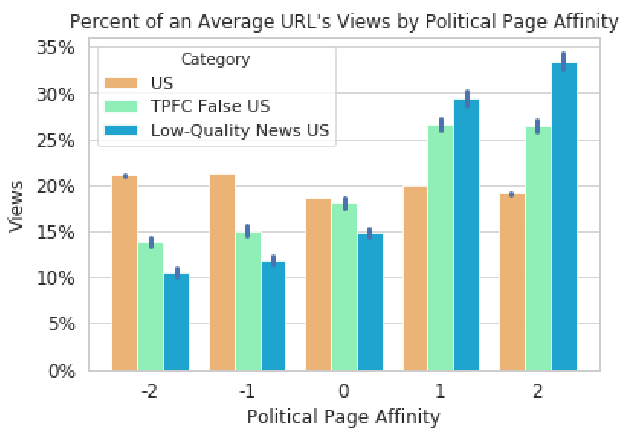
The data confirms a massive demographic skew in who sees misinformation. Users aged 65+ and those with high "Political Page Affinity" (conservative leaning) were shown potential misinformation URLs at a rate significantly higher than the baseline average.
Key Insight 2: The Engagement Paradox
Here is the "Why" that contradicts common intuition: while conservatives were exposed more, the Click-Through Rate (CTR) was remarkably uniform.
- The Findings: Once a false URL is on the screen, a liberal user is roughly as likely to click it as a conservative user (approx. 8-9% CTR for both).
- The Implication: The "problem" of misinformation might be an algorithmic supply issue rather than a behavioral demand difference. Facebook’s algorithm may simply be highly efficient at finding the "right" audience for a specific piece of content, regardless of that audience's ideology.
Key Insight 3: "Blind" Sharing
One of the most startling results is the prevalence of shares without clicks.
- Across all categories, roughly 42% of users shared a URL without even opening it.
- This suggests that on social media, the headline and the social signal of sharing are often more important to users than the actual content of the article.
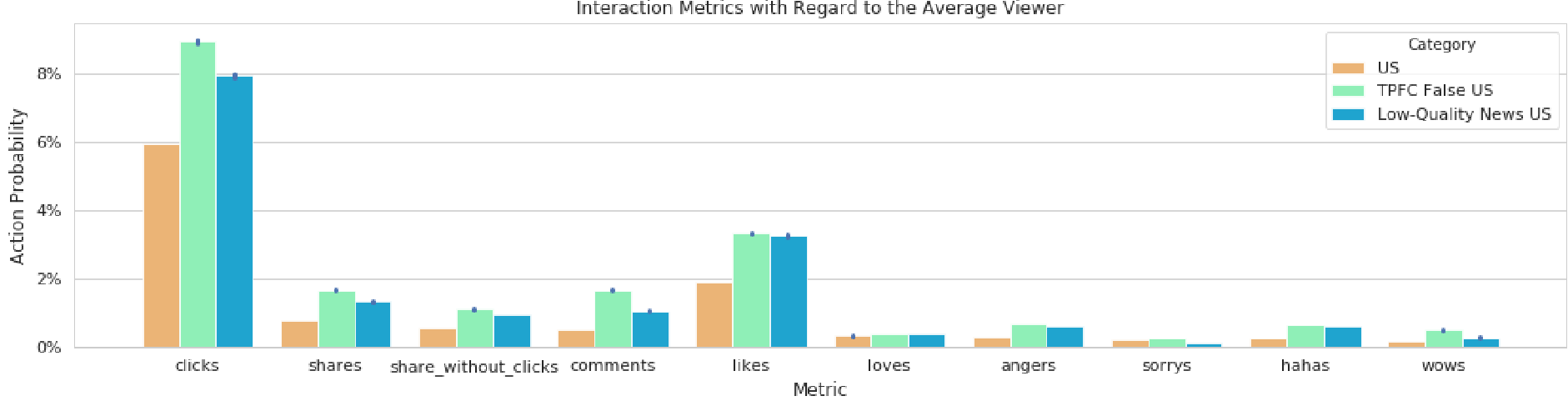 Figure 2: Misinformation URLs garner more engagement (clicks and shares) per view than the average baseline URL.
Critical Analysis & Conclusion
Takeaway
The study proves that misinformation is not just a "user problem"—it is an ecosystem problem. If engagement rates are similar across demographics once exposure happens, then the most effective defense is not "educating" users to be more cynical, but rather adjusting the feed algorithms to prevent the initial exposure.
Limitations
- Algorithm vs. Choice: We still don't know if users saw these URLs because they chose to follow specific pages or because Facebook's "Recommended" algo pushed it.
- Context of Clicks: A "click" doesn't equal "belief." Users might click to debunk or mock a story.
Future Outlook
As major platforms move toward "Share-Time Interventions" (like prompts asking "Do you want to read this before sharing?"), this data suggests such moves are backed by a physical reality: nearly half of us are sharing things we've never actually read.