
Inside the Black Box: How Facebook Personalized the 2018 Brazilian Election
Facebook News Feed personalization filter: a case study during the Brazilian elections
This paper presents a case study on Facebook's News Feed personalization during the 2018 Brazilian presidential elections. Using a "bot-based" measurement methodology and unsupervised clustering, the authors quantify how algorithmic filtering impacts the information diet of users with different political leanings.
TL;DR
During the 2018 Brazilian presidential elections, Facebook’s News Feed didn't just show news; it curated reality. By deploying a fleet of "social media bots," researchers from the Federal University of Rio de Janeiro discovered that Facebook’s personalization algorithms create highly fragmented experiences. Even when bots followed the exact same sources, the overlap in the posts they actually saw was often less than 50%, with the heaviest filtering occurring at the very top of the feed.
The "Black Box" Problem in Democracy
In the era of traditional broadcast media, everyone saw the same political ads and news segments. Today, social media algorithms use implicit feedback (likes, shares, dwell time) to decide what you see. This creates a "black box" where it is nearly impossible to tell if a platform is being fair or if it is inadvertently trapping users in ideological silos. The researchers sought to answer: How different is the "view of the world" for a Left-wing user versus a Right-wing user, even if they follow the same people?
Methodology: Mapping the Political Landscape
The authors used a sophisticated two-step process to quantify political alignment.
1. Candidate Clustering
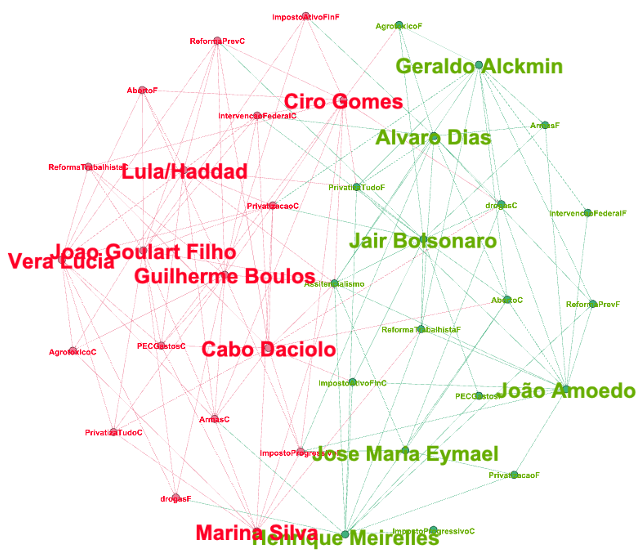
First, they analyzed the official plans of the presidential candidates across 13 dimensions (e.g., drug decriminalization, pension reforms, arms race). Using K-means clustering, they grouped candidates into "Left" and "Right" clusters based on these vectors.
2. The Bot Experiment
Thirteen bots were created:
- 4 Left-wing bots: Polarized by "liking" left-aligned pages.
- 4 Right-wing bots: Polarized by "liking" right-aligned pages.
- 5 Undecided bots: Followed the same sources but gave no explicit likes.
Methodology Detail: The Closeness Index
To measure the bias of media outlets, the researchers leveraged the Facebook Advertising API. By comparing the audience overlap between a candidate () and a publisher (), they derived a Closeness Index . This allowed them to mathematically define the "leaning" of a news source relative to the candidates.
Key Findings: The Fragmentation of Reality
1. The "Top-Heavy" Filter
The study found that Facebook's filtering is most aggressive at the top of the News Feed. As users scroll deeper ( increases), the distribution of political content becomes more balanced. However, since most users only consume the first few posts, the algorithm's "gatekeeping" power is concentrated at the most influential position.
2. Low Bot Closeness
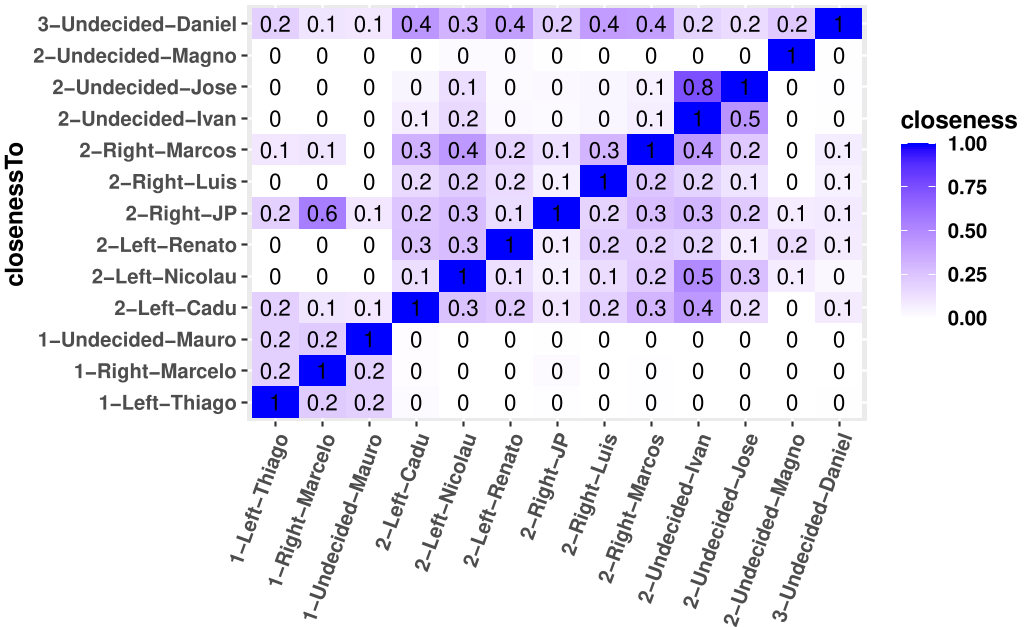
One of the most striking results was the Closeness Metric. Even bots programmed to be "undecided" and following the same publishers frequently saw different sets of posts.
- Typical similarity: < 0.5 (meaning less than half of the posts were shared between users).
- This proves that "non-trivial filtering" occurs even without explicit user polarization, suggesting the algorithm makes deep-seated assumptions about user preferences.
Critical Analysis & Conclusion
This study provides empirical evidence that social media has shifted political discourse from a "shared experience" to a "fragmented reality."
Takeaway: The "Information Diet" of a voter is no longer determined by who they follow, but by how an invisible algorithm prioritizes those sources. This fragmentation makes it harder to combat fake news, as there is no longer a single "public square" where information can be collectively verified.
Limitations: The study was limited to the second round of the 2018 election and used a relatively small number of bots. Future research should explore how these personalization effects evolve over longer periods and across different cultural contexts.