
Facebook: The Architecture of Modern Activism and Online Civic Engagement
Facebook: The enabler of online civic engagement for activists
This exploratory study investigates how activists utilize Facebook as a primary enabler for online civic engagement. By analyzing semi-structured interviews through the lens of Denning’s five modes of Internet activism, the research identifies ten specific activities—ranging from appealing for donations to scheduling collective actions—that transform social networking into a tool for addressing social issues.
TL;DR
Is Facebook merely a repository for personal memories and entertainment? This research says no. By interviewing front-line activists, this study reveals how Facebook has been re-engineered by users into a sophisticated tool for online civic engagement. From bypassing state-filtered news to raising thousands of dollars for social causes via viral "tagging," the platform has redefined the traditional landscape of activism.
Background: Beyond the "Digital Watercooler"
In the early 2010s, as social media adoption exploded, a critical question emerged: could these platforms actually address "civic malaise"? While prior scholarship examined Facebook through the lens of psychology or education, this paper positions it as a functional enabler of social change. In contexts where mainstream media is restricted or social issues like corruption and public health crises (HIV) are rampant, Facebook provides the "Information, People, and Tools" necessary for transformation.
Problem & Motivation: The Gap in the Digital Square
Traditional civic involvement—attending town halls, signing physical petitions—has seen a marked decline. The authors argue that the barrier to entry for civic participation was too high until social media lowered the "cost" of engagement.
The core research intuition here is that activism is not a singular act but a multi-modal process. Previous studies often missed the forest for the trees by looking only at "likes" or "posts." This study looks at the intent and flow of activist behavior.
Methodology: The Five Modes of Internet Activism
To decode how activists use the platform, the authors mapped qualitative data from twelve Malaysian activists onto Denning’s (2000) Five Modes of Internet Activism.
1. The Model of Engagement
The study identifies ten distinct activities that fit into these pillars. Unlike random users, activists use the "Collection" mode to treat Facebook as a "large digital database" for guidelines and history, and "Publication" to broadcast urgent appeals.
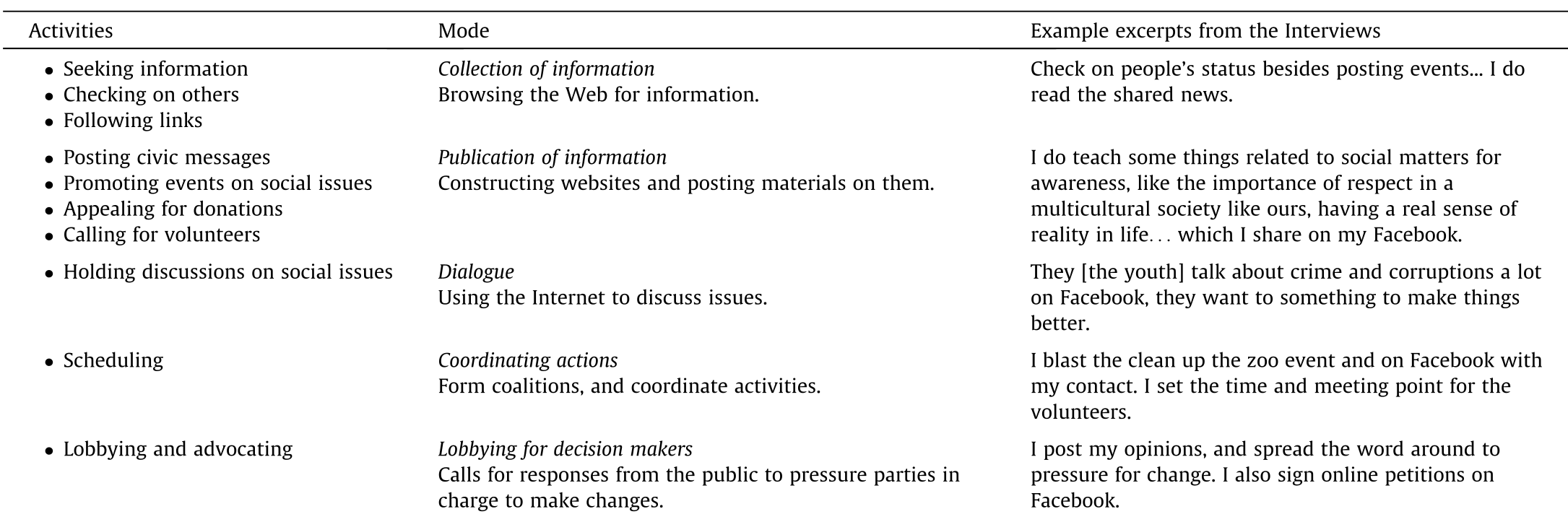
Table 1: Mapping Facebook activities to the theoretical modes of Internet Activism.
Key Insights from the Field
- Information as Liberation: In regions where traditional media is filtered, Facebook serves as an "open" alternative. Activists reported that followers increasingly ignore newspapers in favor of "social news."
- The Power of the 'Tag' & 'Blast': Coordination (Scheduling) has moved from private emails to public timelines. The "Tagging" mechanism acts as a notification system that drives physical attendance at events like "Explore to Clean" expeditions.
- Dialogue and Social Capital: Perhaps most surprisingly, in multi-ethnic societies, Facebook facilitates "bonding" and "bridging." By allowing different groups to share individual perspectives, it helps humanize "the other" in a way traditional media often fails to do.
Experiments & Results: Real-World Impact
The study provides anecdotal but powerful evidence of quantitative success:
- Fundraising: A single Facebook poster shared over 1,000 times raised approximately $8,000 (RM 25,000) for a baby's heart surgery.
- Volunteerism: Organizations reported a significant increase in physical "turn up" rates for events through Facebook promotions compared to traditional recruitment.
- Awareness: Crime warnings and "modus operandi" posts reach tens of thousands within 48 hours, creating a form of "citizen-led public safety."
 Figure 1: Conceptual overview of social issues addressed by online engagement in the studied context.
Critical Analysis & Conclusion
This paper serves as a vital reminder of the Identifiability Affordance. Unlike YouTube (which is often anonymous and prone to "trolling"), Facebook’s culture of real identities allows for deeper "bonding" messages and legitimate relationship building.
Takeaways:
- For NGOs: Success on social media requires shifting from simple "information broadcasting" to "dialogic messages" (thanking donors, fostering community).
- For Policymakers: If civic engagement is moving online, the state must ensure high-speed internet access is viewed as a democratic necessity, not a luxury.
- Limitations: As an exploratory qualitative study, it cannot rank which mode is the most effective. Future research must quantify the "impact value" of a "Like" versus a "Share" in actual policy change.
Final Thought: Facebook didn't just give activists a megaphone; it gave them a Swiss Army knife. By combining information seeking, peer-to-peer dialogue, and logistical coordination, the platform has become the "infrastructure" of the modern social movement.