
Facebook: Beyond Socializing—A Hidden Frontier for English Language Learning
Facebook: An online environment for learning of English in institutions of higher education?
This study investigates whether Facebook (FB) serves as a viable online environment for English language learning among university students. Using a survey of 300 undergraduates at Universiti Sains Malaysia, the research demonstrates that FB promotes incidental learning, significantly enhancing students' confidence, motivation, and positive attitudes toward English.
TL;DR
Is Facebook a distraction or a classroom? This research from Universiti Sains Malaysia argues it is a potent "incidental learning" environment. By surveying 300 students, the study reveals that the social pressure to interact with peers and native speakers on Facebook naturally boosts confidence, motivation, and vocabulary, provided it is supported by a loose academic structure.
Background Positioning
While social media was traditionally viewed by academics as a "social space" distinct from "learning environments," this paper bridges that gap. It positions Facebook within the framework of Socially Situated Learning Theory, suggesting that the most effective language acquisition happens when the learner isn't focused on the "rules," but on the "meaning" of the interaction.
The Problem: The Deterioration of English Fluency
The study is motivated by a critical pain point in Malaysian higher education: the declining standard of English since 1980. Traditional classroom methods often fail to provide authentic communication, leaving students hesitant and fearful of making linguistic mistakes. The authors ask: Can we leverage the "heavy reliance" of the current generation on social networking to fix this?
Methodology: Capturing Incidental Learning
The researchers used a mixed-methods approach (quantitative Likert scales and qualitative situation/activity coding). They focused on Incidental Learning, which is unintentional learning resulting from activities like playing online games or chatting.
Core Mechanism: The Community of Practice
According to the authors, Facebook functions as a Community of Practice. In this space:
- Mutual Engagement: Users negotiate meaning to understand status updates and comments.
- Joint Enterprise: Socializing becomes a shared goal that necessitates language use.
- Shared Repertoire: Users adopt "routines, words, and genres" (like slang or internet shorthand) that facilitate communication.
Key Results: Confidence as a Byproduct
The data confirms that Facebook is more than just a place to post photos. It serves as a tool for linguistic "neo-apprenticeship."
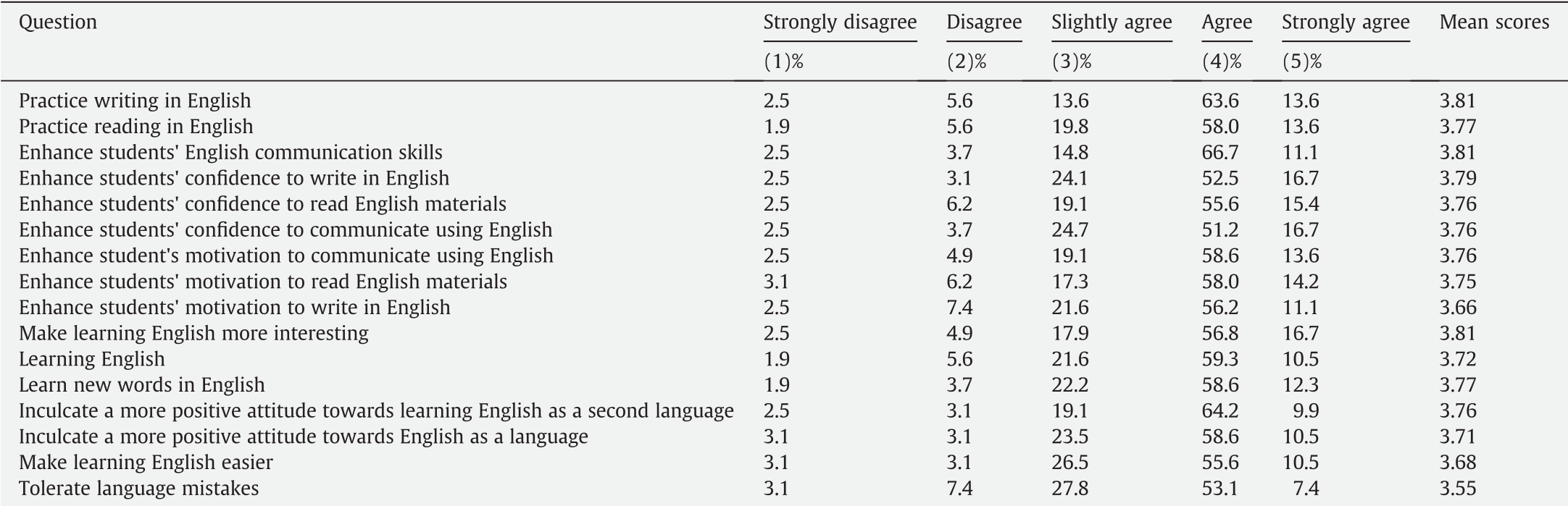
- Communication Benefits: A staggering 77.8% of students felt their communication skills improved.
- The Confidence Factor: Students noted that they "dare to communicate" more on Facebook because the environment is less rigid than a classroom.
- Active Vocabulary Acquisition: Qualitative responses showed students "automatically refer to a dictionary" when a friend leaves a comment using unfamiliar words—a self-directed learning behavior rarely seen in forced assignments.
Performance Metrics
| Aspect of Learning | Mean Score (out of 5) | % Agree/Strongly Agree |
|---|---|---|
| Practice Writing | 3.81 | 77.2% |
| Enhance Confidence | 3.79 | 69.2% |
| Motivation to Read | 3.75 | 72.2% |
| Learning New Words | 3.77 | 70.9% |
Deep Insight: "Writing" vs. "Communication"
A fascinating takeaway from the research is the psychological distinction students make between "school writing" (an exercise for tests) and "Facebook writing" (communication). Because students see Facebook as "real" communication, they are more willing to tolerate their own mistakes and practice more frequently. This affective filter is lowered, allowing for smoother language acquisition.
Critical Analysis & Conclusion
Takeaway
For educators, the message is clear: Stop fighting social media and start integrating it. Facebook's "incidental" nature—where learning is a byproduct of fun—makes it an ideal supplement for English as a Second Language (ESL) learners.
Limitations
The study notes a small minority (8%) of "traditionalists" who believe only academic journals lead to learning. Furthermore, without a teachers' guidance to set "learning projects," Facebook can easily remain a site of "broken English" rather than intentional improvement.
Future Outlook
The authors suggest that future research should use measurable pre-and-post tests to quantify the exact linguistic gain from Facebook "Groups" or "Courses" applications, moving beyond student perception to objective linguistic proficiency.