
Who Would Pay for Facebook? The Psychology of Self-Esteem and Virtual Possessions
Who Would Pay for Facebook? Self Esteem as a Predictor of User Behavior, Identity Construction and Valuation of Virtual Possessions
This study investigates how self-esteem influences Facebook user behavior and the valuation of the platform as a "virtual possession." Using Structural Equation Modeling (SEM) on survey data (N=221), it demonstrates that personal identity construction, rather than social networking, is the primary driver for users' willingness to pay for digital enhancements.
TL;DR
Is Facebook a social utility or a personal mirror? This research discovers that the more you view your Facebook account as an extension of your Personal Identity (the "I"), the more you value it as a Virtual Possession you'd be willing to pay for. Surprisingly, the "Social Identity" (the "Me") focused on others has little to do with how much we financially or emotionally value our digital presence.
Context: Beyond the Social Graph
In the early 2010s, social media research was obsessed with "Social Capital"—how many friends you have and how you look to them. This paper pivots the conversation. It treats Facebook not as a phone book, but as a digital "container" of the self. The authors ask: What psychological traits lead a user to actually care about their data enough to pay for it?
The "I" vs. "Me" Paradigm
The study draws on G.H. Mead’s classic sociological theory:
- The "I" (Agency): The inner, active self. High self-esteem individuals focus here, completing their profiles as a form of self-authorship.
- The "Me" (Self-Monitoring): The social self that is seen by others. Low self-esteem individuals focus here, constantly "cleaning" or customizing their walls to manage impressions.
Methodology: Mapping Psychology to UI
The researchers conducted a survey of 221 users, measuring psychological traits and specific Facebook behaviors. They then used Structural Equation Modeling (SEM) to see which paths actually lead to a user valuing Facebook as a possession.
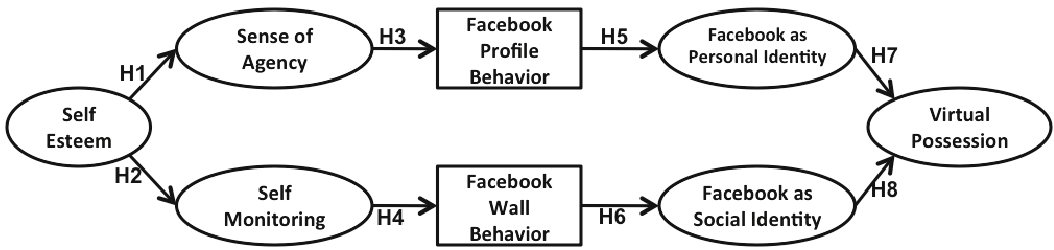 Figure 1: The initial theoretical model linking Self-Esteem to Virtual Possession Valuation via two distinct behavioral paths.
Key Findings: The Power of Personal Identity
The results from the SEM analysis revealed a striking divergence:
- Self-Esteem as a Driver: High self-esteem leads to a "Sense of Agency," which drives Profile Completion. These users are building a museum of themselves.
- The Failure of Social Identity: Interestingly, "Social Identity" (attachment to the public-facing version of Facebook) was removed from the final model because it didn't significantly predict the value of the virtual possession.
- The "Virtual Possession" Link: Personal Identity is the "Golden Path." If a user feels their profile is them, the valuation of the site skyrockets ().
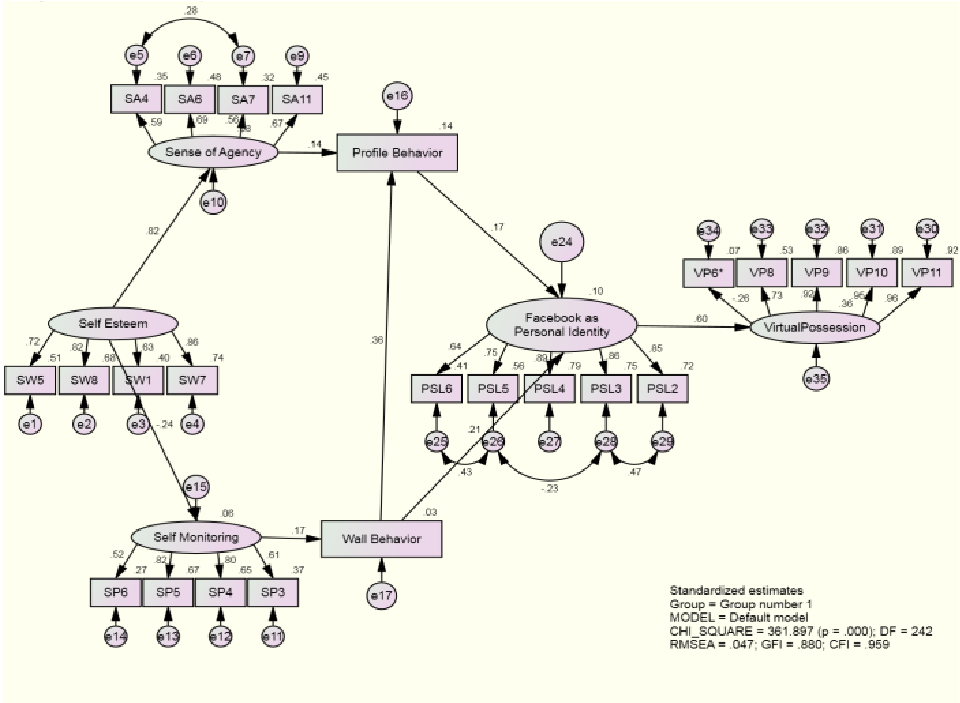 Figure 2: The Final SEM Model showing that both Profile and Wall behaviors eventually feed into Personal Identity, which directly dictates the value of the virtual possession.
Deep Insights
1. Customization is actually "Self-Expression"
A notable finding is that Wall Customization (deleting posts, changing friend lists) was originally thought to be a sign of social anxiety (Self-Monitoring). However, the final data shows it actually contributes to Personal Identity. Users aren't just hiding from others; they are "curating" their ideal selves.
2. Implications for Monetization
This paper explains why digital goods (emoticons, wallpapers, themes) sell. They aren't just "junk"; they are tools for identity construction. If a platform wants to charge its users, it should focus on Agency—giving users more tools to express who they are, rather than just tools to see what others are doing.
Critical Analysis & Conclusion
While the study is limited by its 2012 timeframe and college-aged sample, its core insight remains deeply relevant in the era of TikTok and the Metaverse.
Takeaway: We don't value social media because it connects us to 500 "friends"; we value it because it is the most detailed biography we have ever written. The "I" (the persona we create) is more valuable than any social network.
Future Outlook: Designers should move from "Usability" (is it easy to use?) to "User Experience" (does it help me reflect my identity?). When a digital space becomes a "Virtual Possession," user loyalty becomes nearly unbreakable.