
Masking the Self: The Hidden Dynamics of Facebook Self-Presentation
Students’ self-presentation on Facebook: An examination of personality and self-construal factors
The study investigates university students' self-presentation on Facebook by examining how personality (Extraversion) and culture (Self-Construal) influence online vs. in-person self-disclosure. Using a survey of 463 students, it identifies a significant interaction where collectivistic, low-extraversion individuals disclose the least honest and most audience-relevant information online.
TL;DR
Is your Facebook profile the "real you"? This research reveals that for many, especially those who are introverted or come from collectivistic backgrounds, the answer is a resounding "no." By analyzing 463 university students, the study proves that the digital "paper trail" of social media creates a high-pressure environment that forces certain personality types to prioritize audience expectations over radical honesty.
The "High Accountability" Trap
In a physical conversation, your words often vanish into the air. On Facebook, they are etched into a permanent, searchable record. The authors argue that this creates a state of High Accountability.
The study's core intuition is that this accountability acts as a "filter." For individuals who emphasize social harmony (Allocentrists) and those who are naturally more reserved (Low-Extraverts), the fear of being judged by a diverse audience—from friends to future employers—leads to a strategic shift in how they present themselves.
Methodology: The Psychology of the "Like"
The researchers didn't just look at what people posted; they looked at the psychological gap between how people act in person versus online. They measured six dimensions of disclosure:
- Intent: How conscious is the disclosure?
- Amount: How much is shared?
- Positivity: Is it all "sunshine and rainbows"?
- Honesty: Is it authentic?
- Control/Monitoring: How much is filtered?
- Relevance: Is it tailored to what the audience wants to hear?
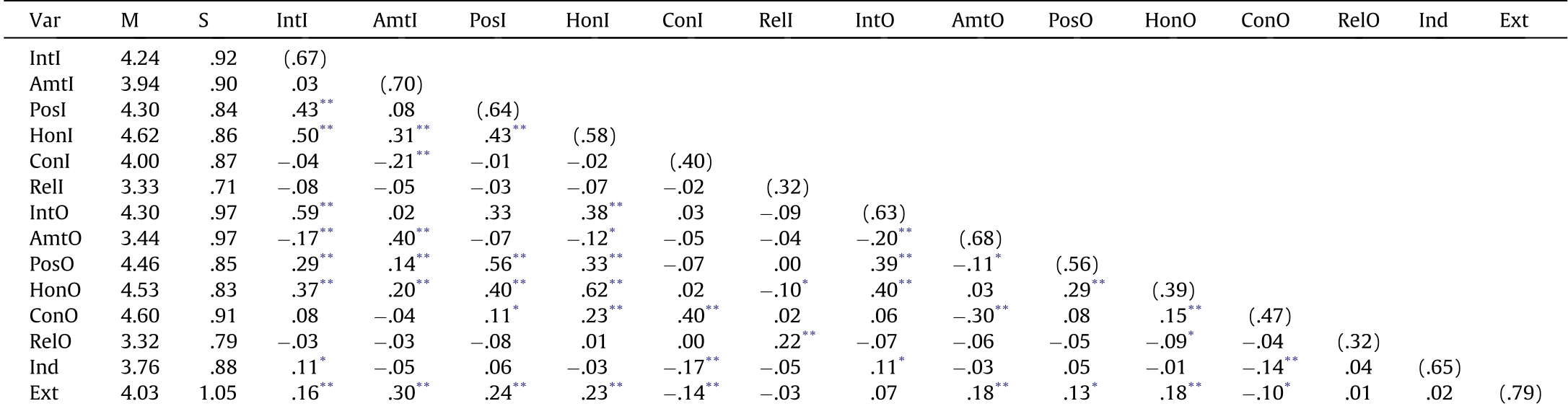 Table 1: The data reveals that while in-person and online disclosures are related, they are distinct constructs with correlation coefficients (e.g., Honesty r=.59) high enough to show relation, but low enough to prove they are different behaviors.
The Core Insight: The "Curation" Effect
The most striking discovery involves the 3-way interaction between Modality, Extraversion, and Culture.
The data shows that Allocentric Non-extraverts (collectivistic, shy individuals) are the master curators of the internet. They don't just share less; they share differently:
- Lower Honesty: They reported significantly lower honesty scores online compared to in-person.
- Higher Relevance: They focused heavily on what their audience deemed important, rather than what they actually felt.
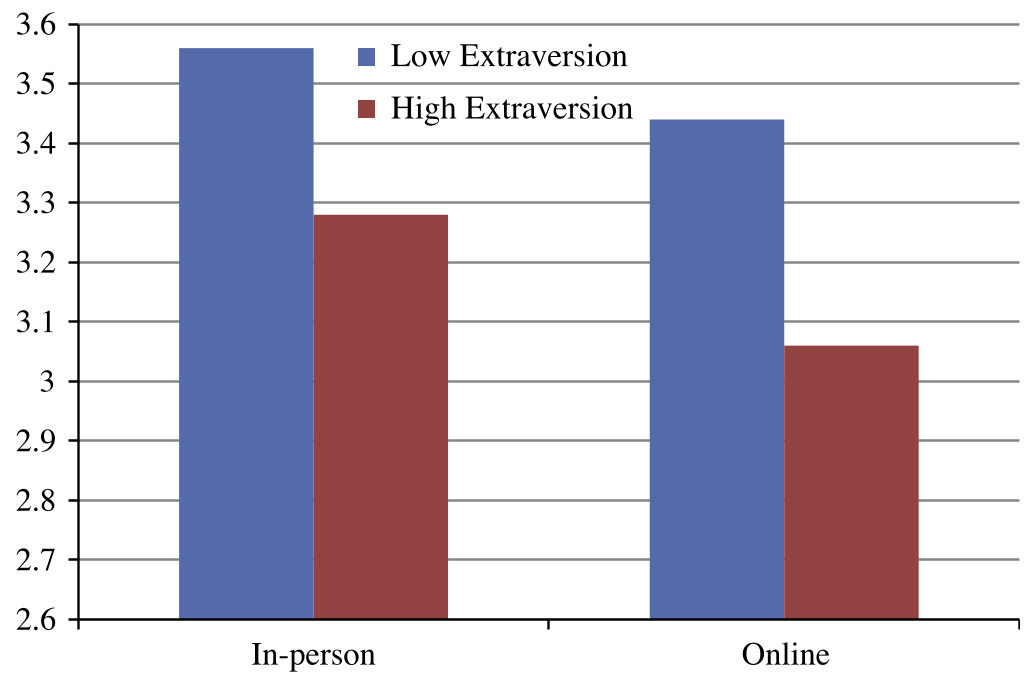 Graph: Low-extraversion individuals (the red line) show a dramatic drop in the amount they disclose when moving from in-person to online settings.
Deep Insight & Conclusion
This paper serves as a critical warning against the "Digital Sincerity" myth. We often assume that because social media allows for "true self" expression, people will use it that way. In reality, the SNS environment stifles individual expression for those who are most vulnerable to social pressure.
Limitations
The study used a primarily White, US-based sample. In more deeply collectivistic cultures (e.g., East Asia), these effects might be even more pronounced. Furthermore, the data was collected via self-reports; future work could benefit from comparing these surveys against actual Facebook metadata.
Final Takeaway
For educators and employers: A student's or candidate's social media is not a diary—it is a performance. Those who are most concerned with group harmony are the most likely to hide their true selves behind a wall of "audience-relevant" content. To find the "true self," we must still look beyond the screen.