
Facebook as a Goldmine: Replacing Explicit Ratings with Social Data for Recommendations
Facebook single and cross domain data for recommendation systems
The paper investigates the use of Facebook profile data (likes/mentions) as a replacement or supplement for explicit user ratings in Collaborative Filtering (CF) systems. It introduces methods for both single-domain and cross-domain recommendations, demonstrating that social network content can effectively mitigate sparsity and cold-start issues.
TL;DR
Is the era of asking users for 1-5 star ratings over? This research demonstrates that data already living on Facebook—what users mention, like, or follow—can replace explicit ratings entirely. By using cross-domain data (e.g., using your music tastes to predict movie interests), the authors achieved higher precision than traditional ratings when data is sparse.
Background: The Rating Fatigue Problem
Most recommendation engines (like Netflix or Amazon) rely on Collaborative Filtering (CF). However, CF has a "starvation" problem: users hate rating things. This creates Data Sparsity (many items, few ratings) and the Cold-Start Problem (new users have no history).
The authors' insight is simple: The data users choose to publish on their profiles is a stronger, more authentic signal of interest than a rating forced by a system.
Methodology: From "Stars" to "Mentions"
The researchers built a crawler to extract "mentions" from 7,700 Facebook profiles. Unlike a 5-star scale, Facebook data is unary (you either mentioned it or you didn't).
Core Algorithms
- Baseline CF-NN & SVD: Standard industry models using explicit 1-5 ratings.
- Jaccard Similarity: Used for Facebook data since it handles binary "sets" of interests better than Pearson correlation.
- Cross-Domain Aggregation (The "Combine" Method): This treats a user’s across-the-board interests (Music + TV + Movies) as a single large vector to find more accurate neighbors.
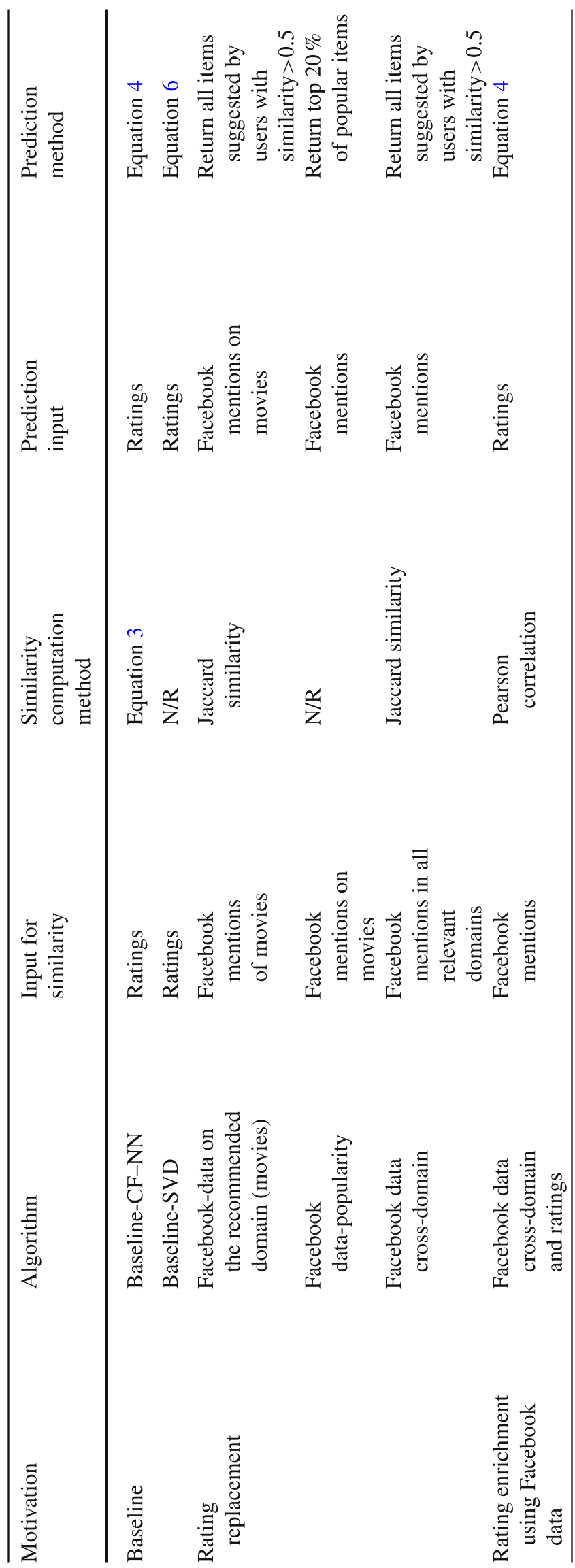
Experimental Battle: Ratings vs. Social Media
The study compared recommendations made from a controlled list of 150 movies against data scraped from the same users' Facebook walls.
Results: The Sparsity Paradox
In a high-density environment (lots of ratings), traditional CF wins. However, real-world systems are rarely dense. When the researchers simulated a realistic sparsity of 95% or higher, the Facebook-driven models took the lead.
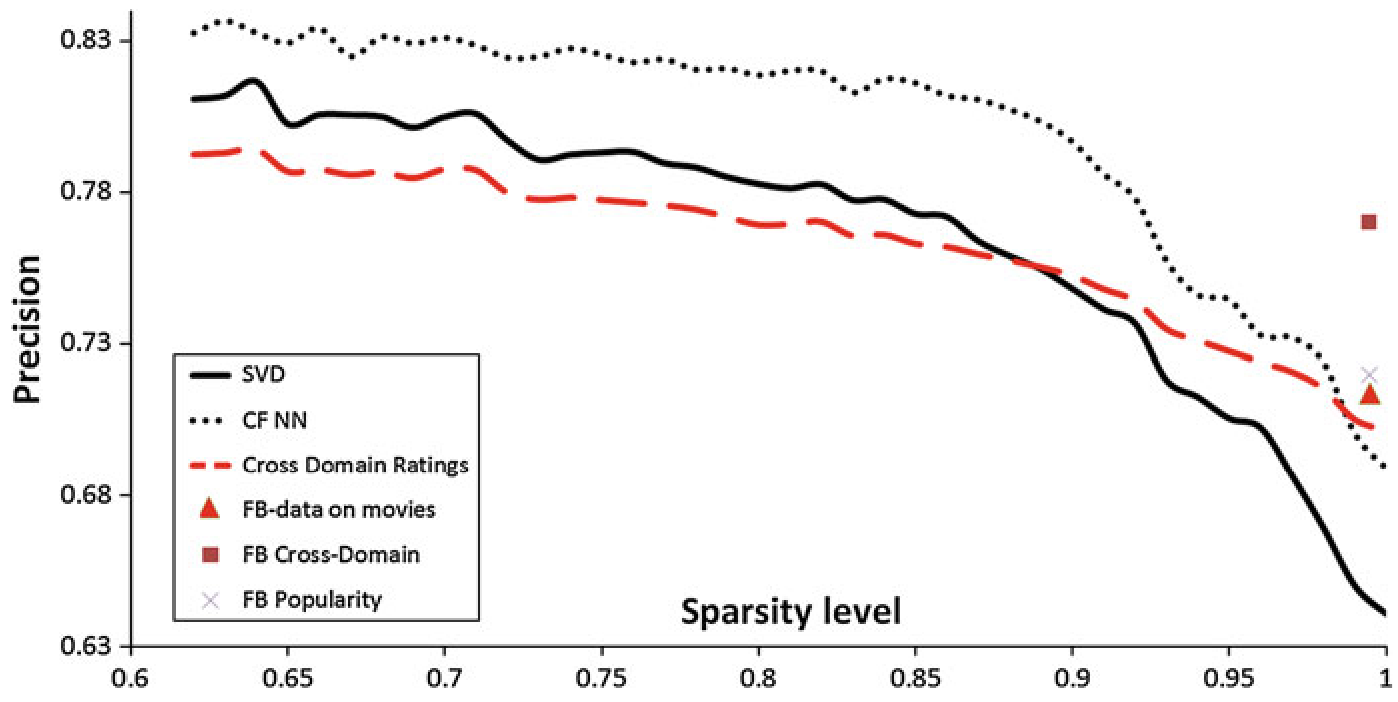
Key finding: At 99% sparsity, cross-domain social data is 8-10% more precise than traditional rating-based CF.
Why Does Cross-Domain Work?
The paper proves that "similarity" is a global trait. If two people have identical tastes in niche Indie-Rock music, they are statistically more likely to share tastes in Science Fiction movies. By "borrowing" the dense music data to plug the holes in sparse movie data, the system successfully bypasses the cold-start problem.
When to use it:
- Correlation matters: Cross-domain boost is highest when domains are related (e.g., TV Shows and Movies).
- New Users: If a user is new to the "Movie" section but has "Liked" 50 bands, the system can immediately generate a high-quality movie profile.
Summary & Critical Analysis
Takeaways
- Implicit beats Explicit: Voluntary social data is a cleaner signal of "love" than forced 1-5 rankings.
- Recall Boost: Cross-domain methods don't just find better items; they find more items (higher coverage).
Limitations
The study was conducted in 2011/2012. Today's API restrictions (post-Cambridge Analytica) make crawling this data much harder. Furthermore, the dataset was limited to university students (homogeneous population).
Future Outlook
With the rise of Large Language Models (LLMs), the "simple heuristic" extraction used in this paper could be replaced by deep semantic understanding of statuses, potentially making social-media-driven recommendations even more potent.