
Facebook in the Classroom: Collaborative Hub or Just a Digital Bulletin Board?
The Use of Facebook as an Assisting Tool in Teaching Computer Science Courses
This study investigates the use of dedicated Facebook pages as supplemental instructional tools in Computer Science courses (Operating Systems and Advanced Databases). It evaluates student engagement across undergraduate and graduate levels to determine if social media can effectively enhance course interaction.
TL;DR
This research examines whether Facebook—a platform students already inhabit—can be successfully pivoted into a Computer Science teaching tool. While students are eager to join and "like" instructor posts, the study reveals a stark reality: students primarily use these pages as digital bulletin boards for announcements rather than collaborative forums, with graduate students showing slightly more discursive depth than undergraduates.
Background: The Social-Academic Paradox
By 2013-2015, Facebook had become the digital "third space" for students. Educators hypothesized that by moving course content into this high-traffic environment, the "engagement factor" would naturally rise. This paper positions itself as an empirical check on this optimism, specifically within the technical rigors of Computer Science departments at Misurata University.
The "Bulletin Board" Trap: Motivation and Findings
The authors hypothesized that Facebook’s tools—likes, comments, and file sharing—would foster a community of inquiry. However, the data suggests a hierarchy of engagement:
- Instructor as Authority: 88% of students viewed the instructor as the sole vital source of information.
- Passive vs. Active: There was a high "Post Reach" and "Like" count for announcements, but "Comments" (the metric of actual discussion) remained low.
- The Age Gap: Graduate students (DB course) were marginally more likely to engage in information exchange compared to undergraduates (OS course), who interacted almost exclusively with deadline-related announcements.
Methodology & Architecture of Engagement
The study tracked two distinct tracks:
- The OS Page (Undergrad): 46 students, focused on Operating Systems.
- The DB Page (Grad): 14 students, focused on Advanced Databases.
The instructor acted as the primary content creator, posting questions, links, and administrative updates. The research then analyzed the "Human-Computer Interaction" (HCI) through the lens of engagement metrics.
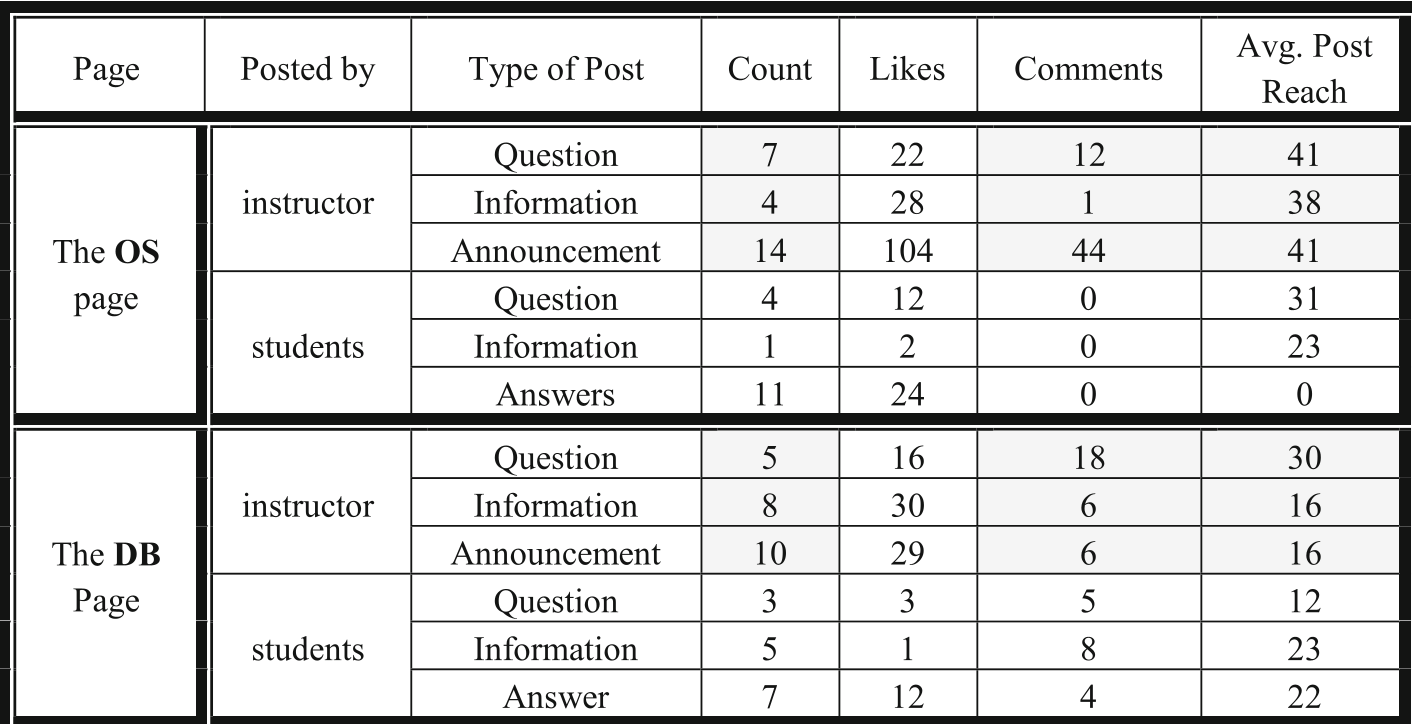 Figure 1: Comparison of interaction levels between Instructor posts and Student posts.
Key Insights: Why Wasn't It More Collaborative?
The results show a weak correlation between "Likes" and "Comments." In the OS course, the Pearson correlation was , while in the DB course, it was a negligible .
Why did this happen?
- Extrinsic Motivation: Students followed the pages primarily to avoid missing exam hints or schedule changes (Information/Announcements).
- Social Friction: Despite being a "social" network, students were hesitant to answer questions publicly on the timeline, preferring to consume the instructor's answers.
- The Bulletin Board Effect: The "Reach" was high (Avg. 41 for OS), proving students saw the content, but the "Comments" were low (0 for many student-led posts), proving they didn't want to discuss it.
Critical Analysis & Conclusion
Takeaway
Facebook is superior to email for rapid dissemination of information due to the high frequency with which students check the app. However, it is not a "magic bullet" for collaboration. Without specific grade-based incentives for participation, the platform remains a one-way broadcast tool.
Limitations
The study is localized to a single faculty and a specific timeframe. Furthermore, the "Page" format (compared to a private "Group") may have limited the sense of privacy required for students to feel comfortable making mistakes in public.
Future Outlook
For educators looking to replicate this, the authors suggest focusing on the type of content. Questions that directly mirror exam formats drive the most hits, but fostering true peer-to-peer learning likely requires a more structured, incentivized social framework than a standard Facebook Page provides.