
Facebook as a Virtual Classroom: Bridging Social Networking and Pedagogy
Facebook as virtual classroom – Social networking in learning and teaching among Serbian students
This study investigates the adoption of Facebook as a "virtual classroom" among Serbian university students, utilizing Structural Equation Modeling (SEM) to identify key motivational drivers. The research demonstrates that Facebook can transition from a purely social tool to an educational asset by fostering communication and resource sharing.
TL;DR
Is Facebook a distraction or a digital frontier for education? This study analyzes 238 Serbian students to prove that Facebook can function effectively as a "Virtual Classroom." By utilizing Structural Equation Modeling (SEM), the researchers found that social connectivity and collaborative material sharing can bridge the gap between informal socializing and formal academic achievement, with cooperation emerging as the most critical factor for success.
Problem & Motivation: The Digital Native Dilemma
Today's students are "digital natives" born into an era where being offline is equated with non-existence. However, traditional academia often views social media—specifically Facebook—with suspicion.
The conflict is twofold:
- The Distraction Hypothesis: Critics argue that time spent on Facebook decreases focus and leads to poorer exam results due to "multitasking" costs.
- The Engagement Gap: Traditional teaching strategies often fail to reach students where they actually spend their time, leading to a disconnect between professors and the "Internet generation."
The authors' insight is simple yet profound: instead of fighting the platform, educators should harness its "social glue" properties to build a virtual space where learning feels as natural as status updates.
Methodology: The SEM Framework
The researchers didn't just ask if students like Facebook; they built a complex causal model to understand why they use it for school. They categorized 15 variables into four latent constructs:
- Facebook Adoption: Perceived usefulness and ease of use.
- Intended Use: Factors like group identity and social relations.
- Educational Use: Daily activities, cooperation, and sharing resources.
- Virtual Classroom: The ultimate goal—using the platform for tasks, discussion, and announcements.
 Figure 1: The proposed structural model showing the interplay between social and educational variables.
Key Results: Cooperation is King
The study utilized Structural Equation Modeling (SEM), a rigorous statistical method that goes beyond simple correlation to determine cause-and-effect paths.
1. The Power of Cooperation
The factor "Cooperation" yielded a high coefficient (beta = 0.699), indicating it is the most critical driver of educational use. Students aren't just looking for content; they are looking for a venue to solve problems together.
2. Social Relation as a Catalyst
"Social Relation" (beta = 0.672) proved that the primary motivation for using Facebook remains social, but this social capital is what makes the "Virtual Classroom" viable. It reduces the fear of asking questions that students might be too "embarrassed" to ask face-to-face.
3. Model Accuracy
The model explained 74.5% of the variance in the "Virtual Classroom" concept, proving that the variables selected were highly relevant to student behavior.
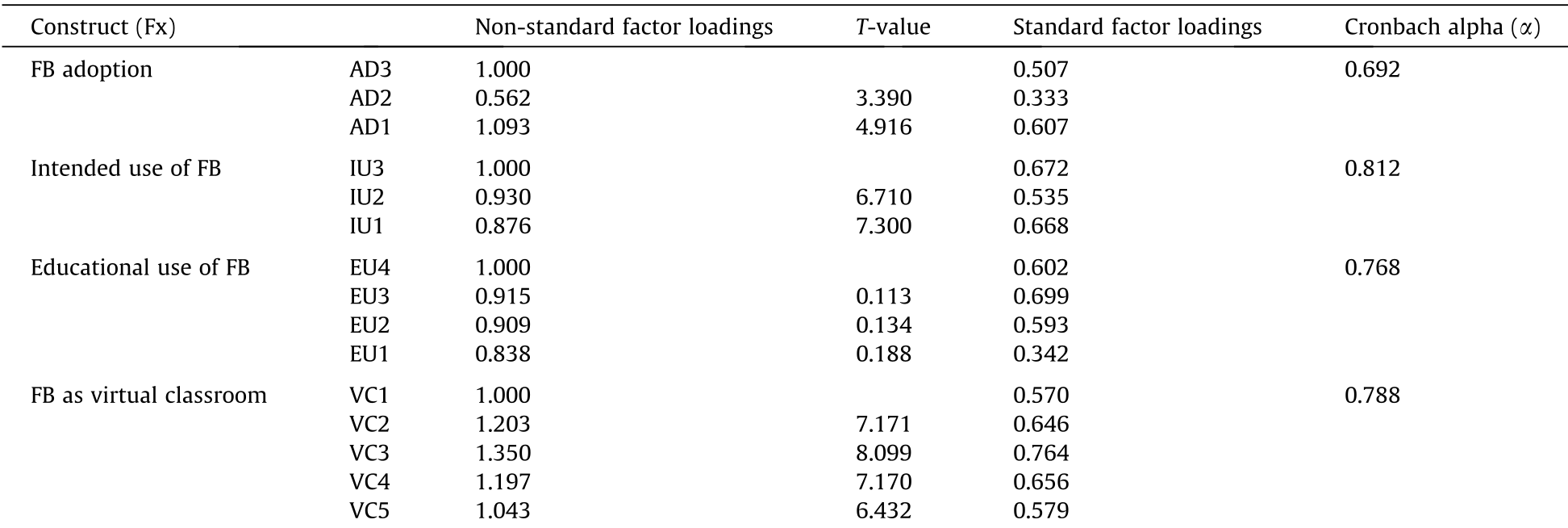 Table 2: Factor Loadings and Reliability (Cronbach's Alpha) for the tested constructs.
Critical Insight & Conclusion
The merit of this paper lies in its objective validation of an informal tool. While many professors view Facebook as an enemy of the syllabus, this research suggests it is actually a support infrastructure.
Limitations to Consider:
- Era Specificity: The study was conducted during the peak of Facebook's dominance (2014-2015). Current students may favor platforms like Discord or Instagram for similar "virtual classroom" activities.
- Privacy Concerns: 12.6% of students expressed concerns about privacy invasion, a hurdle that any social-media-based curriculum must address.
Final Takeaway: The "Virtual Classroom" is not about the technology itself, but about the collaborative culture it enables. For higher education to survive the 21st century, professors must act as facilitators within these digital spaces, transforming "social glue" into "academic fuel."