
Facebooking for Health: Why Your Feed Might Be the Best Medicine for Your Confidence
Facebooking for health: An examination into the solicitation and effects of health-related social support on social networking sites
The study examines how social networking sites (SNS), specifically Facebook, facilitate health-related social support (HRSS) and influence health self-efficacy. By analyzing 291 respondents via structural equation modeling (SEM), the researchers established a causal link between health concerns, active support-seeking, and improved psychological health management capabilities.
TL;DR
Is Facebook actually good for your health? This study reveals that when we face health concerns, we turn to our social network for more than just news—we seek support. The research finds that emotional support obtained on Facebook is a powerful driver of health self-efficacy (your belief in your ability to manage your health), effectively counteracting the anxiety and helplessness often caused by illness.
The "Support Gap" in the Digital Age
Most of us use the Internet to Google symptoms, but few understand how general social platforms like Facebook function as health resources. The researchers identified a critical tension: having a health concern naturally lowers your self-efficacy because it increases anxiety. Traditionally, we thought "more information" was the cure. However, this paper argues that the social layer—specifically how we talk to our peers—is what actually restores our sense of control.
Methodology: Mapping the Path from Concern to Confidence
The study employed a structural equation model (SEM) to map the flow of health interactions. They didn't just look at if people got support, but what kind of support they received across four categories:
- Emotional: Empathy and encouragement.
- Esteem: Validation of one's ability to handle the situation.
- Appraisal: Objective feedback and advice.
- Tangible: Practical help, like a ride to the doctor.
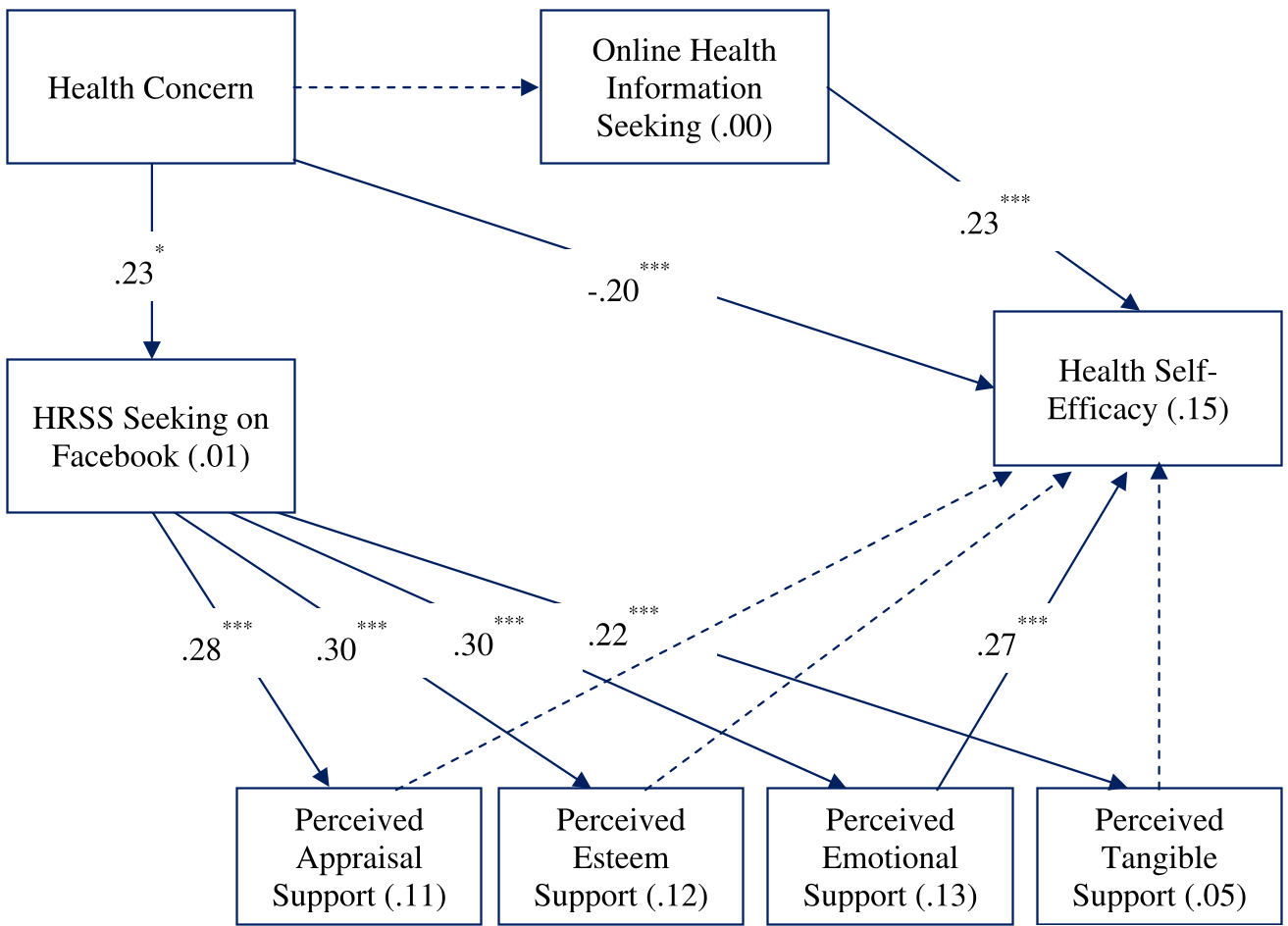 Note: The model depicts how health concerns drive seeking behavior, which in turn leads to perceived support.
Key Insights: Emotion Over Information
The findings were striking in their specificity. While individuals sought all forms of support, emotional support stood out as the "MVP."
- The Emotional Advantage: Emotional support was the most frequently perceived type of support on Facebook and the only one that significantly predicted an increase in health self-efficacy.
- Information Displacement: Interestingly, the study found no significant link between having a health concern and general online information seeking (like search engines). Instead, people preferred the personalized, networked reactions of their Facebook friends.
- Optimal Matching: This supports "Optimal Matching Theory"—the idea that for health stressors, the empathy of a friend is more effective than the cold hard facts of a medical blog.
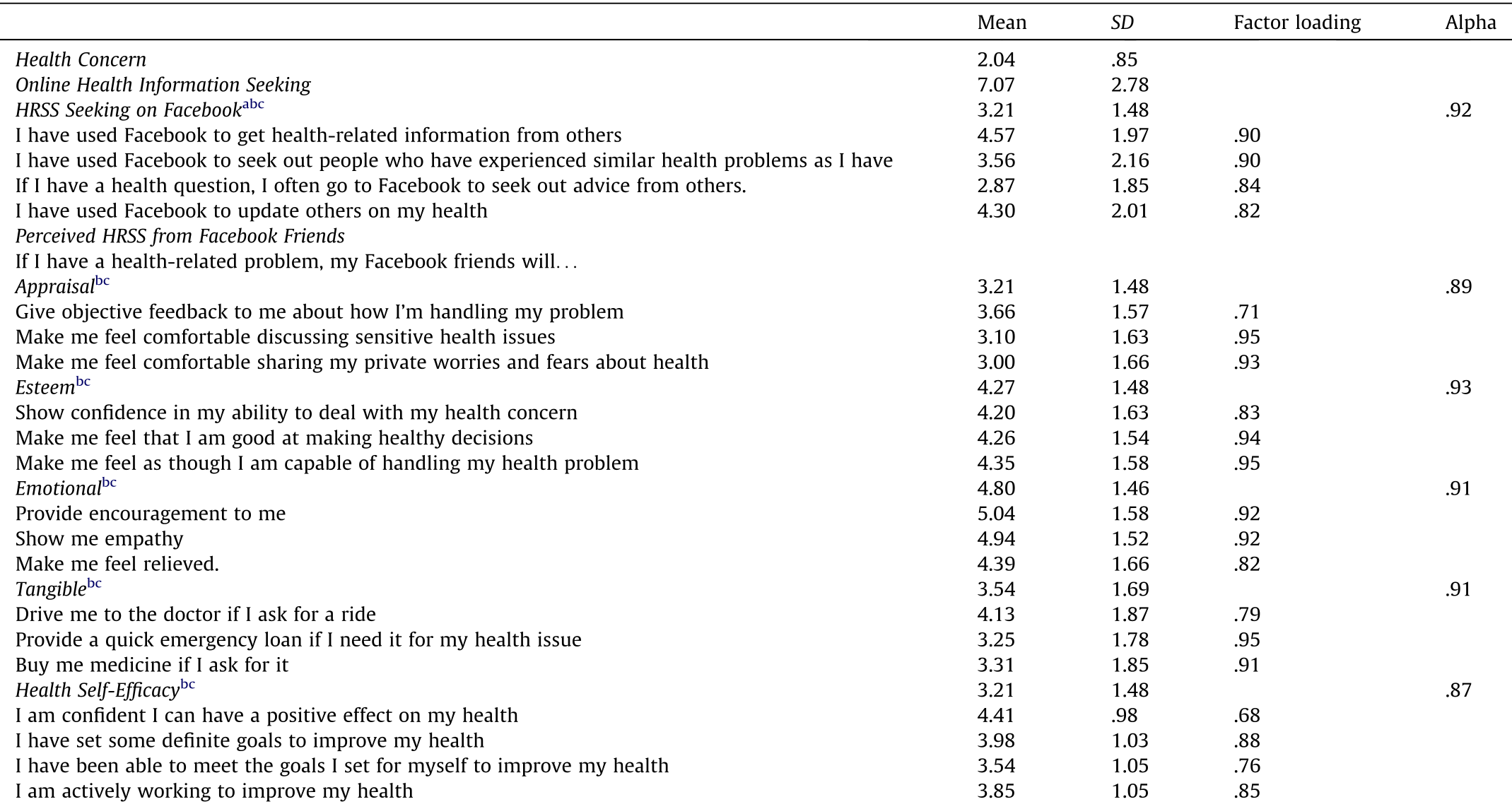 The data confirms high internal consistency (Alpha > .90) for the support dimensions measured.
Critical Analysis & Real-World Impact
This research highlights that Facebook’s peer-based architecture is uniquely suited for health management not because it provides the best medical data, but because it provides the best psychological buffer.
Limitations to Consider:
- Low Adoption: Only about 39% of the sample had actually sought health support on Facebook, suggesting there is still a significant "stigma" or privacy barrier.
- The Privacy Paradox: Many users may feel uncomfortable sharing sensitive health data on a platform where their employer or acquaintances might see it.
Conclusion
The takeaway for the healthcare industry is clear: technology should facilitate human connection, not just data transmission. If a social networking site can enhance a patient's confidence to manage their chronic illness through a few empathetic comments, it ceases to be just a social tool and becomes a vital component of the modern healthcare ecosystem.
Takeaway: In the journey of recovery, a "Like" or a comment of encouragement might be just as statistically significant as a search result.