
Jodel and the Faceless Vicinity: Why We Crave Anonymous Local Connection
The Faceless Vicinity: Who Uses Location-Based Anonymous Social Networks Like Jodel and Why?
This study investigates the usage motivations and user roles within Jodel, a location-based anonymous social network (ASNs). Utilizing the Uses and Gratifications Theory, the researchers identify distinct user archetypes—Producers, Commenters, Raters, and Consumers—and explore how gamification elements like "Karma points" influence engagement among Digital Natives in Germany.
TL;DR
Why do millions of users flock to an app where you can't have a profile picture, a real name, or a permanent friend list? This study deconstructs Jodel, the leading anonymous social network (ASN) in Europe. It reveals that boredom, the thrill of "Karma" points, and the need for hyper-local Q&A drive a highly active ecosystem of "Digital Natives" who value community even when faces are absent.
The Paradox of Anonymity
In an era of real-name policies (Facebook) and visual self-branding (Instagram), Jodel is an outlier. It limits communication to a 10km radius and strips away all identity. The authors argue that this actually lowers the barrier to social interaction. Instead of performing for a global audience, users engage in a "faceless vicinity"—a digital town square where the content matters more than the creator.
Methodology: Who is the "Jodeler"?
The researchers surveyed 871 participants, predominantly from Generations Y and Z. They categorized the community into four distinct roles:
- Producers: The content creators (24%).
- Commenters: The conversationalists (48%).
- Raters: The "judges" who up-vote or down-vote content (91%).
- Consumers: The silent observers (62%).
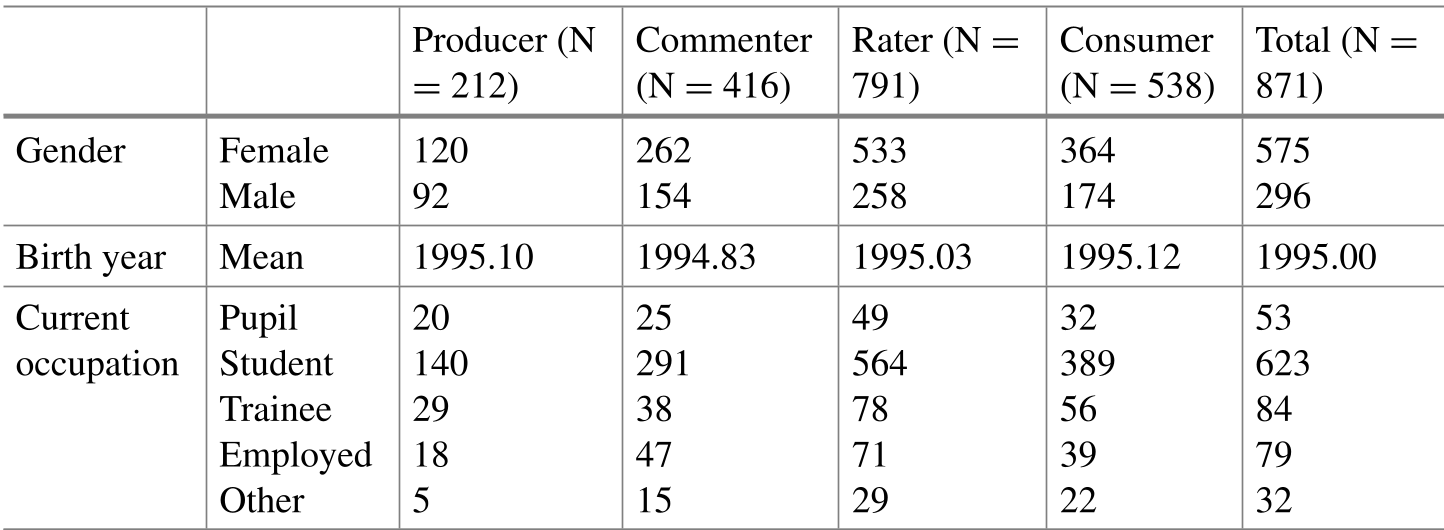 Table 1: Socio-demographic distribution of Jodel user roles.
Key Insights: Why We Use It
Using the Uses and Gratifications Theory, the study found that motivations are not uniform across roles:
- Boredom & Entertainment: These are universal. Almost everyone uses Jodel to "kill time" and find "funny postings."
- The Social Producer: Producers aren't just shouting into the void; they use the anonymity to ask questions they might be too embarrassed to ask on LinkedIn or Facebook.
- Karma Hunters: Prolific creators are significantly motivated by Karma Points (Correlation 0.303***). Even though these points have no monetary value and can't be "spent," they provide a psychological sense of achievement and community standing.
Methodology & Architecture
The platform's architecture relies on a unique Moderator System and Hyper-locality. Unlike the failed American app Yik Yak, Jodel empowers high-karma users to act as moderators, collectively deciding whether to block reported content. This self-policing mechanism is key to its longevity.
 Table 2: Correlations between user roles and specific usage motivations.
The Role of Gamification: Validating the "Loudest"
Jodel uses a "Loudest" category—essentially a leaderboard for the most up-voted posts in the area. The study found that:
- Active producers feel a high sense of Joy when their post becomes the "Loudest" (Correlation 0.226***).
- The Voting Function is the soul of the app. Even "Consumers" who rarely post content still actively rate others, suggesting that "rating" is a low-effort way to feel part of the community.
Critical Analysis & Conclusion
Takeaway
The success of Jodel proves that anonymity is not synonymous with anti-social behavior. By anchoring the digital experience to a physical location (10km), Jodel prevents the "context collapse" of global social media, allowing users to discuss niche, local, and honest topics without the fear of social repercussion.
Limitations
The study notes a gender imbalance (2/3 female) and a geographical focus on Germany. Furthermore, as Jodel attempts to expand beyond the "student app" niche, the motivations of its user base may shift from simple boredom to more utilitarian information-seeking.
Future Outlook
As the "down-vote mafia" and toxic disinhibition remain risks for any anonymous platform, the study points toward the importance of collective moderation and meaningful gamification as the primary defenses against platform decay.