
Facencounter: Why Your Facebook Popularity Doesn't Matter in Real Life
Facencounter: Bridging the Gap between Offline and Online Social Networks
This paper presents "Facencounter," a study investigating the interplay between Offline Social Networks (encounter networks) and Online Social Networks (Facebook). By tracking 35 students over a month and merging their physical encounter data with Facebook friendship graphs, the authors analyze the structural overlaps and differences in node centralities across these distinct social layers.
TL;DR
Is the person with 1,000 Facebook friends also the "life of the party" in the physical world? The Facencounter study suggests the answer is likely "no." By tracking the real-world encounters and Facebook friendships of a student group, the researchers found that these two social layers have less than a 5% overlap and that "popularity" (centrality) rarely translates from the digital screen to the physical street.
Context: The Multi-Layered Social Reality
We live in a "multilayered complex network." We have our digital personas on Facebook, LinkedIn, or X, and our physical personas built through face-to-face meetings. While researchers have studied these separately for decades, the Facencounter project aims to bridge the gap. The goal is to see if Online Social Networks (OSNs) are drifting toward a "flat, unstructured social graph" that no longer reflects the rich, nuanced hierarchies of real-life human behavior.
The "Facencounter" Experiment
Unlike previous studies that used Bluetooth or WiFi proximity (which might just mean you were standing near a stranger on a bus), this experiment used a volunteer group of 35 students who manually logged intentional encounters.
- Duration: 4 weeks.
- Data: 1,115 physical encounters vs. 10,291 Facebook friends.
- Mapping: Real-world names were mapped to Facebook IDs using the Graph API to create a unified data set.
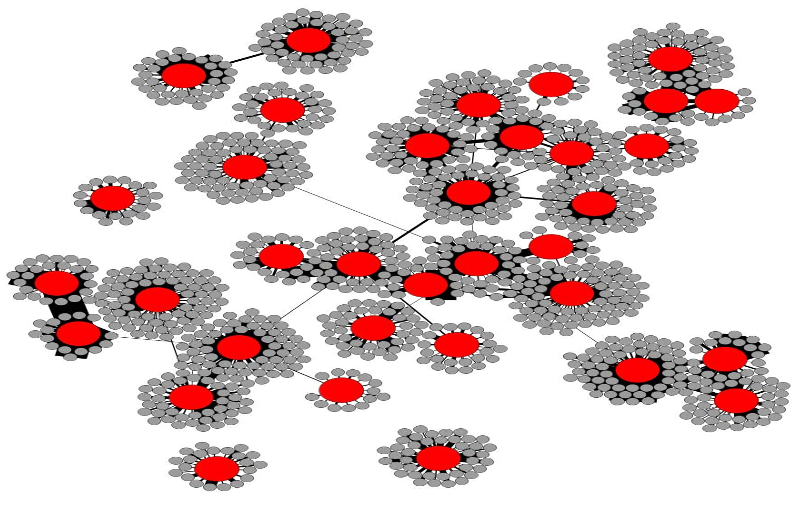 Fig 1: A comparison of the Facebook Graph (left) and the Weighted Contact Graph (right). Note the difference in density and connectivity.
Methodology: The Unified Network Model
The authors define a merged graph where edges are labeled based on their nature:
- Relationships only on Facebook ().
- Relationships only in real life ().
- Relationships existing in both layers ().
This allowed them to apply complex network metrics—like Betweenness and Eigenvector Centrality—to see if a "node" (a person) holds the same rank in both worlds.
Key Insights: Strength and Scarcity
1. The Overlap is Startlingly Low
The researchers found that on average, only 4% of a user's Facebook friends were met during the month-long experiment. Conversely, 45% of physical contacts involved Facebook friends, while many real-world encounters involved people who weren't even on the social network.
2. Popularity is Not Transferable
Using Spearman’s rank correlation, the study analyzed whether a "popular" person on Facebook (high degree centrality) is also a "bridge" in real encounters.
- Degree Centrality: The correlation between Facebook popularity and classroom popularity was weak (). Some "hubs" on Facebook were peripheral in daily physical interactions.
- Betweenness Centrality: This metric measures how much a person acts as a "bridge" for information. The study found that these rankings were almost uncorrelated across layers. A bridge in the digital world is rarely the bridge in the physical hall.
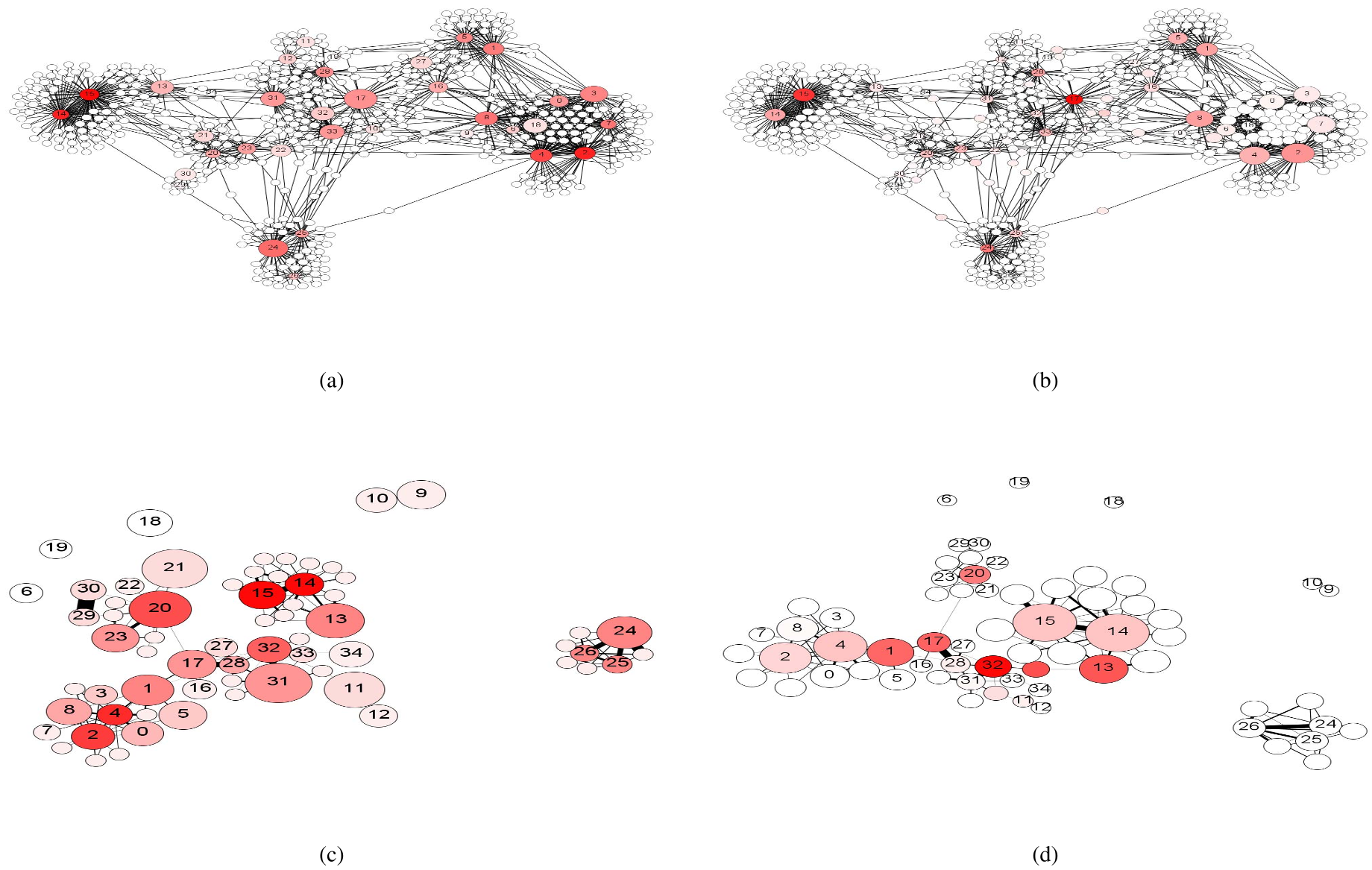 Fig 2: Visualization of centralities. Node size and color represent different metrics. You can see that the "hubs" in Facebook (Top) don't necessarily align with the influential nodes in the physical contact graph (Bottom).
Critical Analysis: What Does This Mean for Tech?
The study highlights a major flaw in current Recommendation Systems and Ad Targeting. If a system recommends a product based solely on Facebook "Common Neighbors," it may be failing because only 15% of those common neighbors actually interact in real life.
Limitations: The sample size (35 students) is small and represents a specific demographic (CS students). Furthermore, a one-month window might miss infrequent but significant real-world ties (e.g., meeting a childhood friend once a year).
Conclusion
The Facencounter paper proves that online and offline social networks are fundamentally different animals. While Facebook provides a "flat" view of connectivity, the physical encounter network is "sparse but deep." For future social technologies—like the Metaverse or Hyper-local Advertising—to succeed, they must stop treating the online graph as a perfect mirror of reality and start accounting for the unique weights of face-to-face interaction.