
Faces of Emotion: Decoding User Frustration through Facial EMG
Faces of emotion in human-computer interaction
The paper investigates the link between user emotions and interface usability by monitoring spontaneous facial expressions during software tasks. Using Electromyogram (EMG) sensors to measure muscle activity, the researchers established a baseline correlation between task difficulty and facial expressions in a Human-Computer Interaction (HCI) context.
TL;DR
Researchers from Harvard Medical School and IMEDIA explored whether our faces "tell on us" when software becomes difficult to use. By using Electromyogram (EMG) sensors to track facial muscle tension, they proved that as a task becomes more frustrating, specific facial muscles fire more frequently. This establishes a "biometric baseline" for building future software that can automatically sense when a user is struggling.
The "PC Rage" Problem: Why Clicking Isn't Enough
Despite decades of UI/UX improvements, user frustration remains rampant. Traditional usability studies—like heatmaps or click-stream analysis—tell us where a user went, but not necessarily how they felt about it. Previous attempts to measure emotion relied on heart rate or "Skin Conductivity" (Galvanic Skin Response), which are great for measuring general excitement (arousal) but poor at identifying the specific "flavor" of frustration.
The authors argue that the face is the most "honest" interface. By capturing spontaneous facial expressions, we can identify the exact moment an "adverse event" occurs without requiring the user to stop and fill out a survey.
Methodology: High-Fidelity Frustration Tracking
The researchers recruited 16 volunteers for a Microsoft Word formatting task. To guarantee frustration, they even performed a "destabilization" tactic: removing a specific font required for the task, making certain goals unsolvable.
The Sensor Array
They targeted three key muscle groups:
- Corrugator Supercilii: The "frown" muscle that pulls eyebrows down.
- Frontalis: The muscle that raises eyebrows.
- Zygomaticus Major: The muscle responsible for smiling.
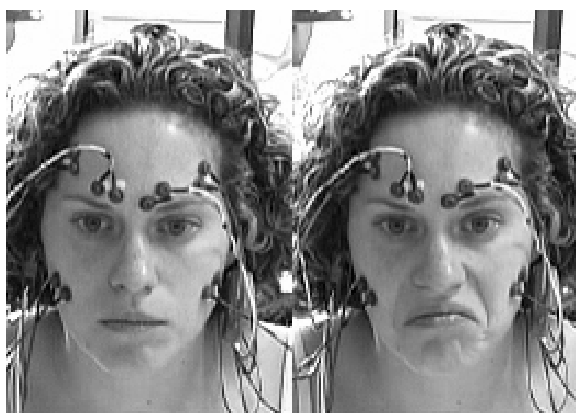
Rather than using a "think-aloud" protocol (which would distort facial muscle readings), they used a 6-point difficulty scale applied post-hoc to screen recordings, ranging from "Fine" (1) to "Cannot solve or quits" (6).
Key Insights and Results
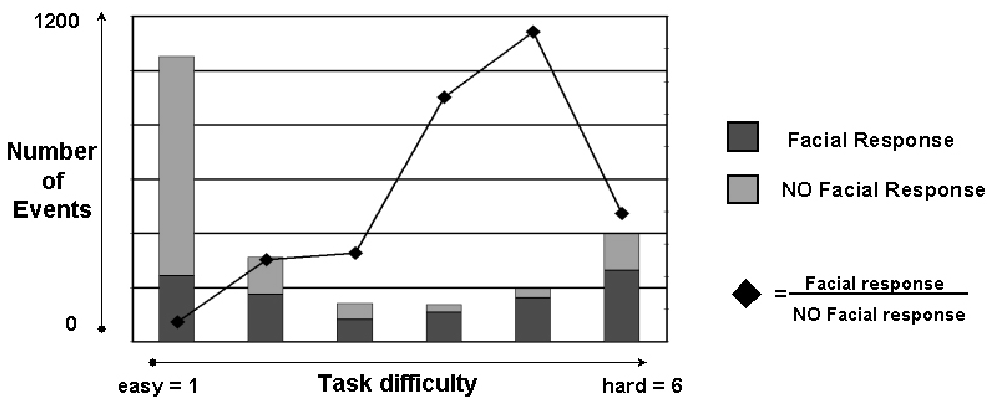
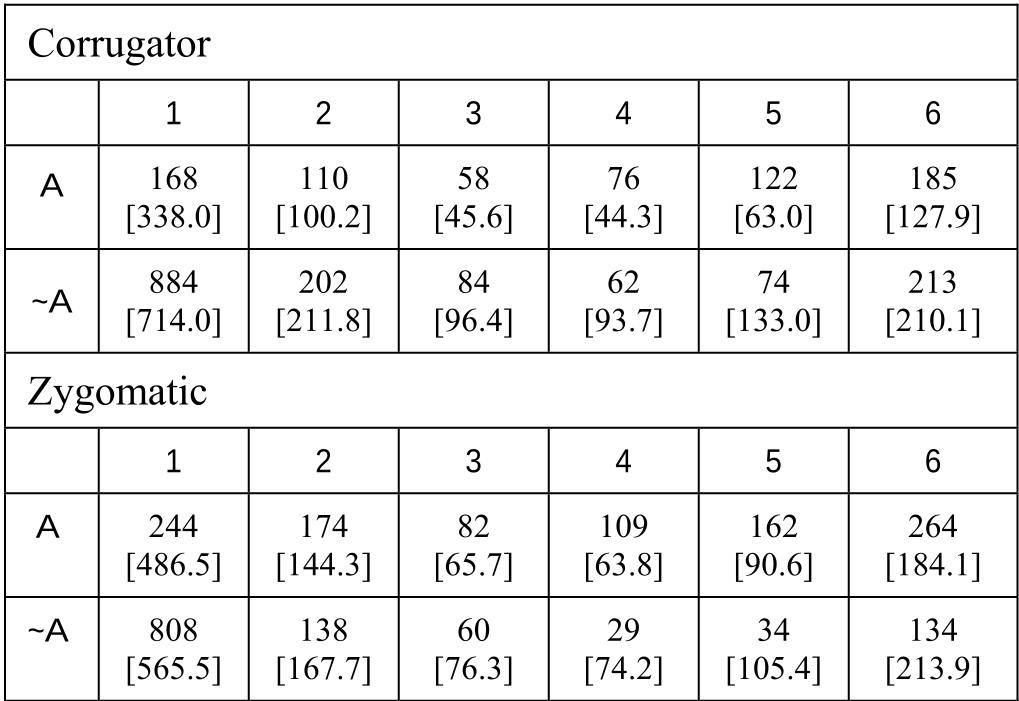
The study found a statistically significant link between muscle activity and task difficulty.
- The Frustration Paradox: Interestingly, the Zygomatic muscle (usually associated with smiling) showed strong activity during difficult tasks. This suggests that in HCI, "smiling" isn't always an indicator of joy—it can represent a grimace or a "nervous" reaction to software obstacles.
- The Resignation Dip: As shown in the data below, muscle activity peaked at difficulty level 5 but actually dropped at level 6. When users hit an unsolvable wall, they don't just get mad—they give up, leading to a state of "resignation" where facial activity essentially flatlines.
Deep Insight: Toward the "Unobtrusive" Usability Lab
The real value of this paper isn't the EMG sensors themselves—which are bulky and impractical for daily use—but the validation of the data. By proving that EMG signals correlate with software difficulty, the authors provide the necessary "ground truth" for training camera-based systems.
Limitations and Future Outlook
While the study was conducted in a controlled lab, real-world application faces hurdles:
- Context Sensitivity: How do we distinguish a frown caused by a software bug from a frown caused by a colleague walking into the room?
- Ethical Implications: Constant facial monitoring via webcam for "usability reporting" raises significant privacy concerns.
Conclusion
This work marks a shift from measuring what a user does to how a user feels. As webcams become ubiquitous and facial recognition algorithms (like those from Neven Vision mentioned in the text) become more sophisticated, the "frowning log" may become as common as the "crash report."
Takeaway for Designers: If your user is silent, they might not be happy—they might just be "resigned" (Level 6). Monitoring the subtle "micro-expressions" of the brow and mouth could be the key to identifying UX friction points that metrics alone miss.