
Faceted Identity: Why Being "Yourself" Online is Technically and Socially Broken
Faceted identity, faceted lives: social and technical issues with being yourself online
This paper introduces the concept of "Faceted Identity" to describe how individuals maintain distinct social boundaries across different life contexts (work, family, social). Through a questionnaire study of 631 participants, it evaluates how these facets are managed using different communication models in Email and Facebook, revealing that users strategically switch platforms to prevent role strain.
TL;DR
The industry-standard assumption that "you have one identity" online is a fundamental design flaw. This paper by Farnham and Churchill (CSCW '11) argues that humans naturally live "faceted lives," maintaining different personas for work, family, and hobbies. As social media forces these circles to collide, users experience significant "role strain," leading them to retreat to the privacy of Email for meaningful communication.
The "Singular Identity" Fallacy
In the early 2010s, the design philosophy of major social networks (notably Facebook) was built on the premise that a single, unified profile was sufficient for all social interactions. The authors argue this is not just a technical choice but a flawed sociological assumption.
In reality, a person might be a "nurturing mother" at home and a "formidable professor" at the university. These facets have different norms, behaviors, and audiences. When platforms push "context collapse"—forcing these audiences into one feed—it creates social friction.
Methodology: Measuring the "Facets"
The researchers surveyed 631 users to define three key constructs:
- Faceted Identity: The degree to which a person feels their life parts are separate.
- Facet Incompatibility: The extent to which these roles conflict (e.g., "party self" vs. "work self").
- Impression Management: The effort spent tailoring one's image to specific audiences.
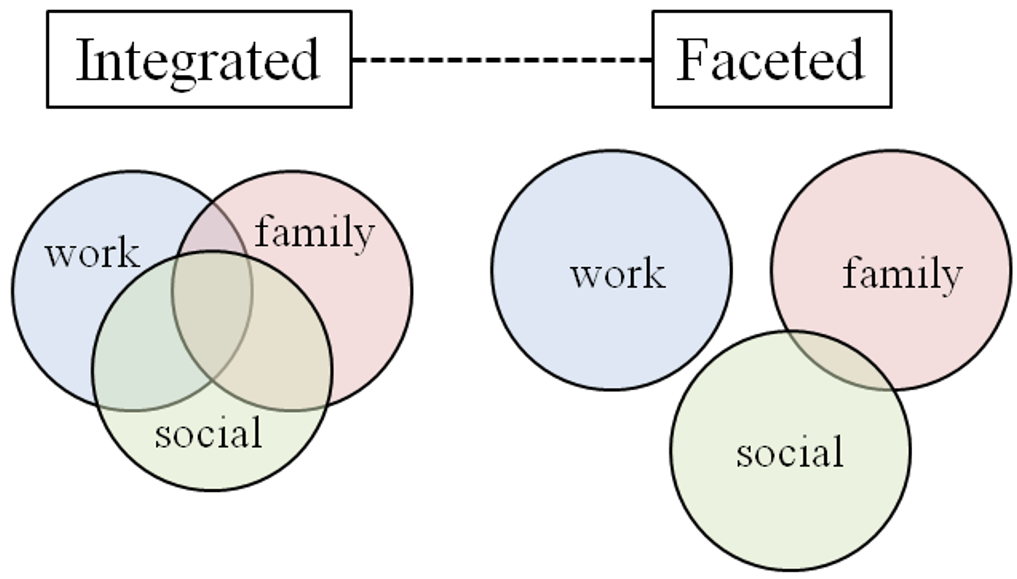 Figure 1: Visualizing how individuals vary in their degree of identity integration vs. segmentation.
Key Findings: The "Privacy Paradox" and Platform Utility
The study revealed a stark contrast in how we use different tools:
- Email as a Shield: Email is not being replaced by social networks; instead, it is used for "Serious Social" interactions. Because Email requires explicit recipient selection, it is the preferred tool for those with high facet incompatibility.
- The High-Risk Groups: Single, working men were found to have the highest levels of incompatible facets. Conversely, women with children showed more integrated identities.
- The Barrier of Worry: A direct correlation exists between how "different" your life segments are and how much you worry about sharing on social networks.
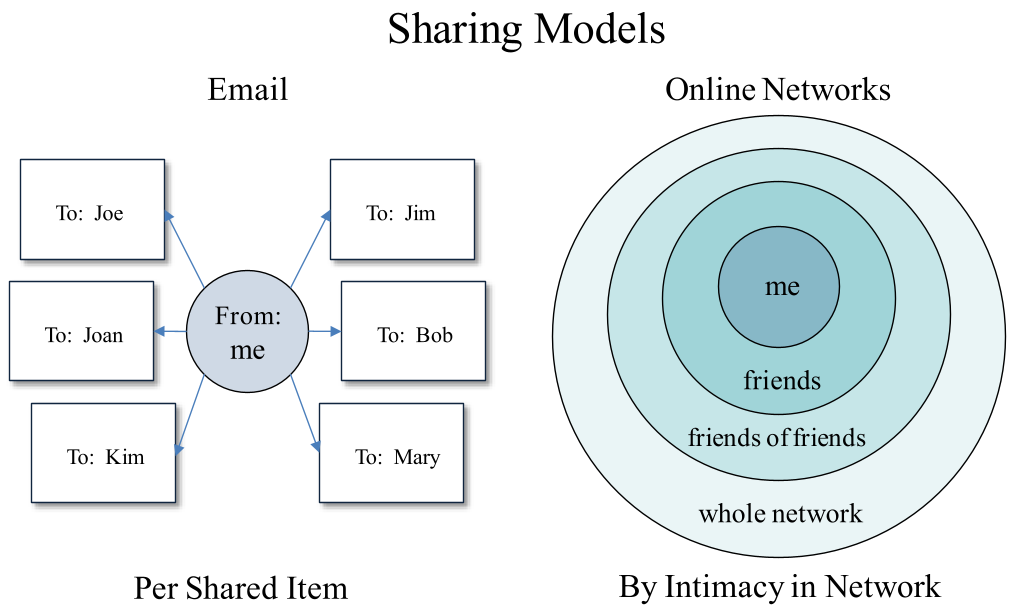 Figure 2: The structural difference between the Broadcast Model of social networks and the Controlled Sharing Model of Email.
Why This Matters Today
While this paper was published in 2011, its insights are more relevant than ever in the age of "Cancel Culture" and professional brand management. The "leaking" of information from one life facet to another (e.g., an old tweet being judged by a new employer) is the exact "role strain" the authors predicted.
Critical Analysis & Conclusion
The core takeaway is that privacy is not just about hiding information; it is about controlling the flow of information between facets of the self.
Limitations: The study was conducted on a Yahoo-based demographic which skewed older (median age 50). Younger "digital natives" might have different strategies for integration, or perhaps they have simply become more adept at self-censorship.
Future Outlook: For developers of AI-driven social tools or communication platforms, the goal should not be to build a "better profile" but to build better "context filters." Systems that can automatically distinguish between professional and personal contexts—and provide seamless switching between them—will win the next generation of social interaction.