
Min-Max Similarity: A Lightweight Precision Strike for Facial Emotion Recognition
Facial emotion recognition using min-max similarity classifier
This paper introduces an efficient Facial Emotion Recognition (FER) algorithm utilizing a Min-Max Similarity Classifier within a Nearest Neighbor framework. By combining Gaussian pixel normalization with a similarity metric designed to suppress outliers, the method achieves a SOTA accuracy of 98.57% on the JAFFE database.
TL;DR
Researchers have developed a surprisingly simple yet powerful approach to facial emotion recognition (FER) that sidesteps the need for heavy Deep Learning or complex dimensionality reduction. By focusing on pixel-level normalization and a specialized Min-Max similarity metric, the algorithm achieved a record-breaking 98.57% accuracy on the JAFFE database, proving that "less is more" when dealing with feature outliers.
Back to Basics: Why Complex Models Fail at the Edge
Facial expressions are notoriously difficult for machines to "match" because of natural variability. A slight change in lighting or a minor tilt of the head can cause huge pixel-level mismatches (intra-class variation).
Current SOTA methods usually throw massive architectures like CNNs or high-dimensional descriptors (like Gabor wavelets) at the problem. However, these methods:
- Demand high computational power, making them unsuitable for smart vehicles or embedded security systems.
- Suffer from outliers: Standard classifiers like KNN or SVM often fail to distinguish between meaningful facial shifts and random noise/occlusion.
The Core Innovation: Min-Max Similarity
The authors propose a specialized similarity measure in a Nearest Neighbor framework. The intuition is elegant: the ratio of the minimum value to the maximum value of two compared pixels will be exactly 1 for a perfect match and decrease toward 0 as the mismatch grows.
1. Gaussian Normalization
Before matching, the image undergoes Gaussian normalization using local mean () and standard deviation (). This effectively "flattens" the illumination, making the features invariant to light intensity changes.
2. Outlier Suppression
The secret sauce lies in the exponential parameter . By setting in their similarity formula: The classifier non-linearly penalizes differences. This "squashing" effect ensures that outlier pixels (caused by noise or unusual shadows) have a minimal impact on the final decision, while consistent features are amplified.
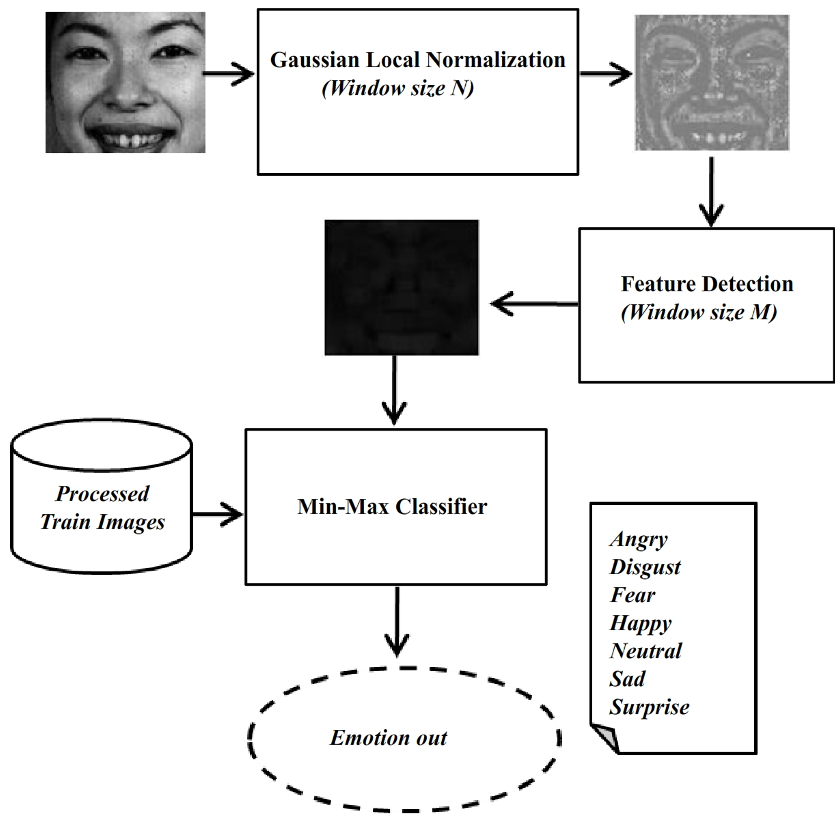 Fig 1: The pipeline from cropping to Min-Max classification.
Experimental Results: Beating the Giants
The performance on the Japanese Female Facial Expression (JAFFE) database was remarkable. Using a leave-one-out cross-validation, the Min-Max classifier outperformed established heavyweights.
| Method | Accuracy |
|---|---|
| Convolutional Neural Network (CNN) | 95.80% |
| DWT + 2D-LDA + SVM | 95.71% |
| Proposed Min-Max Method | 98.57% |
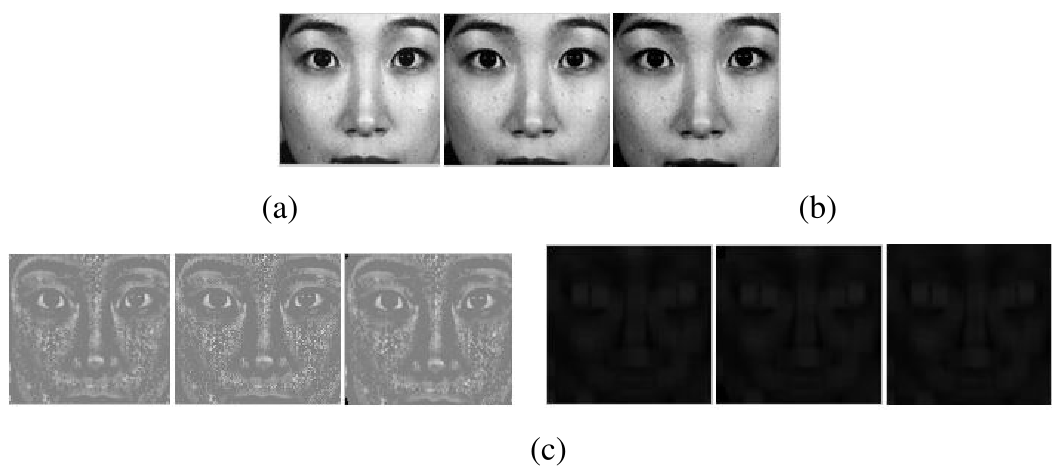 Fig 2: Robustness to illumination. Whether light is added or subtracted (row a), the normalized features (row b) and final detected features (row c) remain consistent.
Conclusion & Critical Analysis
This work represents a significant victory for template matching. It proves that for specific tasks like FER, we don't always need millions of parameters; sometimes, a robust understanding of the underlying signal statistics is enough.
Strengths:
- Efficiency: Extremely low computational footprint—ideal for real-time applications on mobile or IoT devices.
- No Black Box: The feature extraction and classification are mathematically transparent.
Limitations:
- Storage: Being a template-based method, it requires storing representative templates for each class, which may scale poorly as the number of "classes" or "identities" grows.
- Scalability: While excellent for the JAFFE dataset, its performance on more "in-the-wild" datasets with extreme pose variations remains to be seen.
Future Outlook
The Min-Max metric could potentially be adapted into the loss functions of modern neural networks to help them become more robust to outliers. It also opens doors for low-power biometric matching in wearable health devices where power consumption is the ultimate constraint.