
Specialized FER: Decoding Facial Expressions in the Ageing Population
Facial Expression Recognition in Ageing Adults: A Comparative Study
This study presents a Deep Learning approach for Facial Expression Recognition (FER) specifically targeting ageing adults using a Convolutional Neural Network (CNN) architecture. Evaluated on the FACES dataset, the method achieves specialized state-of-the-art results for older demographics, outperforming traditional handcrafted feature methods by a margin of 8.2%.
TL;DR
Recognizing emotions in elderly faces is notoriously difficult due to age-related structural changes like wrinkles that resemble permanent expressions. This paper introduces a CNN-based pipeline that replaces traditional handcrafted features with automated deep learning. By leveraging the FACES dataset and advanced data augmentation, the authors achieved over 93% accuracy for older adults, outperforming traditional machine learning baselines by a significant 8% margin.
Background: The Hidden Complexity of Aging Faces
In the context of an aging global population, automated Facial Expression Recognition (FER) is becoming vital for assistive robotics and medical technology. However, there is a technical wall: Ageing. Most SOTA models are trained on young or middle-aged subjects. When applied to the elderly, the "Inductive Bias" of handcrafted features (like geometric landmarks) fails because permanent facial folds can be misinterpreted by the model as active emotional signals (e.g., sadness or anger).
Methodology: Beyond Handcrafted Descriptors
The authors argue that manual feature engineering—such as Active Shape Models (ASM) or Local Binary Patterns (LBP)—is too rigid for the nuanced textures of older skin.
1. The Pipeline
The system utilizes a multi-stage pre-processing workflow:
- Data Augmentation: To solve the "Small Data" problem in geriatric datasets, they used flipping, rotation, and noise injection to expand the dataset 32-fold.
- Normalization: They employed CLAHE (Contrast Limited Adaptive Histogram Equalization) to enhance contrast without amplifying noise, which is crucial for identifying subtle muscle movements under wrinkled skin.
2. CNN Architecture
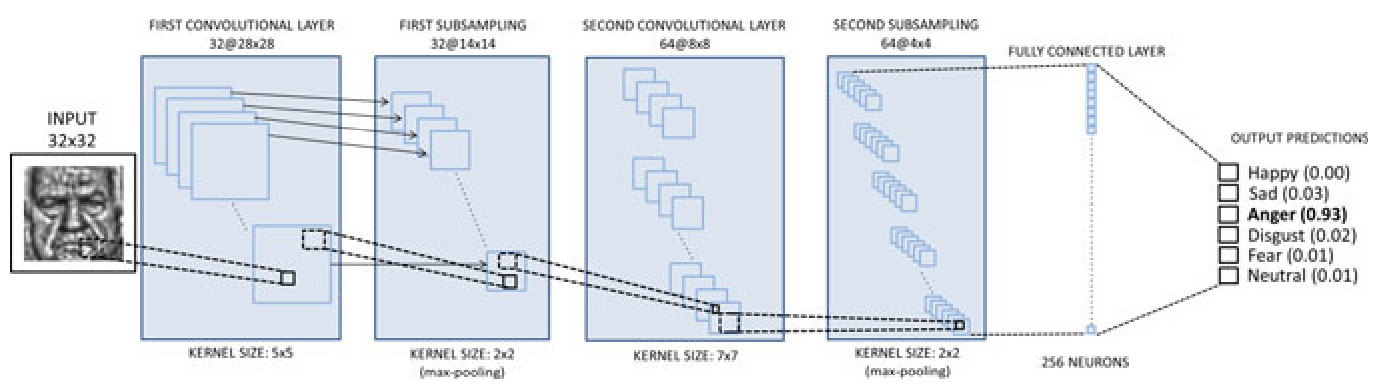
The core is a refined LeNet-5 style architecture. It consists of two convolutional layers paired with max-pooling, culminating in a fully connected layer with a Softmax output.
- Feature Learning: The first layer captures simple edges; the second identifies contextual face elements.
- Invariance: This structure provides higher invariance to geometric transformations than manual landmarking.
Experiments and Results
The study used the FACES database, unique for including labeled expressions from subjects aged 19 to 80.
Quantitative Performance
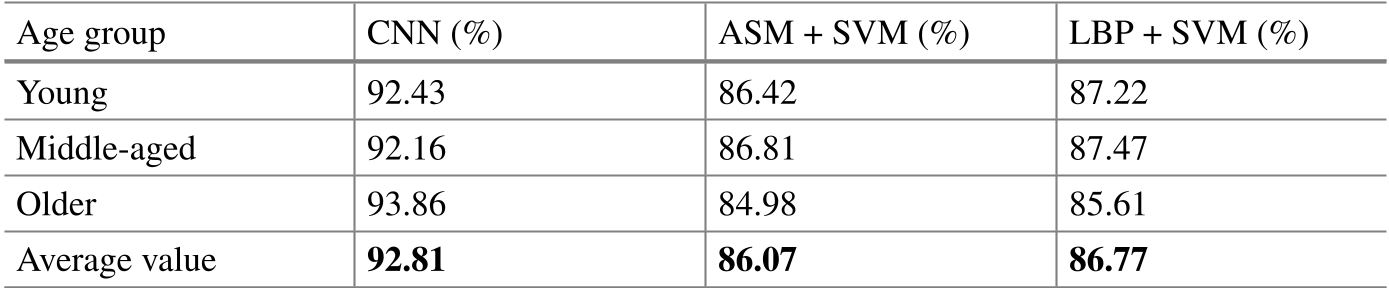
The CNN significantly beat the traditional baselines (ASM and LBP):
- Older Group Accuracy: CNN (93.86%) vs. LBP (85.61%).
- Observation: Interestingly, while traditional methods performed better on younger faces than older ones, the CNN actually performed its best on the older demographic, proving it successfully learned to navigate age-related noise.
Confusion Matrix Insights
For older adults:
- High Performance: Anger and Fear were recognized with nearly 95-97% accuracy.
- The Challenge: Sadness and Neutral states were the most frequently confused. This validates the "masked expressivity" theory in elderly subjects, where resting facial features can look naturally "sad."
Critical Analysis & Conclusion
Takeaway
The primary contribution is demonstrating that unsupervised feature learning (CNNs) is superior to supervised manual design for specific demographic subsets. By allowing the network to find its own relevant "age-invariant" triggers, the model overcomes the bias inherent in human-defined landmarks.
Limitations
- Frontal Bias: The study relies on frontal, well-lit images. In real-world assistive tech (like home cameras), faces are often viewed at oblique angles.
- Architecture Complexity: The LeNet-5 style is relatively shallow by modern standards.
Future Work
The authors suggest moving toward more complex architectures like ResNet or VGG and exploring non-frontal views to make the technology viable for "Smart Home" environments where elder monitoring is critical for safety and wellbeing.