
DTP: Advancing Gender Classification through Directional Edge Quantization
Facial feature representation with directional ternary pattern (DTP): Application to gender classification
This paper introduces the Directional Ternary Pattern (DTP), a novel facial feature descriptor for gender classification. DTP encodes local texture by quantizing directional edge responses into three levels, achieving a SOTA classification accuracy of 93.11% on the FERET database.
TL;DR
Determining gender from facial images remains a cornerstone of biometrics and HCI. This paper proposes the Directional Ternary Pattern (DTP), a robust descriptor that moves beyond simple pixel comparisons. By encoding the "significance" of edges in eight directions and using a ternary logic to handle smooth surfaces, DTP achieves a superior 93.11% accuracy on the FERET database, proving more resilient than traditional LBP or LDP methods.
Problem & Motivation: The Fragility of Local Patches
Most facial recognition pipelines rely on local descriptors to build a feature vector. However, the industry-standard Local Binary Pattern (LBP) has a fatal flaw: it is binary. A tiny shift in lighting or a speck of sensor noise can flip a bit, leading to inconsistent features.
While newer methods like Local Directional Pattern (LDP) utilize edge responses (which are more stable than raw light intensity), they force a binary choice on every direction. This creates "unstable codes" in smooth areas of the face—like the forehead or cheeks—where there isn't actually a dominant edge. The authors' intuition was simple: if we can't find a strong edge, we should label it as 'neutral' (0) rather than forcing it into a binary 0 or 1.
Methodology: The Power of Eight Directions
DTP transforms the image into a more stable representation through a three-step process:
- Directional Filtering: Instead of comparing center pixels to neighbors, DTP applies Robinson masks in eight orientations (North, East, South, West, and diagonals) to calculate the "edge response" for every pixel.
- Ternary Quantization: Unlike binary patterns, DTP compares each response to the average () of all eight responses. It uses a threshold ():
- +1: If the response is significantly higher than average (strong edge).
- 0: If the response is near the average (smooth texture).
- -1: If the response is significantly lower than average.
- Code Splitting: To keep the feature vector manageable, the ternary code is split into a Positive DTP (PDTP) and a Negative DTP (NDTP), which are converted into histograms.
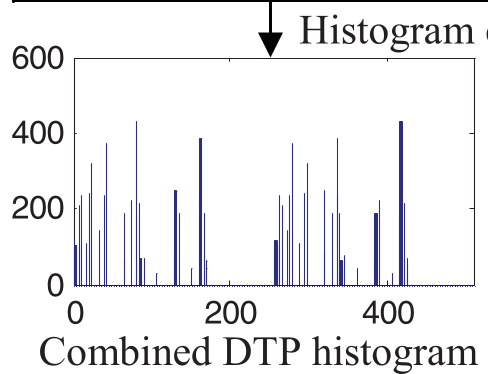 Above: The DTP operator converts image gradients into stable ternary codes, capturing the local "pulse" of the texture.
Spatial Intelligence
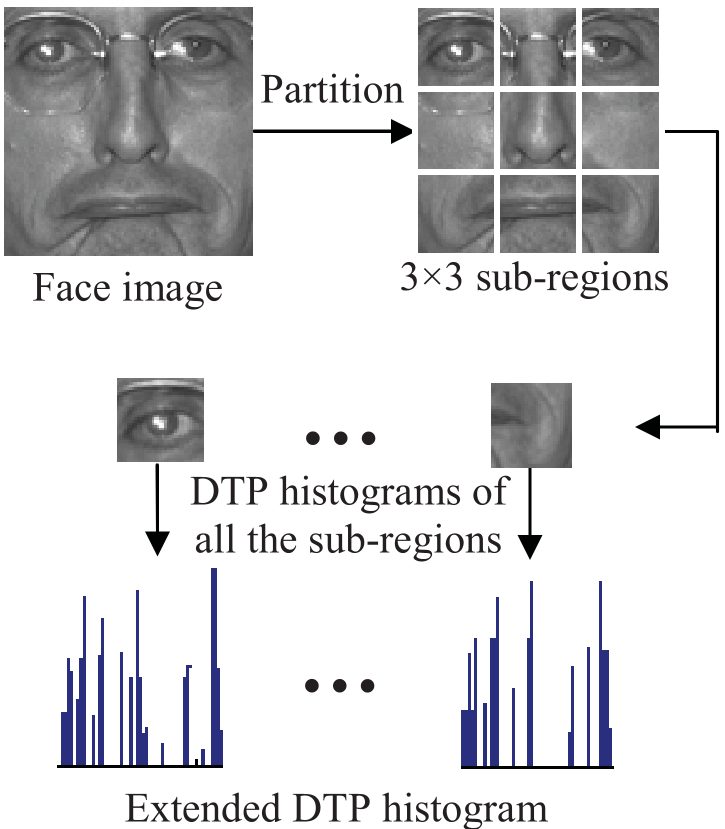
To capture the global structure of a face (e.g., the position of eyes vs. mouth), the authors don't just aggregate one histogram. They partition the face into a grid (e.g., ) and concatenate the histograms from each sub-region. This injects spatial context into the machine learning model (SVM), allowing it to recognize that a specific edge pattern near the jawline is more indicative of gender than one on the forehead.
Experimental Validation
Testing on 1,800 images from the FERET database, the authors conducted a rigorous 10-fold cross-validation.
Key Findings:
- The Threshold Matters: A threshold of was found to be the "sweet spot" for filtering noise without losing vital facial details.
- Resolution of Grid: Increasing the grid from to significantly boosted accuracy (from 85.78% to 93.11%), highlighting the importance of local spatial relationships.
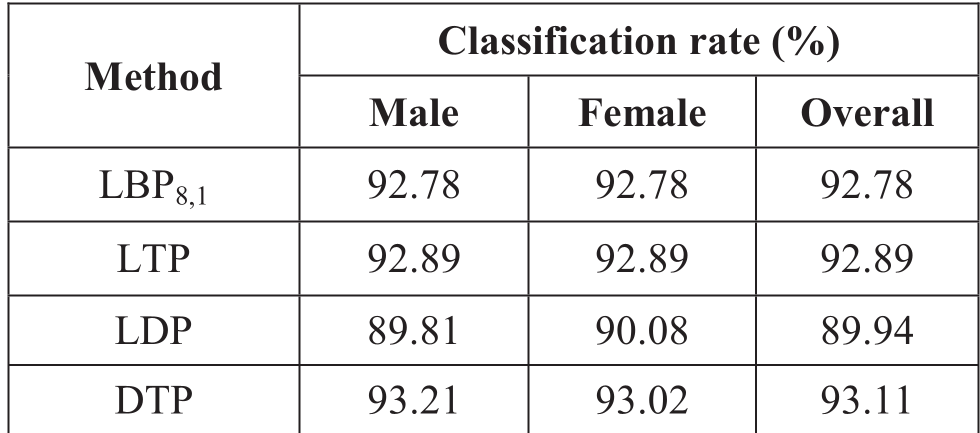
- Superiority Over SOTA: DTP consistently outperformed LBP and the more recent LDP, particularly because LDP's binary nature struggled with the "smooth" regions of the face.
Critical Analysis & Conclusion
Takeaway
The Directional Ternary Pattern successfully marries two powerful concepts: directional edge stability and ternary noise-insensitivity. It effectively solves the instability of LDP in smooth regions while retaining the computational efficiency required for real-time biometrics.
Limitations
While DTP is robust, the current implementation results in a fairly large feature vector (25,088 dimensions for a grid), which may increase latency in low-power mobile applications. Furthermore, the threshold is "user-specified," suggesting that an adaptive threshold based on local image contrast might be a valuable future improvement.
Future Outlook
DTP provides a template for how we can "clean" input data before feeding it into classifiers. In the era of Deep Learning, DTP-like layers could serve as non-trainable, robust front-ends to CNNs, potentially reducing the massive data requirements for training gender-specific models.