
Social VPN: Turning Your Friend List into a Secure Virtual Infrastructure
Facilitating the deployment of ad-hoc virtual organizations with integrated social and overlay networks
The paper introduces a novel framework for deploying ad-hoc Virtual Organizations (VOs) by integrating social networking platforms with self-configuring peer-to-peer (P2P) overlay networks. It leverages existing social trust relationships to automate the complex process of cryptographic key exchange and IPsec tunnel configuration, achieving a "Social VPN" for secure resource sharing.
TL;DR
Deploying secure, cross-organizational computing environments (Virtual Organizations) has long been a headache for researchers due to the complexity of PKI and networking. This paper proposes a Social VPN approach: leveraging social networks (like Facebook) to bootstrap trust and automatically configure P2P overlay networks (IPOP), allowing non-experts to create secure, ad-hoc clusters for resource sharing with zero manual configuration.
The "Overhead" Barrier: Why VOs Fail to Scale
Large-scale Virtual Organizations (VOs) like the Large Hadron Collider's computing grid are successful because they have the budget for full-time sysadmins. However, small-to-medium collaborations usually die in the "configuration phase."
The two primary friction points are:
- Trust Management: Setting up a Public Key Infrastructure (PKI) and Certificate Authorities (CA) is daunting.
- Connectivity: NATs, firewalls, and diverse ISP policies make end-to-end communication for distributed tools (like Condor or MPI) nearly impossible without complex tunneling.
The authors' insight is simple: We've already mapped our trust relationships—not in a technical database, but on social networks.
Methodology: The Architecture of a Social VPN
The system merges the "Human" layer (Social Networks) with the "Protocol" layer (P2P Overlay).
1. The Trust Bootstrap
Instead of a manual CA, the system uses a social network API to:
- Authenticate the user.
- Generate RSA key pairs automatically.
- Publish the public key and virtual IP to the user's social profile (e.g., via Facebook's DataStore).
2. The IPOP Overlay
The technical backbone is the IPOP (IP-over-P2P) network. This overlay creates a virtual tap device on the user's machine, providing a consistent IPv4 address regardless of the physical network.
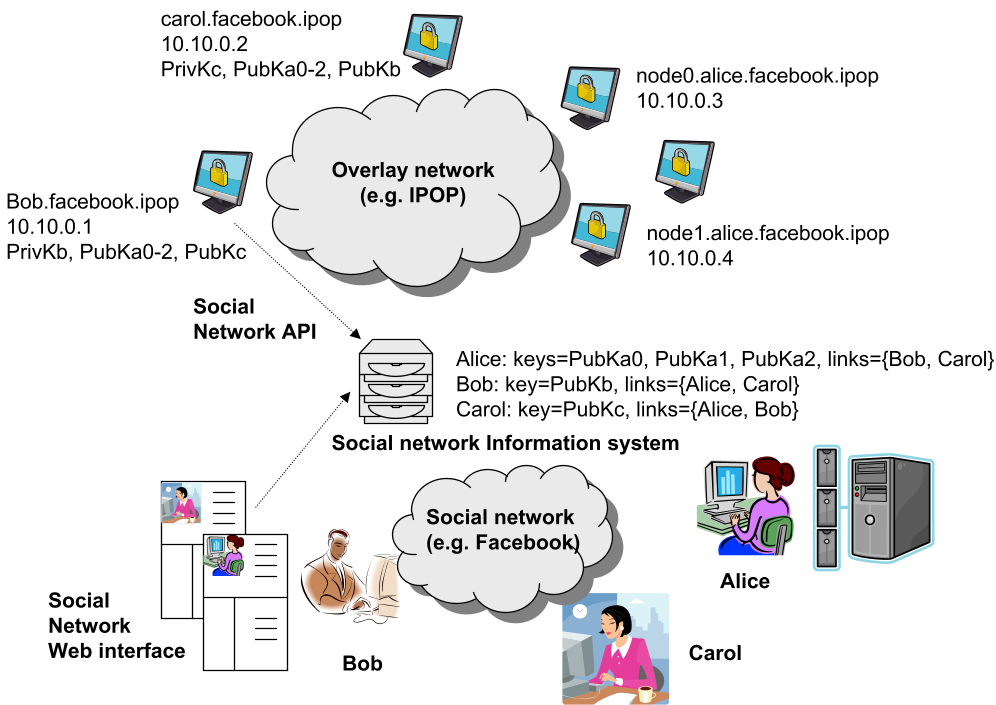 Figure 1: The integration of social layers (trust/key exchange) and overlay layers (IP tunnels).
3. Transparent Execution
When Alice "friends" Bob on the social network:
- The Social VPN middleware polls the API.
- It fetches Bob's public key and virtual IP.
- It automatically configures an IPsec tunnel between Alice and Bob.
- Standard applications (e.g.,
ssh bob.facebook.ipop) just work.
Use Case: The Social Condor Pool
The most powerful application is "Social Cycle-Sharing." By packaging this stack into a Virtual Machine (VM) appliance, users can create a Condor pool (a high-throughput batch scheduler) that scales across friends' idle workstations.
The workflow transitions from manual networking to social interaction:
- Alice starts a "Manager" appliance.
- She invites Bob and Carol via the social app.
- Their "Worker" appliances automatically join the pool over the encrypted Social VPN.
Experimental Validation
The paper validates this via a prototype using the Facebook API and IPOP. The implementation handles:
- P2P Peer Discovery: Using DHTs to find nodes behind NATs.
- Dynamic DNS: Mapping social IDs to virtual IPs.
- Isolation: Virtual namespaces ensure that different VOs don't leak traffic to each other, even if they share the same physical P2P substrate.
Critical Insight & Future Outlook
While this paper was written in 2008 (the era of early Facebook and Grid Computing), its core philosophy—Identity as Infrastructure—is more relevant than ever.
Strengths:
- User-Centric: It correctly identifies that "social trust" is a prerequisite for "computational trust."
- Transparency: By using a virtual TAP device, existing legacy software requires zero modifications.
Limitations:
- Social Provider Lock-in: Relying on a single API (like Facebook) creates a SPOF (Single Point of Failure). Modern iterations would likely use Decentralized Identifiers (DIDs).
- Scalability of Trusted Lists: As the number of "friends" grows, the IPsec mesh connectivity could face performance bottlenecks.
Conclusion
This work paved the way for modern "Socially-aware Networking." It proves that the "Human Factors" of distributed systems are just as important as the throughput and latency. For today’s developers, it suggests that the best way to deploy complex infrastructure is to hook into the identity systems users already trust.