
Scaffolding Action with Language: How Linguistic Instructions Enable Complex Robot Manipulation
15192_The Facilitatory Role of Linguistic Instructions on Developing Manipulation Skills.
This paper presents a simulated iCub humanoid robot that learns to reach, grasp, and lift objects using a Recurrent Neural Network (RNN) trained via evolutionary algorithms. The study demonstrates that providing binary linguistic instructions as supplementary sensory input significantly facilitates the acquisition of complex, multi-phase motor sequences.
TL;DR
Researchers have demonstrated that for a humanoid robot to master the sequence of reaching, grasping, and lifting, motor skills alone aren't enough. By providing "linguistic" cues that label task phases, a neural-controlled iCub simulation was able to bridge the gap between elementary actions and complex behavioral sequences, a feat it could not achieve through trial-and-error alone.
The "Transition" Problem in Robotics
Why is it so hard for a robot to move from grabbing an object to picking it up? For a robot controlled by a neural network, the "sensory-motor state" (what it sees and feels) when its hand is wrapped around a ball is nearly identical to the state when it is about to lift it. Without a clear signal to change its internal state, the robot often gets "stuck" in a behavioral loop or plateaus in its learning process.
Existing robotic control often relies on hand-coded finite state machines. This paper argues for an emergent approach: let the robot discover its own motor strategies, but provide language as a "roadmap" to navigate the complexity of the task.
Methodology: Muscles, Neurons, and Words
The researchers employed an anthropomorphic model based on the iCub, a robot designed for developmental research.
1. The Muscle Model
Instead of simple position control, the arm uses antagonistic muscle pairs (Hill's model). This provides "compliance"—the arm isn't a rigid machine but behaves more like biological tissue that can react to collisions and external forces naturally.
2. The Recurrent Neural Network (RNN)
The "brain" is a Recurrent Neural Network. Crucially, the recurrent connections allow the robot to have a "memory" of previous states. In the experimental group, three specific neurons were dedicated to Linguistic Instructions:
[1, 0, 0]- "Reach the object"[0, 1, 0]- "Grasp the object"[0, 0, 1]- "Lift the object"
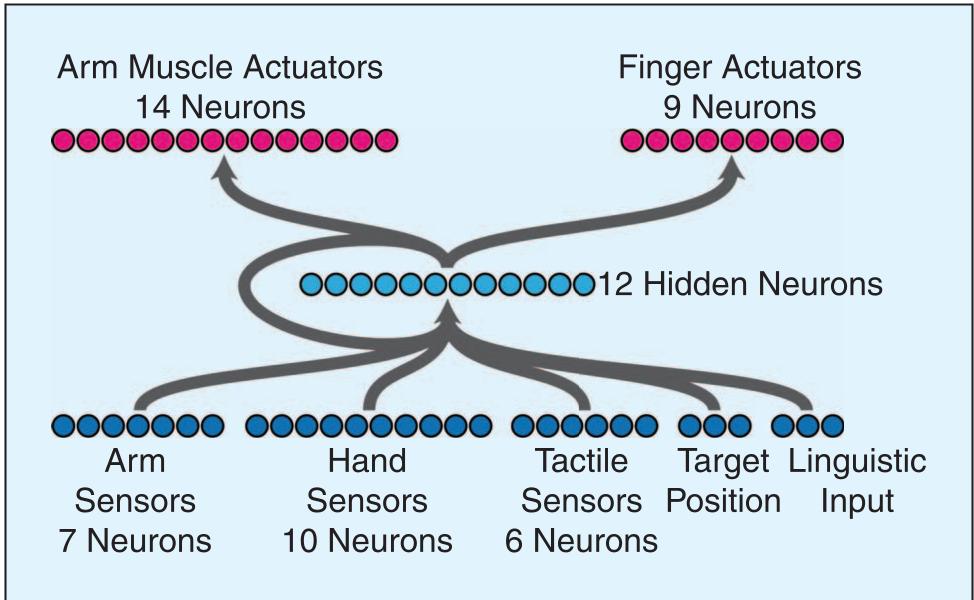 Figure 1: The RNN architecture showing the integration of tactile, proprioceptive, and linguistic inputs.
Experiments: The Power of Scaffolding
The team ran two conditions: Exp A (With Language) and Exp B (No Language).
The results were conclusive. In Exp B, robots learned to reach and even grasp, but they almost never learned to lift. The fitness curve reached a plateau. In contrast, Exp A (specifically Run 7) showed a distinctive "step-wise" growth in fitness. As the linguistic signal changed, the robot evolved specific weights to handle the transition from grasping to lifting.
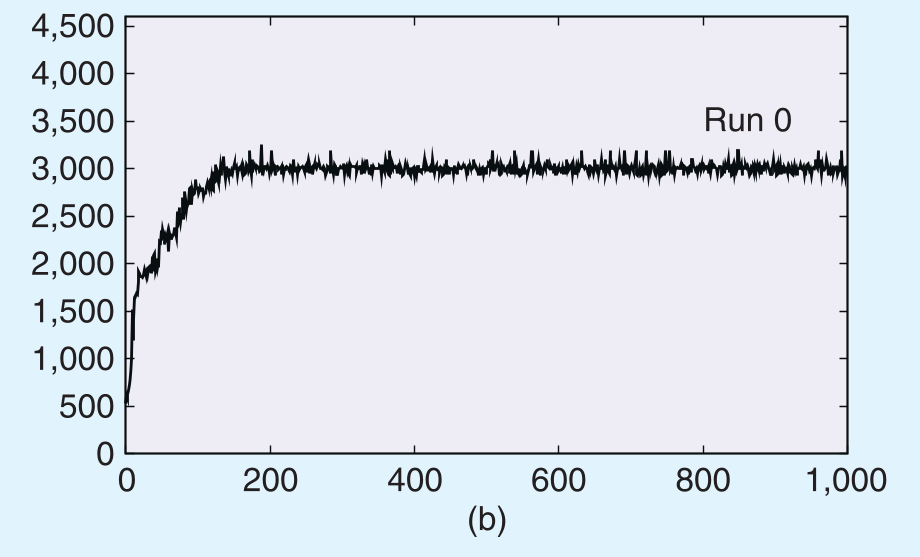 Figure 2: Fitness curves showing that only with linguistic cues (Run 7, Exp A) did the robot master all three task phases.
Critical Insight: Why Does It Work?
The authors suggest that the linguistic instruction acts as a contextual anchor.
- Reach to Grasp: This transition has high sensory differentiation (the hand goes from open space to touching an object). Even without language, robots can learn this transition.
- Grasp to Lift: This transition has low sensory differentiation. The robot is still touching the object. Here, the "linguistic label" provides the necessary push to switch the neural state from "hold" to "pull up."
Future Outlook and Limitations
While highly successful in simulation, the linguistic instructions were provided by an external "experimenter." The next logical step, which the authors acknowledge, is internalization. Can the robot learn to "talk to itself"? In human development (as per Vygotsky), children use "private speech" to guide their own complex actions.
The ultimate goal is to move this from the Newton Game Dynamics simulation to the physical iCub hardware, utilizing its 6-axis force sensors to emulate the muscle-like compliance demonstrated in this study.
Conclusion
This work highlights that language is not just for communication—it is a cognitive tool for action. By labeling the world and our actions within it, we provide the skeletal structure upon which complex behavior can be built.