
Twitter’s Information Overload: Solving the Timeline Problem with Machine Learning
Understanding factors that affect response rates in twier
This paper investigates the factors influencing user interaction on Twitter (replies and retweets) to combat information overload. It proposes a timeline reordering system using Naive Bayes and Support Vector Machine (SVM) classifiers, achieving a 50-60% increase in the visibility of high-interest tweets in the top positions of a user's feed.
TL;DR
Social media users are drowning in a "flood of information," where only a small fraction of content is actually worth reading. This seminal research by Comarela et al. moves beyond simple reverse-chronological feeds. By analyzing a massive dataset of 1.7 billion tweets, the authors identify key behavioral signals—like how often a person tweets and your past relationship with them—to reorder timelines. The result? A 50-60% boost in finding the tweets you actually want to reply to at the very top of your feed.
The Problem: The "Chronological" Tax
In the early days of Twitter, the reverse-chronological feed was king. However, as the network grew, active users began receiving thousands of tweets daily. Research suggests that only 36% of a Twitter feed is worth reading.
The authors argue that the traditional feed forces a "search tax" on users. Their data shows that users often have to dig through hundreds of messages to find something to interact with. If a tweet isn't seen quickly, its chance of receiving a reply or retweet drops exponentially.
Research Insight: The Signals of "Interestingness"
Instead of looking at what a tweet says (which is computationally expensive for mobile devices), the researchers looked at how users interact. They discovered three critical factors:
- Tweet Age: The probability of interaction peaks immediately and decays. However, retweets have a "longer tail" than replies—people share old news but rarely join old conversations.
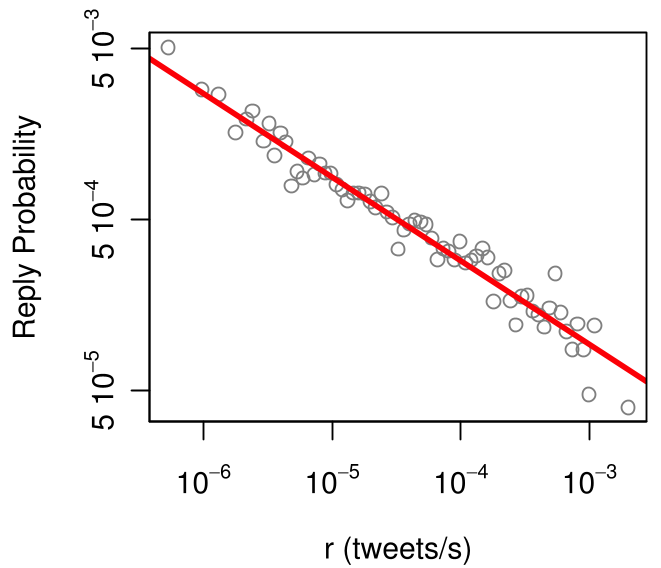
- Sender Rate: Users are actually less likely to interact with "loud" accounts that post constantly. High-volume senders essentially dilute their own importance.
- Prior Interaction: If you have replied to someone once, you are 5 times more likely to retweet them in the future.
Methodology: Re-engineering the Timeline
The authors proposed a two-step approach to fix the feed:
1. The ON-OFF Model
Since we don't always know when a user is looking at their screen, the researchers built an "ON-OFF" model. By looking at gaps in posting activity, they determined that a "session" usually lasts until there is a 3-hour break (). This allows the system to know when to "batch" and "re-rank" tweets that arrived while the user was away.
2. Machine Learning Re-ranking
They tested two lightweight models:
- Naive Bayes: Calculates a score by multiplying the independent conditional probabilities of the three signals mentioned above.
- SVM (Support Vector Machine): A classifier that categorizes tweets into "Interesting" or "Not Interesting," then pushes the interesting ones to the top.

Performance: Quantitative Gains
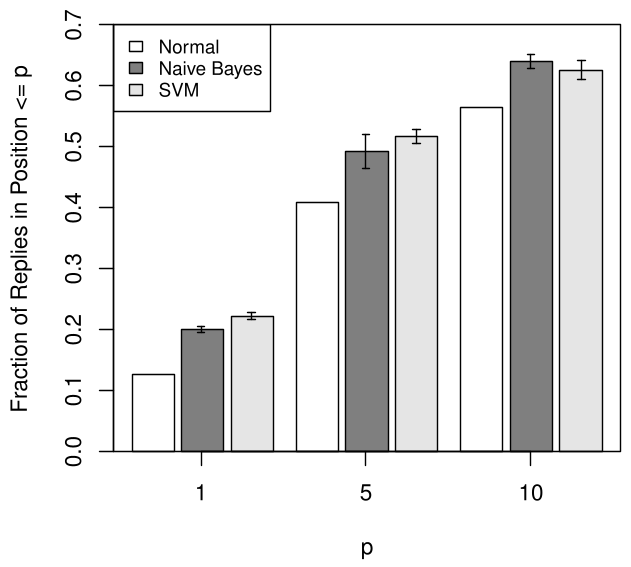
The simulation results were striking. By using these algorithms:
- The fraction of high-value tweets appearing in the 1st position increased by 50%.
- The system worked effectively for both "Active" users (who check often) and "Passive" users (who check rarely).
- Crucially, these gains were achieved without reading the text of the tweets, making the system fast and privacy-friendly.
Critical Analysis & Conclusion
The value of this work lies in its simplicity. While modern algorithms use complex LLMs to understand sentiment, this paper proves that metadata is power. By understanding the "rhythm" of a user's social circle, we can filter the noise effectively.
Limitations: The study assumes that a "Reply" or "Retweet" is the ultimate measure of importance. In reality, a user might find a tweet highly valuable but choose to simply read it (a "lurker" behavior) which this model doesn't fully capture.
Future Outlook: This methodology paved the way for the "Home" vs. "Latest" toggle we see on platforms today. For developers of niche social apps or decentralized protocols (like Bluesky or Farcaster), these content-independent features remain the most cost-effective way to implement high-quality discovery.