
Digital Altruism: Why Technology Security Outweighs Branding in SNS Donations
Factors influencing intention to donate via social network site (SNS): From Asian’s perspective
This study investigates the determinants of online donation intentions via Social Network Sites (SNS) among Asian donors (specifically from Malaysia and South Korea). Utilizing Structural Equation Modelling (SEM), it identifies "Internet technology features" as the primary driver of general attitudes toward online donation, which subsequently dictates the intention to donate via SNS.
TL;DR
In the era of social media, one might assume that a compelling "Charity Project" or a prestigious "Charity Organization" would be the primary driver for donations. However, a study of Asian donors reveals a surprising reality: Internet Technology Features (Security and Privacy) are the only factors that significantly shape the attitude toward online giving. Without a foundation of technical trust, even the most noble cause fails to trigger a donation via Social Network Sites (SNS).
The "Relationship Gap" in Online Giving
For years, non-profits have treated the Internet as a digital brochure. While Web 2.0 and SNS (Facebook, Twitter) promised interactivity, many organizations still struggle to convert "Likes" into "Dollars." The researchers identified a core problem: we don't fully understand the "Why" behind the "How." Why do users who follow a charity's page hesitate when it comes to the actual transaction?
The authors argue that donation behavior is a mix of intrinsic desire (helping others) and extrinsic triggers (the platform used). By focusing on the Asian perspective (specifically Malaysia and South Korea), this study dives into the extrinsic factors that move the needle.
Methodology: Extending the Theory of Planned Behavior (TPB)
The study utilizes the Theory of Planned Behavior, which posits that "Attitude" is the strongest predictor of "Intention." To modernize this for the SNS era, the researchers tested four external antecedents:
- Charity Project: The cause itself.
- Charity Organization: The entity's reputation.
- Internet Technology Features: Security, privacy, and reliability.
- SNS Features: Interactivity and user-generated content.
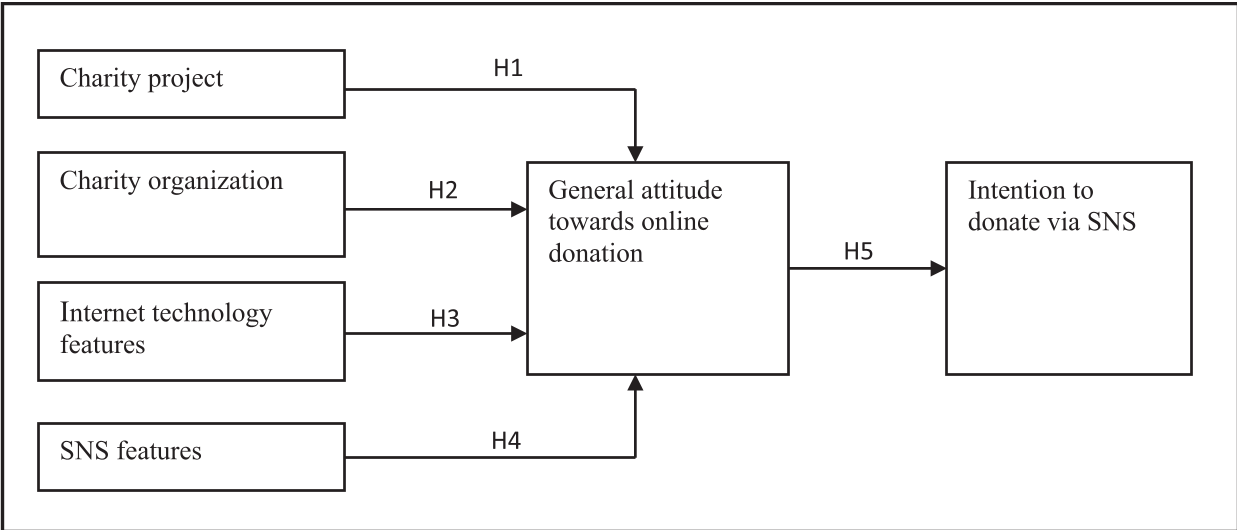 The conceptual framework illustrating the path from external factors to donation intention through the mediator of general attitude.
The Results: A Reality Check for Non-Profits
Using Structural Equation Modelling (SEM) on data from 258 respondents, the study reached several counter-intuitive conclusions:
1. The Security Paradox
Only Internet Technology Features significantly influenced general attitudes toward donating. Interestingly, this relationship was negative—as users became more aware of the technical features (and potential risks like privacy leaks), their general attitude softened unless security was guaranteed. Trust in the "pipe" is more important than the "source."
2. The Failure of "Features"
Surprisingly, SNS Features (like photo sharing or interactive games) and Charity Reputation did not significantly sway the general attitude toward online donation. This suggests that while these elements are good for engagement, they are not the primary drivers of the fundamental psychological shift required to give money online.
3. The Mediation Effect
The study found a full mediation effect. This means tech features don't directly make people want to donate; rather, they influence the user's overall attitude toward the safety and ease of online giving, which then creates the intention to donate via SNS.
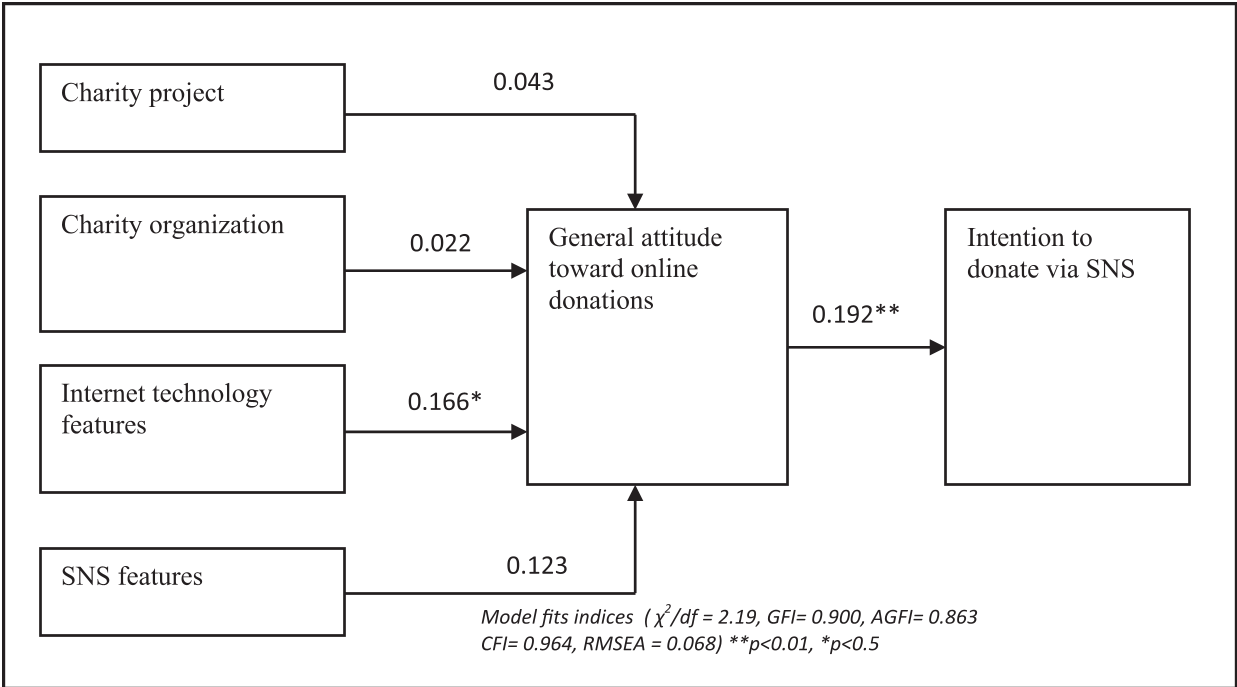 The Final Structural Model showing significant paths (H3 and H5 supported).
Critical Insight: Trust is the New Currency
The most profound takeaway for the industry is the Mechanisms of Trust. For a non-profit, a "Good Track Record" (H2) or a "Human Welfare Cause" (H1) is secondary to "Internet Trustworthiness" (C13).
If a donor perceives that an SNS transaction is inconvenient or insecure, the nobility of the cause becomes irrelevant. Non-profits should stop obsessing over "engagement metrics" and start focusing on "security signals"—clear privacy policies, secure payment gateways, and transparent transaction logs.
Limitations and Future Directions
While the study provides a robust look at the Asian market, the authors acknowledge that culture plays a huge role. Collectivist cultures might respond differently than individualistic ones to "Social Pressure" (Subjective Norms), which were not the focus here. Future research should look into the "Benefits" (recognition, tax rewards) which might outweigh the "Causes" in driving intention.
Conclusion
In the digital world, altruism is mediated by the machine. To unlock the potential of SNS for fundraising, the path forward is clear: Secure the platform first, then tell the story.