
The Privacy Optimization: Why Granular Control and Transparency Drive Social Media Engagement
Factors mediating disclosure in social network sites
This study investigates the mediating roles of privacy settings and privacy policy consumption in the relationship between privacy attitudes and information disclosure on Facebook. Using a survey of 122 users, it demonstrates that technical customization and policy transparency can mitigate privacy concerns, ultimately fostering a "Privacy Optimization" state that encourages content sharing.
TL;DR
Does being more private actually make you share more? Counter-intuitively, this paper argues the answer is "Yes." By applying Boundary Regulation Theory to Facebook users, the researchers show that when users "read the manual" (privacy policies) and "set the rules" (customizing friend lists), their inherent privacy fears no longer block them from sharing sensitive contact information.
Background Positioning
This work serves as an empirical bridge between classical communication theories and modern SNS design. It moves the conversation beyond just "how much people share" to "what mechanisms allow them to feel safe enough to share."
The Core Conflict: Privacy Attitudes vs. Disclosure
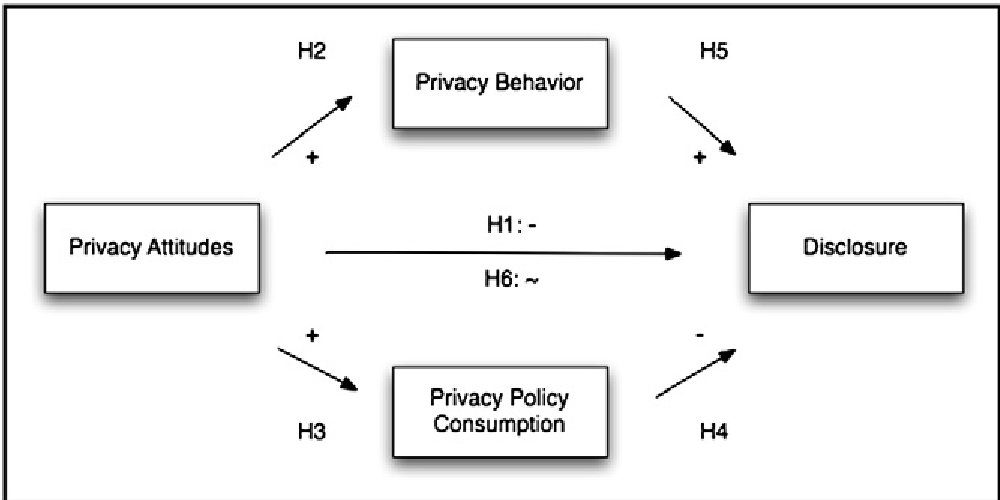
Social Network Sites (SNS) thrive on transparency and user-generated content, yet users are increasingly aware of risks like identity theft and cyberstalking. Traditionally, high concern leads to low sharing. The authors suggest this relationship is not fixed but is mediated by two factors:
- Knowledge: Understanding how data is used (Privacy Policy Consumption).
- Agency: Having the technical tools to draw boundaries (Privacy Behavior).
Methodology: Mapping the Boundaries
The researchers surveyed 122 Facebook users and categorized disclosures into two types:
- Identity-based: Real name, birth date, high school.
- Contact-furthering: Cell phone number, address, IM screen name.
They utilized a Nested Ordinal Logistic Regression model to test how privacy attitudes interact with policy knowledge and technical customization.
Key Insights & Results
The study’s findings challenge the idea that privacy tools suppress platform activity.
1. The Power of Customization
The most striking finding was that players who customized their settings (specifically choosing which friends see what) were significantly more likely to share contact information. In fact, they were 2.9 to 3.3 times more likely to be in a higher disclosure category.
2. The Policy Burden
Reading the privacy policy actually decreased disclosure. As users became more aware of the "aggressive" nature of data practices, they pulled back. However—and this is the crucial part—the positive effect of technical customization was roughly double the negative effect of policy consumption.
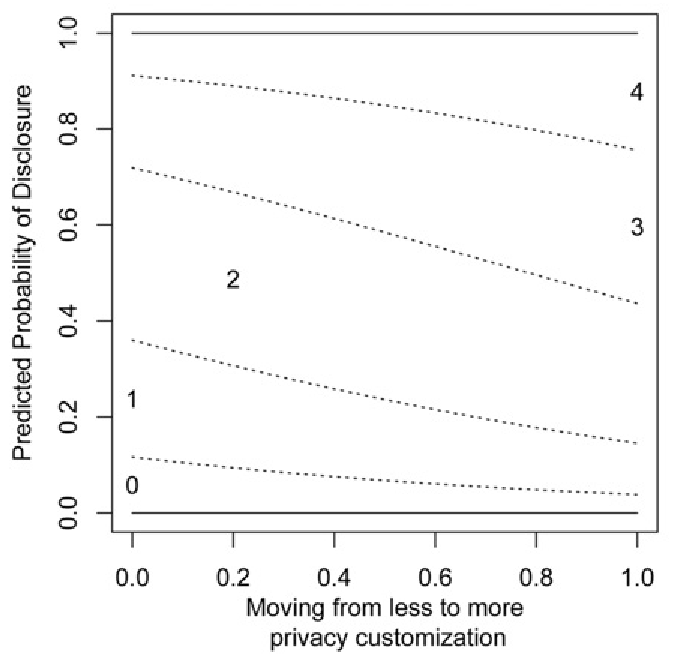
Fig: The Visualization shows that as users increase customization (moving to higher bands), the probability of being in the highest disclosure groups shifts upward significantly.
Critical Analysis & Takeaways
The paper provides a roadmap for SNS design that favors Empowered Privacy:
- Design for "Rule-Making": Platforms should not just offer "Public/Private" toggles but granular, rule-based systems (like Petronio’s model suggests).
- Transparency as a Baseline: While reading a policy might cause a slight dip in sharing, it builds the foundational trust required for users to engage with technical controls.
Limitations: The study’s sample is restricted to U.S. college students (2009-2010 era Facebook). In the modern era of "Shadow Profiles" and AI-driven data scraping, the "Technical Control" users feel might be more illusory than it was a decade ago.
Conclusion
The "Privacy Optimization" process suggests that users are willing to be "open" in a "closed" environment. For developers and researchers, the goal shouldn't be to reduce privacy to increase sharing; it should be to increase privacy controls to enable sharing.