
Connected Classrooms: Why Faculty Social Networks are the Secret to STEM Reform
Examining the relationship between faculty teaching practice and interconnectivity in a social network
This study investigates the correlation between STEM faculty's social connectedness and their implementation of Learner-Centered (LC) teaching practices. Utilizing Social Network Analysis (SNA) and the Reformed Teaching Observation Protocol (RTOP), the researchers demonstrate that highly connected faculty are significantly more likely to adopt reformed pedagogical strategies.
TL;DR
Is the key to better engineering education found in the syllabus or the faculty lounge? This study suggests the latter. By mapping the social "webs" of STEM professors, researchers found that those who are more socially connected—frequently discussing and collaborating on instruction—are significantly more likely to use effective, learner-centered teaching methods. In short: Isolation breeds lectures; connection breeds innovation.
The "Say-Do" Gap in STEM Education
For decades, the push for "Learner-Centered" (LC) instruction—where students actively construct meaning rather than passively receiving information—has struggled to take root in University STEM departments.
The problem isn't necessarily a lack of workshops. Previous research has identified a frustrating phenomenon: faculty go to training, believe they are changing, but then return to their classrooms and continue lecturing. This "say-do" gap often stems from a lack of social support. Without a tribe of colleagues to discuss trials and failures with, faculty naturally revert to the path of least resistance: the traditional lecture.
Methodology: Mapping the Intellectual Web
The researchers didn't just ask faculty "how do you teach?" They looked at who they talk to.
- Network Mapping: Using Social Network Analysis (SNA), they identified "nodes" (faculty) and "edges" (collaborations or advice-seeking).
- The Yardstick: They used the RTOP (Reformed Teaching Observation Protocol)—a rigorous, 3rd-party observation tool—to grade actual classroom behavior, and the ATI (Approaches to Teaching Inventory) to measure internal beliefs.
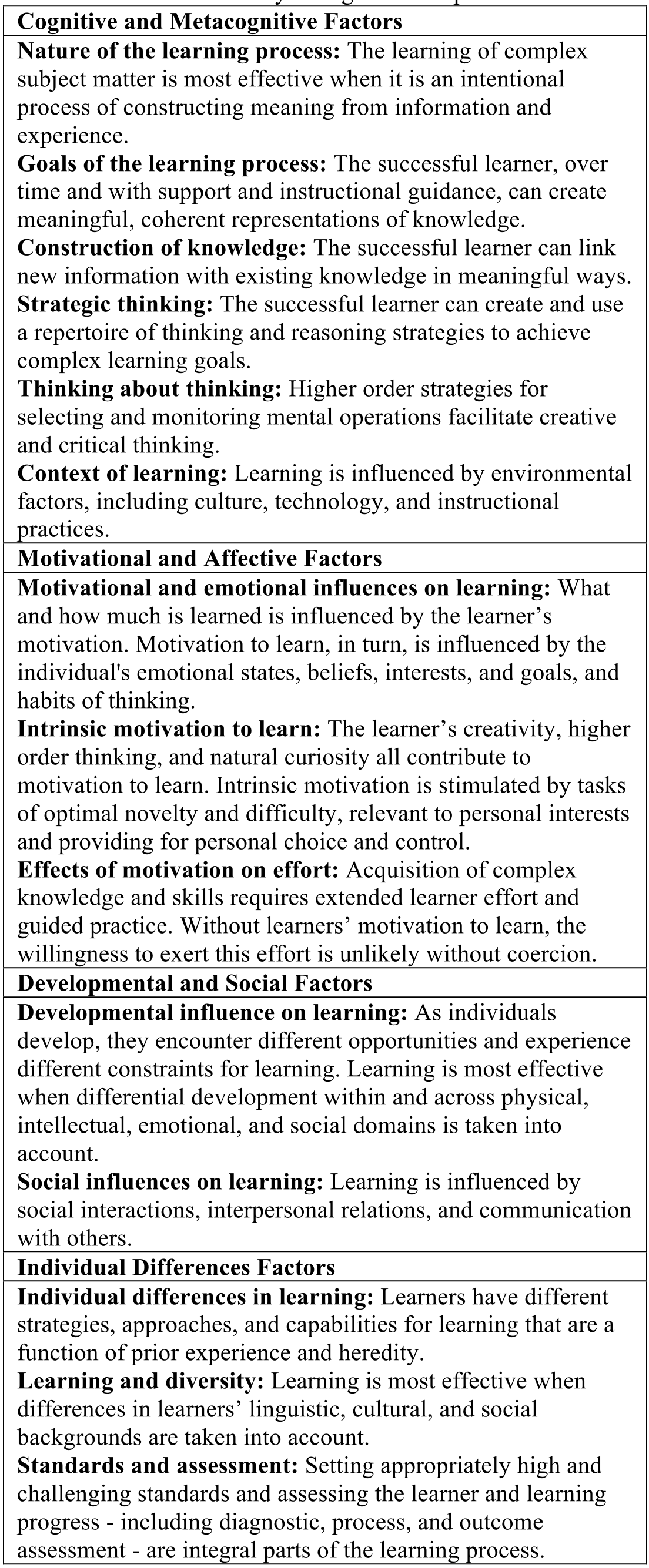 Above: The APA framework for Learner-Centered variables used to define the study's goal.
The Core Insight: Connection Predicts Practice
The results were striking. The more "connected" a faculty member was, the higher their scores in reformed teaching.
Key Correlations:
- Lesson Design & Implementation (r = .704): This was the strongest link. Connected faculty are much better at using student ideas to direct lessons and creating a "learning community" in the classroom.
- Procedural Knowledge (r = .629): Connected faculty tend to emphasize hypothesis building and multiple representations of ideas.
- Teacher-Centeredness (Negative Correlation): As connectedness goes up, the tendency to view teaching as mere "information transmission" goes down.
 Table 2: Data showing that departments like Bioengineering and Physics had higher mean connections, correlating with their more innovative pedagogical profiles.
Why Does This Work? (The Physics of Collaboration)
Why does knowing more people make you a better teacher? The authors suggest that in a social network, being a "node of advice" is a form of informal leadership.
- Diffusion of Innovation: Ideas like Process-Oriented Guided Inquiry Learning (POGIL) or "flipping the classroom" don't spread via brochures; they spread via peer endorsement.
- Collective Reflection: When faculty collaborate, they move into the "trial and adoption" phase of innovation more quickly because the social cost of failure is lowered.
 Table 3: The statistical proof—RTOP scores (actual practice) are more heavily influenced by network density than internal attitudes alone.
Critical Insight & Future Outlook
The most telling finding of this paper is that actual practice (RTOP) was more strongly correlated with social networks than beliefs (ATI) were. This implies that even if a professor isn't 100% "sold" on the theory of learner-centeredness, being part of a high-functioning, collaborative group will pull their practice toward better outcomes regardless.
The Takeaway for Universities: If you want to transform engineering education, don't just buy new chairs or hold a weekend seminar. You must break down the silos between departments and incentivize faculty to talk to one another. Innovation is a social process.
Limitations
The study notes that while the correlations for practice were strong, the correlations for attitudes were not statistically significant, likely due to a small sample size (n=21). Further research with larger datasets will be needed to confirm if social networks change "hearts and minds" or just "actions."