
Beyond the Like Button: How "Cringe" and "Fail" Redefine Digital Literacy
“Fail, Clickbait, Cringe, Cancel, Woke”: Vernacular Criticisms of Digital Advertising in Social Media Platforms
This paper investigates how social media users employ vernacular terms like "fail," "clickbait," "cringe," "cancel," and "woke" to criticize digital advertising. By analyzing a corpus of French-speaking Twitter interactions, the study demonstrates how these expressions signify a specialized form of digital advertising literacy that challenges the platformization and commodification of social networks.
TL;DR
Social media platforms have transitioned from "places for friends" to highly competitive advertising engines. However, users aren't just scrolling; they are fighting back with language. This paper explores how vernacular terms like fail, clickbait, cringe, cancel, and woke represent a new, sophisticated form of digital advertising literacy used by audiences to deconstruct and mock promotional content.
The Evolution of the Social Ad-Space
In the early 2000s, sites like MySpace were conceptualized as purely social. Fast forward to 2024, and the "platformization" of the web has turned every interaction into a potential transaction. The author argues that as brands become more invasive, users have developed a defense mechanism: a specialized vocabulary of criticism that goes far beyond simple "dislikes."
Methodology: The Micrological Approach
The author uses a "micrological-philological" method, looking at the "scraps of language" found in French-speaking Twitter (X). By analyzing how users pair hashtags like #Fail or descriptors like Putaclic (Clickbait) with screenshots of ads, the study reveals a deep understanding of platform mechanics.
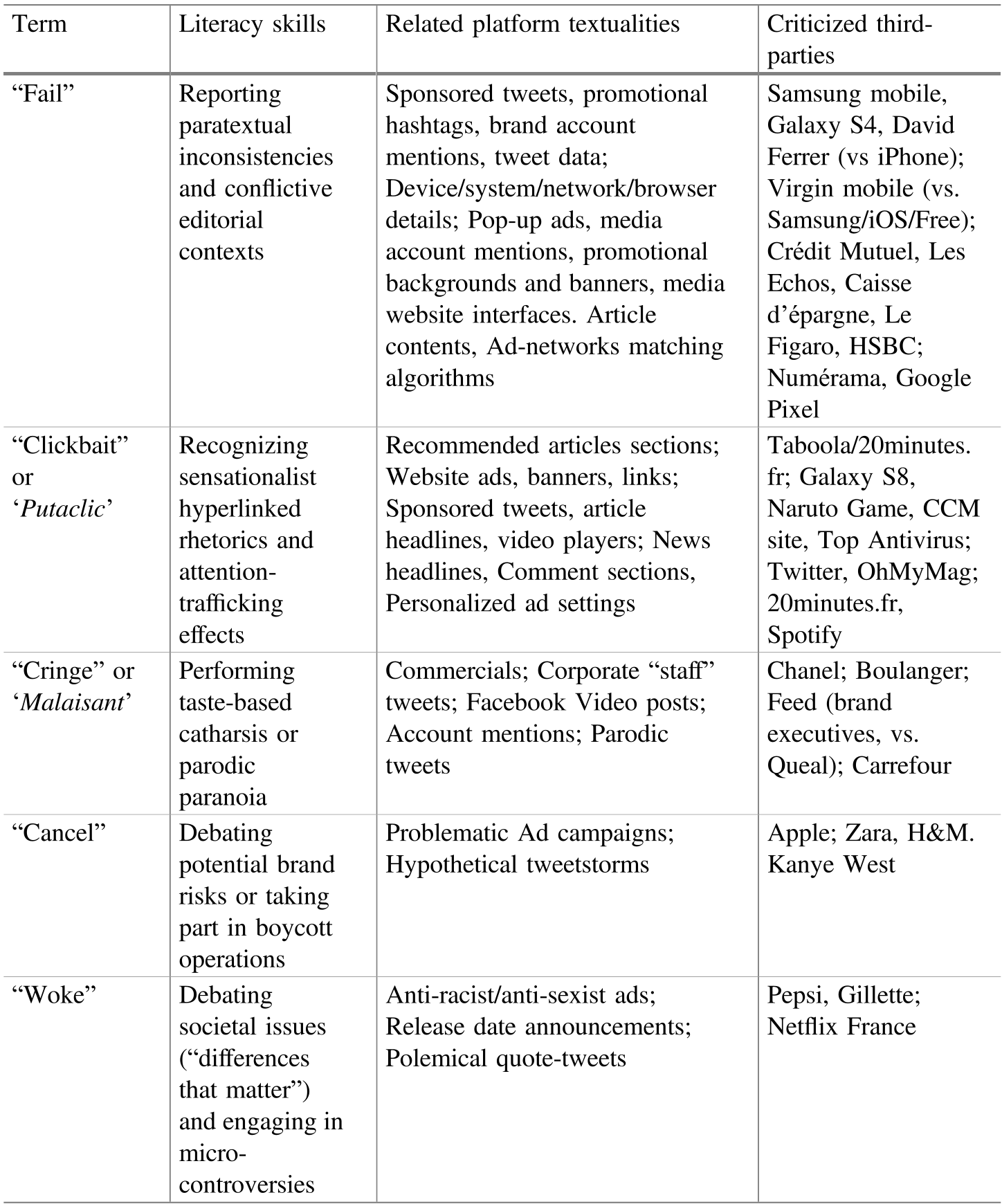
1. "Fail": Spotting the Glitch in the Matrix
The term "Fail" is no longer just about a mistake; it's about reporting paratextual inconsistencies.
- Direct Inconsistency: A tennis player tweeting praise for a Samsung phone while the metadata reads "via Twitter for iPhone."
- Contextual Mismatch: A bank ad for life insurance appearing next to a tragic news story about a suicide.
This indicates users are literate in recognizing editorial context and algorithmic mismatching.
2. "Clickbait": The Economy of Disappointment
Users recognize "Clickbait" (or the harsher French term Putaclic) as a specific digital genre. The criticism here is economic; users acknowledge that their attention is being trafficked. By labeling an ad as clickbait, they signal their awareness of the hyperlinked rhetoric designed to deceive.
3. "Cringe": The Aesthetic Defense
"Cringe" is perhaps the most visceral reaction. It occurs when a brand tries too hard to be "empathetic" or "cool" and fails. The study highlights how "cringeworthy" ads often go viral for all the wrong reasons, leading to a "parodic paranoia" where users wonder if the brand was actually trying to be bad just to get "buzz."
4. "Cancel" & "Woke": The Ethical Scrutiny
These terms shift the criticism from how an ad looks to what it stands for.
- Cancel: Used as a tool for collective boycott when a brand's ethics are questioned.
- Woke: Often used to criticize "woke-capitalism" or "woke-washing," where brands adopt social justice stances purely for profit.
Deep Insight: A Multilayered Literacy
The paper concludes that digital advertising literacy is not just about understanding a message; it’s about evaluating the platform's materiality.
- Hypertextual Literacy: Understanding how links and traffic work.
- Algorithmic Literacy: Recognizing when a bot has placed an ad inappropriately.
- Ethical Literacy: Navigating the "culture wars" embedded in modern feeds.
Conclusion and Future Outlook
The study proves that the "vernacular creativity" of everyday users is a powerful form of media criticism. As advertising becomes more integrated with AI and personalized data, the vocabulary of criticism will likely grow even more complex. Brands that ignore the "cringe" factor or the "fail" of their automated placements do so at their own peril, as the contemporary user is more literate—and more cynical—than ever before.