
Collective Intelligence: Turning Twitter into a Real-Time Network Monitor during Disasters
Development of Failure Detection System for Network Control using Collective Intelligence of Social Networking Service in Large-Scale Disasters
The paper introduces an SNS-based network failure detection system that utilizes the "collective intelligence" of Twitter to monitor telecommunications status during large-scale disasters. By combining a bootstrap-based keyword extraction method with SVM-light classification, the system identifies telephony failures and enables autonomous network control through the FLARE architecture.
TL;DR
In the wake of catastrophic events, telecommunications often go dark just when they are needed most. This paper presents a system that harvests "collective intelligence" from Twitter to detect telephony failures. By analyzing user-generated reports, the system can pinpoint failure locations and automatically trigger network control protocols (FLARE/JGN-X) to optimize traffic, achieving over 91% accuracy in classifying localized issues.
Context: When the Network Monitors Fail
During the 2011 Great East Japan Earthquake, the sheer scale of physical damage and congestion made traditional internal monitoring systems inadequate. While internal hardware might report a node is "up," it doesn't always reflect whether a user can successfully complete a call. Interestingly, even when voice services fail, packet-switched SNS platforms often remain functional, allowing users to broadcast their frustrations in real-time. This paper argues that these users are, in effect, "mobile sensors" for the network infrastructure.
Methodology: From Raw Tweets to Autonomic Control
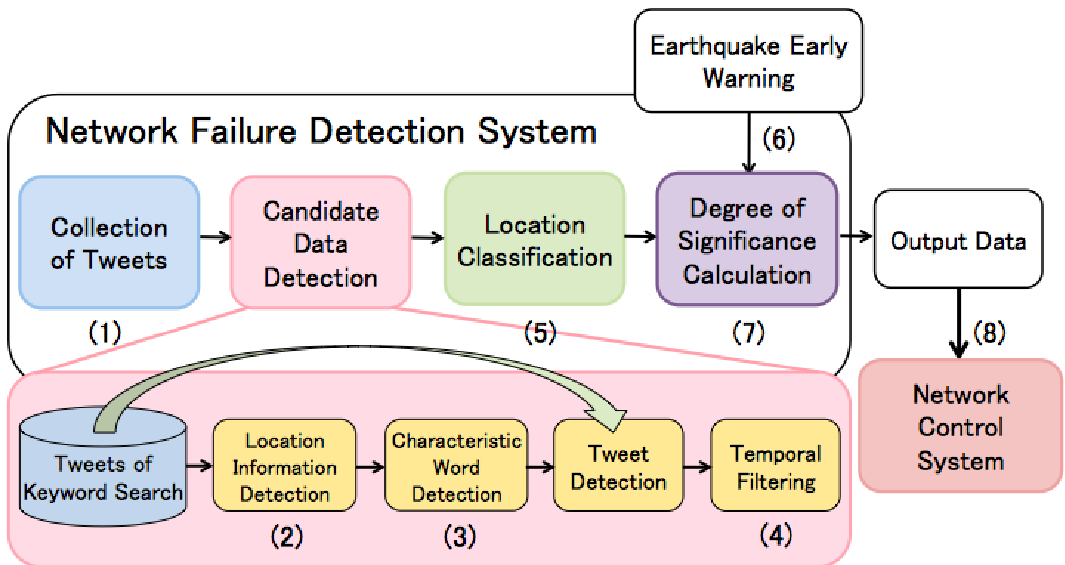
The system follows a rigorous pipeline designed to handle the noise of social media:
1. The Bootstrap Keyword Engine
To avoid missing critical failure reports, the authors used a Bootstrap Method. Starting with base terms like "telephone" and "congestion," the system iteratively finds new failure expressions by calculating a reliability score based on the distance between terms.
2. Temporal and Spatial Filtering
To separate signal from noise, the system fits tweet frequency to an exponential distribution. This allows it to identify the "burst" of reports following an event while filtering out irrelevant historical chatter.
3. Machine Learning Classification
One of the unique insights is the Location Classification Method. It is not enough to find a tweet with a location; the system must know if the failure is at the user's location or if the user is calling to a failed location. By using an SVM with a "Person/Family Dictionary" (detecting tweets like "calling my mother in Miyagi..."), the system dramatically improved classification accuracy.
Experimental Insights: Prioritizing What Matters
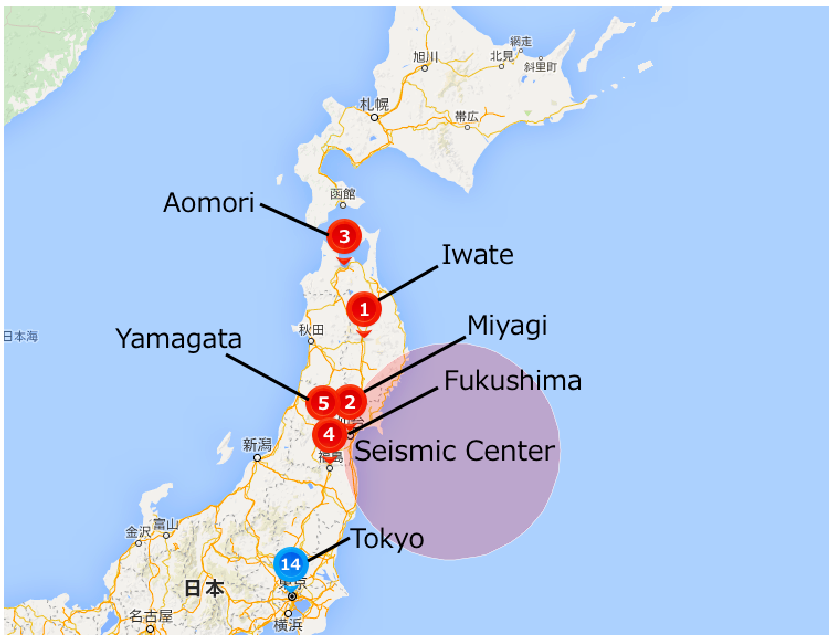
A common pitfall in SNS analysis is the "Tokyo Bias"—large cities always have more tweets. However, the authors' Degree of Significance calculation uses three indicators:
- Tweet Rate of Telephony Failure.
- Predicted Seismic Intensity.
- Tweet Increasing Rate.
By normalizing these values, the system correctly prioritized Miyagi and Iwate (the hardest-hit areas) over Tokyo, despite Tokyo having a higher raw tweet volume.
Theoretical and Practical Impact
The true innovation lies in the integration with FLARE, a software-defined data plane. Instead of just showing a dashboard to a human operator, the collective intelligence of Twitter can directly influence route control and traffic optimization in an autonomic loop.
Limitations & Future Work
While the results are robust, the system relies on the availability of some form of internet (3G/LTE/WLAN) or reports from outside the disaster zone. Future iterations aim to provide even more granular detection of "user situations" to allow for content-based traffic prioritization (e.g., prioritizing emergency data over social media traffic).
Conclusion
This work shifts the paradigm of network management from purely internal monitoring to a holistic approach that treats the user base as a distributed, intelligent sensor network. It proves that even in the chaotic environment of a major earthquake, social media metadata can be distilled into actionable, engineering-grade telemetry.